Austin, Aug. 08, 2025 (GLOBE NEWSWIRE) -- Food Robotics Market Size & Growth Insights:
According to the SNS Insider,“The Food Robotics Market size was valued at USD 2.23 Billion in 2024 and is projected to reach USD 10.00 Billion by 2032, growing at a CAGR of 20.64% during 2025-2032.”
Revolutionizing Food Processing and Delivery: How Robotics Are Reshaping the Future of the Food Industry
The food robotics market is predicted to perform well owing to the growing trend of automation in food processing, packaging, and delivery to improve productivity, sanitary needs, and efficiency across the food industry. The growing need for ready-to-go items and stringent food safety laws are leading producers to use robotics in order to reduce contamination and human error With more innovation such as AI, machine vision, and smart sensors, robotics capabilities are branching out to variety applications from cutting and sorting to palletizing and autonomous delivery. The labour shortage in developed regions like Japan and the U.S. will accelerate automation, too. On the other hand, transporting goods within cities represents its own set of challenges and has been the source of a new generation of AI-driven sidewalk and delivery robots, such as Uber Eats' recent initiative in Tokyo and DoorDash's partnership with Coco Robotics in Los Angeles.
Get a Sample Report of Food Robotics Market Forecast @ https://www.snsinsider.com/sample-request/7773
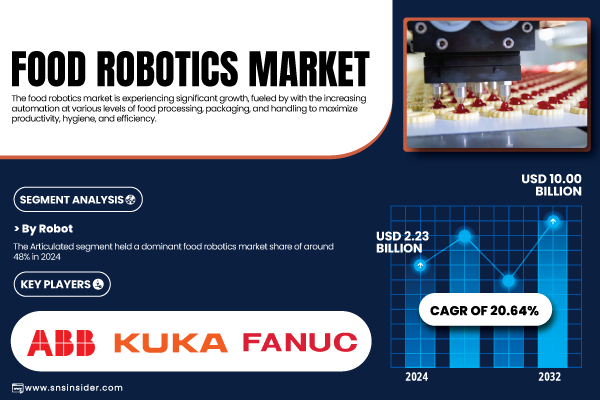
Leading Market Players with their Product Listed in this Report are:
- ABB
- KUKA AG
- Kawasaki Heavy Industries Ltd.
- Fanuc Corporation
- Rockwell Automation
- YASKAWA ELECTRIC CORPORATION
- Denso Corporation
- Mitsubishi Electric Corporation
- Universal Robots A/S
- JR Automation (Hitachi Ltd.)
Food Robotics Market Report Scope:
| Report Attributes | Details |
| Market Size in 2024 | USD 2.23 Billion |
| Market Size by 2032 | USD 10.00 Billion |
| CAGR | CAGR of 20.64% From 2025 to 2032 |
| Report Scope & Coverage | Market Size, Segments Analysis, Competitive Landscape, Regional Analysis, DROC & SWOT Analysis, Forecast Outlook |
| Key Segmentation | • By Robot (Articulated, Parallel, SCARA, Cylindrical and Others) • By payload (Low, Medium and Heavy) • By Application (Packaging, Repackaging, Palletizing, Picking, Processing and Others) |
Purchase Single User PDF of Food Robotics Market Report (20% Discount) @ https://www.snsinsider.com/checkout/7773
Key Industry Segmentation
By Robot
The articulated segment bounced to lead the food robotics market in the year, accounting 48% in revenue share in 2024due to its versatility, accuracy and efficacy to handle loads.
The SCARA is expected to exhibit the fastest CAGR of 28.30% over the forecast years 2025 to 2032, due to its high-very low weight, compact nature, and application in pick-and-place and sorting operations that are mainly used in space-constrained areas that require lightweight and high-precision automation.
By Payload
In 2024, the medium segment dominated the food robotics market with a 52% share, due to its versatility in handling various food processing tasks. These robots offer an ideal blend of speed, accuracy, and load capacity, making them suitable for packaging, palletizing, and medium-weight handling in both fully and semi-automated lines.
Meanwhile, the heavy segment is projected to grow at the fastest CAGR of 25.90% from 2025 to 2032, driven by rising automation in bulk packaging, meat processing, and other labor-intensive operations requiring high load capacity and durability.
By Application
In 2024, the packaging segment led the food robotics market with a 22% share, driven by the growing need for automation in primary and secondary packaging to boost speed, consistency, and hygiene. Factors like the rise of e-commerce, demand for convenience foods, and labor shortages have further accelerated packaging line automation.
The picking segment is projected to grow at the fastest CAGR of 30.18% from 2025 to 2032, supported by advancements in AI, computer vision, and sensors enabling precise, hygienic handling of delicate food items.
North America Leads as Asia-Pacific Emerges as Fastest-Growing Market in Food Robotics
In 2024, North America led the food robotics market with a 44% revenue share, driven by advanced technological infrastructure, early adoption of automation, and increasing labor shortages in food processing. The region benefits from strong R&D investments and a high demand for packaged and ready-to-eat foods.
Asia-Pacific is expected to grow at the fastest CAGR of 22.52% from 2025 to 2032, fueled by industrialization, rising demand for processed foods, and increasing automation adoption in countries like China, India, and Japan. Europe remains a strong contender, supported by advanced infrastructure, food safety regulations, and sustainability goals. Meanwhile, LATAM and MEA show steady growth, supported by urbanization, infrastructure investment, and rising food safety awareness.
Do you have any specific queries or need any customized research on Food Robotics Market? Submit your inquiry here @ https://www.snsinsider.com/enquiry/7773
Recent Developments:
- In April 2025, BurgerBots has launched a new restaurant in Los Gatos, California, featuring ABB’s IRB 360 FlexPicker and dual-arm YuMi robots to automate fast-food assembly and stock monitoring, enhancing efficiency and customer service.
- IN May 2025, KUKA has introduced the KR Delta HM, a high-speed parallel-arm robot designed for ultra-precise handling in hygiene-critical sectors like food processing, pharmaceuticals, and electronics, ensuring compliance with strict safety standards.
USP FOR Food Robotics Market
- Cycle Time Efficiency – Helps You Evaluate The Operational Productivity Gains Driven By Robotics, Highlighting Reduced Downtime And Faster Throughput In Food Processing Lines.
- Hygienic Design Compliance – Helps You Assess How Robotic Systems Align With Stringent Food Safety Regulations (E.G., Ehedg, Usda), Influencing Buyer Confidence And Market Access.
- Vision-Guided Robot Penetration – Helps You Identify The Growing Use Of Advanced Imaging And Ai In Robotic Systems, Enabling Precision Sorting, Inspection, And Handling For Quality Assurance.
- Energy Efficiency Gains – Helps You Track Improvements In Power Consumption Of Food Robotics, Supporting Esg Goals And Reducing Operational Costs.
- Technology Modularity & Integration – Helps You Analyze The Ability Of Robots To Seamlessly Integrate With Conveyor Systems, Sensors, And Ai Platforms, Offering Scalability And Customization.
- Robotic Flexibility Index – Helps You Understand Adaptability Across Tasks (E.G., Packaging, Palletizing, Pick-And-Place), Particularly Relevant In High-Mix, Low-Volume Production Environments.
About Us:
SNS Insider is one of the leading market research and consulting agencies that dominates the market research industry globally. Our company's aim is to give clients the knowledge they require in order to function in changing circumstances. In order to give you current, accurate market data, consumer insights, and opinions so that you can make decisions with confidence, we employ a variety of techniques, including surveys, video talks, and focus groups around the world.
