Dublin, Dec. 17, 2025 (GLOBE NEWSWIRE) -- The "Location-Based Entertainment Market - Global Forecast 2025-2030" report has been added to ResearchAndMarkets.com's offering.
The location-based entertainment market is rapidly transforming the guest experience landscape, blending immersive technologies, advanced analytics, and creative design to deliver interactive, narrative-driven environments. As venues and operators adapt to shifting audience expectations, this market presents new opportunities and operational challenges for growth-oriented decision-makers.
Market Snapshot: Location-Based Entertainment Market Overview
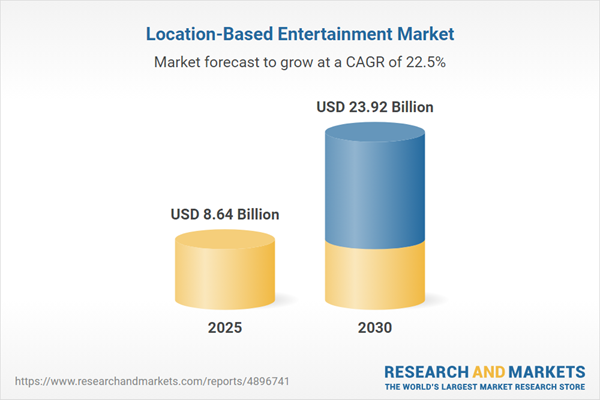
The Location-Based Entertainment Market grew from USD 7.07 billion in 2024 to USD 8.64 billion in 2025. It is expected to continue growing at a CAGR of 22.53%, reaching USD 23.94 billion by 2030. This growth reflects rising demand for interactive amusement options powered by augmented reality, projection mapping, and cloud-connected simulation platforms. The sector is expanding beyond traditional paradigms, with diverse applications across theme parks, arcades, museums, sports venues, and cultural centers. Operators are increasingly adopting data-driven personalization and modular technology architectures to meet evolving guest expectations and drive competitive differentiation.
Scope & Segmentation
This report provides a comprehensive analysis spanning multiple components, technologies, venue types, business models, experience categories, and applications across key global regions.
- Component Categories: AR & VR accessories, arcade and gaming machines, audio and spatial sound systems, motion simulator modules, projection and display screens, sensors, consulting and integration services, customer support and technical assistance, game hosting and maintenance, analytics and data management, content creation and game development, content management, booking and CRM platforms, simulation platforms, and system control and integration solutions.
- Venue Types: Theme parks, water parks, arcades, museums, zoos, indoor sports halls, stadiums, and cultural centers.
- Technologies: Cloud merged reality, augmented reality, virtual reality, 3D, 4D, and 5D projection mapping.
- Business Models: Pay-per-use and subscription or membership-based approaches.
- Experience Types: Dimensional cinematic attractions, immersive storytelling, and interactive games.
- Applications: Educational and edutainment, gaming and eSports, historical and cultural showcases, and science and exploration experiences.
- Regional Coverage: Americas (United States, Canada, Mexico, Brazil, Argentina, Chile, Colombia, Peru), Europe, Middle East & Africa (United Kingdom, Germany, France, Russia, Italy, Spain, Netherlands, Sweden, Poland, Switzerland, United Arab Emirates, Saudi Arabia, Qatar, Turkey, Israel, South Africa, Nigeria, Egypt, Kenya), Asia-Pacific (China, India, Japan, Australia, South Korea, Indonesia, Thailand, Malaysia, Singapore, Taiwan).
Key Takeaways for Senior Decision-Makers
- Immersive audience engagement is evolving from passive viewing to participatory experiences, integrating storytelling, interactive gaming, and tailored education.
- Successful operators are forming strategic alliances with technology vendors and content creators, enhancing both creative delivery and system interoperability.
- Cross-disciplinary talent pools, including software developers, creative directors, and guest analytics specialists, are essential for agile innovation and competitive advantage.
- Personalization and modular technology adoption drive sustained guest satisfaction and efficient expansion of immersive offerings.
- Regional development strategies must reflect differences in infrastructure maturity, regulatory factors, and diverse cultural preferences to optimize investment and growth.
Why This Report Matters
- Enables stakeholders to benchmark opportunities, risks, and innovation pathways in the evolving location-based entertainment sector.
- Provides actionable recommendations for operational agility, cross-functional alignment, and technology adoption within immersive venues.
- Helps identify optimal strategies for regional market entry, tariff mitigation, and enhanced guest engagement outcomes.
Conclusion
As the market advances, the interplay of technology, creative content, and regional strategies is reshaping audience experiences. Effective leadership and agile partnership models will position organizations to thrive and lead in location-based entertainment.
Key Attributes
| Report Attribute | Details |
| No. of Pages | 183 |
| Forecast Period | 2025-2030 |
| Estimated Market Value (USD) in 2025 | $8.64 Billion |
| Forecasted Market Value (USD) by 2030 | $23.94 Billion |
| Compound Annual Growth Rate | 22.5% |
| Regions Covered | Global |
Market Insights
- Rise of hyper-localized pop-up immersive experiences blending local culture with branded storytelling
- Expansion of e-sports arenas within entertainment complexes featuring live streaming and spectator engagement
- Integration of large-scale VR free-roam adventures with real-time audience analytics and social sharing
- Adoption of AI-driven personalization engines to tailor attraction pathways based on guest preferences
- Implementation of contactless queue management and virtual queuing to enhance guest satisfaction and throughput
- Integration of multi-sensory effects and haptic feedback technologies in location-based dark rollercoaster experiences
- Growth of modular pop-up funhouses combining AR gaming zones with F&B micro-concepts in urban districts
- Adoption of sustainable materials and LEED-certified design practices in new immersive entertainment venues
- Emergence of subscription-based access models for location attractions driving recurring revenue streams
- Integration of big data analytics platforms capturing in-venue customer behavior to optimize attraction layouts
The companies profiled in this Location-Based Entertainment market report include:
- 4Experience sp. z o.o.
- AEON Fantasy Co.,Ltd.
- Apple Inc.
- CyberGlove Systems LLC
- Falcon's Beyond Global, Inc.
- Fantawild Holdings Inc.
- Fennec Labs Ltd.
- Google LLC by Alphabet, Inc.
- Habo Studio Inc.
- HOLOGATE GmbH
- HQ Software
- HTC Corporation
- Huawei Technologies Co., Ltd.
- IMAX Corporation
- Kabum s.r.l.
- Kingsmen Creatives Ltd.
- Magic Leap Inc.
- Meta Platforms, Inc.
- Microsoft Corporation
- NBCUNIVERSAL MEDIA, LLC
- Niantic Inc. by Scopely, Inc.
- NVIDIA Corporation
- Oxford Metrics plc
- Panasonic Holdings Corporation
- Samsung Electronics Co. Ltd.
- Sandbox VR, Inc.
- Sony Group Corporation
- SpringboardVR by Vertigo Studios B.V.
- Tencent Holdings Ltd.
- The VOID LLC
- The Walt Disney Company
- Zero Latency Pty Ltd.
- Zooom Studios
For more information about this report visit https://www.researchandmarkets.com/r/q96gty
About ResearchAndMarkets.com
ResearchAndMarkets.com is the world's leading source for international market research reports and market data. We provide you with the latest data on international and regional markets, key industries, the top companies, new products and the latest trends.
Attachment
