Dublin, Dec. 30, 2025 (GLOBE NEWSWIRE) -- The "Thailand Digital Transformation Market Report by Type, Enterprise Size, Deployment Model, End-User, States and Company Analysis, 2025-2033" has been added to ResearchAndMarkets.com's offering.
Thailand's Digital Transformation Market is expected to reach US$ 19.87 billion by 2033 from US$ 9.21 billion in 2024, with a CAGR of 8.92% from 2025 to 2033. Thailand's digital transformation is driven by government efforts, expanding mobile internet usage, cloud adoption, and greater enterprise need for automation and customer-centric digital solutions. 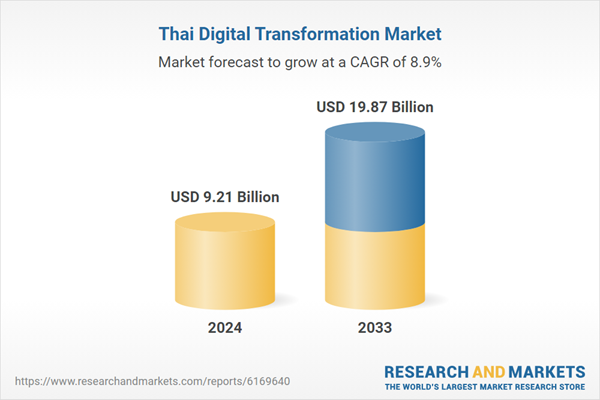
Key Factors Driving the Thailand Digital Transformation Market Growth
Vision and Policy of the Government
Thailand's national digital strategy plays a crucial role in fostering transformation. The Thailand 4.0 program supports economic modernization through digital technology, establishing the country as a regional innovation powerhouse. Investments in 5G, digital literacy programs, and e-governance are boosting public and private sector partnership. The government's direct involvement helps streamline regulatory frameworks and speeds infrastructure development. These deliberate efforts boost the country's digital ecosystem and provide a conducive climate for company growth and international investment. As policy support continues to expand, firms are better poised to migrate toward digitally integrated models that boost operational efficiency and customer experience.
Growing Internet and Mobile Penetration
Thailand's expanding smartphone usage and internet availability throughout urban and semi-urban areas are fuelling digital engagement. Businesses are exploiting this connectivity to reach bigger audiences through e-commerce, mobile apps, and digital marketing. Consumers want fast, safe, and personalized digital experiences, prompting organizations to invest in digital tools and platforms. This digital consumer culture encourages enterprises to innovate and integrate digital channels into their core operations. High mobile penetration also fosters the rise of digital payments and online services, further embedding digital transformation into everyday life. The future of Thailand's consumer and corporate environments will be greatly influenced by this trend.
Growing Use of AI and Cloud Technologies
Cloud computing and artificial intelligence are becoming crucial to Thailand's digital initiatives. Organizations are increasingly adopting cloud-based services for scalability, cost-efficiency, and flexibility. AI-driven solutions are being utilized to automate operations, increase customer service, and create actionable insights. These technologies help firms to make data-informed decisions and innovate faster. The availability of regional cloud data centers and AI development hubs further helps this trend. As digital maturity develops, businesses across sectors - from retail to manufacturing - are embedding AI and cloud capabilities into their digital frameworks, greatly contributing to the country's broader transformation ambitions.
Challenges in the Thailand Digital Transformation Market
Lack of Digital Skills and Talent
The lack of qualified IT workers is one of the major obstacles facing Thailand's digital transformation. The workforce is undertrained in critical fields like artificial intelligence, cybersecurity, and data analytics, despite the growing utilization of technology. Innovation is slowed down and organizations are unable to properly employ digital tools due to this talent gap. For businesses that must make significant investments in upskilling or importing expertise, the scarcity of digital specialists also raises operating expenses. To close this gap, persistent work in public-private partnerships, vocational training, and educational reform is needed to develop domestic talent that can sustain long-term digital growth.
Disparities in Infrastructure and Connectivity
Although Thailand's cities have sophisticated digital infrastructure, rural and isolated areas continue to struggle with connectivity and digital access. These differences lead to unequal chances for economic involvement and digital inclusion. Implementing digital solutions is difficult for businesses in less connected areas, which might exacerbate the economic divide between urban and rural areas. National digital transformation projects are also hampered by inconsistent infrastructure. To get around this, specific funding is required to expand technological hubs outside of big cities, improve broadband networks, and encourage reasonably priced internet access. A comprehensive and sustainable digital economy requires balanced regional growth.
Current Developments in the Industry
- In June 2025, Thailand announced that THB 1.34 trillion would be used to construct a smart city in Huai Yai as part of the EEC initiative, with 350,000 residents to be served by ubiquitous IoT grids.
- The National AI Committee, which coordinates AI policy across ministries and the corporate sector, was formally established in May 2025.
- In March 2025, the cabinet authorized USD 2.7 billion for investments in data centers, which included a 300 MW construction project by Haoyang Cloud & Data.
Key Attributes
| Report Attribute | Details |
| No. of Pages | 200 |
| Forecast Period | 2024-2033 |
| Estimated Market Value (USD) in 2024 | $9.21 Billion |
| Forecasted Market Value (USD) by 2033 | $19.87 Billion |
| Compound Annual Growth Rate | 8.9% |
| Regions Covered | Thailand |
Key Topics Covered
1. Introduction
2. Research & Methodology
3. Executive Summary
4. Market Dynamics
4.1 Growth Drivers
4.2 Challenges
5. Thailand Digital Transformation Market
5.1 Historical Market Trends
5.2 Market Forecast
6. Market Share Analysis
6.1 By Type
6.2 By Enterprise Size
6.3 By Deployment Model
6.4 By End-User
6.5 By States
7. Type
7.1 Analytics, AI and ML
7.2 Extended Reality (XR)
7.3 Internet of Things (IoT)
7.4 Industrial Robotics
7.5 Blockchain
7.6 Additive Manufacturing/3D Printing
7.7 Cyber-security
7.8 Cloud and Edge Computing
7.9 Others
8. Enterprise Size
8.1 Large Enterprises
8.2 Small and Medium Enterprises (SMEs)
9. Deployment Model
9.1 On-premise
9.2 Cloud
9.3 Hybrid
10. End-User
10.1 Manufacturing
10.2 Oil, Gas and Utilities
10.3 Retail and E-commerce
10.4 Transportation and Logistics
10.5 Healthcare
10.6 BFSI
10.7 Telecom and IT
10.8 Government and Public Sector
10.9 Others
11. States
11.1 Bangkok
11.2 Chiang Mai
11.3 Kanchanaburi province
11.4 Lopburi
11.5 Phuket
11.6 Ayutthaya
11.7 Phi Phi Islands
11.8 Ko Samui
11.9 Krabi
11.10 Rest of Thailand
12. Value Chain Analysis
13. Porter's Five Forces Analysis
13.1 Bargaining Power of Buyers
13.2 Bargaining Power of Suppliers
13.3 Degree of Competition
13.4 Threat of New Entrants
13.5 Threat of Substitutes
14. SWOT Analysis
14.1 Strength
14.2 Weakness
14.3 Opportunity
14.4 Threats
15. Pricing Benchmark Analysis
16. Key Players Analysis
- Accenture plc
- IBM Corp.
- Microsoft Corp.
- Amazon Web Services Inc.
- Google LLC (Alphabet)
- Siemens AG
- SAP SE
- Cisco Systems Inc.
- Oracle Corp.
For more information about this report visit https://www.researchandmarkets.com/r/tl7x5n
About ResearchAndMarkets.com
ResearchAndMarkets.com is the world's leading source for international market research reports and market data. We provide you with the latest data on international and regional markets, key industries, the top companies, new products and the latest trends.
Attachment
