Wilmington, DE, United States, Sept. 10, 2026 (GLOBE NEWSWIRE) -- Food Preservation is Shifting from a Formulation Function to a Shelf Access Strategy
The conversation around preservation has shifted in a way that boardrooms have been slow to register. What was once a back-end formulation decision now sits close to the center of brand strategy, pricing power, asnd distribution reach. Consumer scrutiny of ingredient labels and the steady expansion of cold-chain-light retail formats have turned preservation choices into a question of where a product can be sold and at what margin.
For the better part of a decade, the food preservatives market was read as mature and slow-moving. That reading is now out of date. Reformulation pressure, the rise of natural systems, and tighter regulation across major economies have reorganized who holds the advantage. The companies that recognized this early are no longer competing on price alone. They are competing on access to clean-label technology that rivals cannot quickly replicate.
Request a Free Sample Report: https://marketmindsadvisory.com/request-sample/?report_id=2295
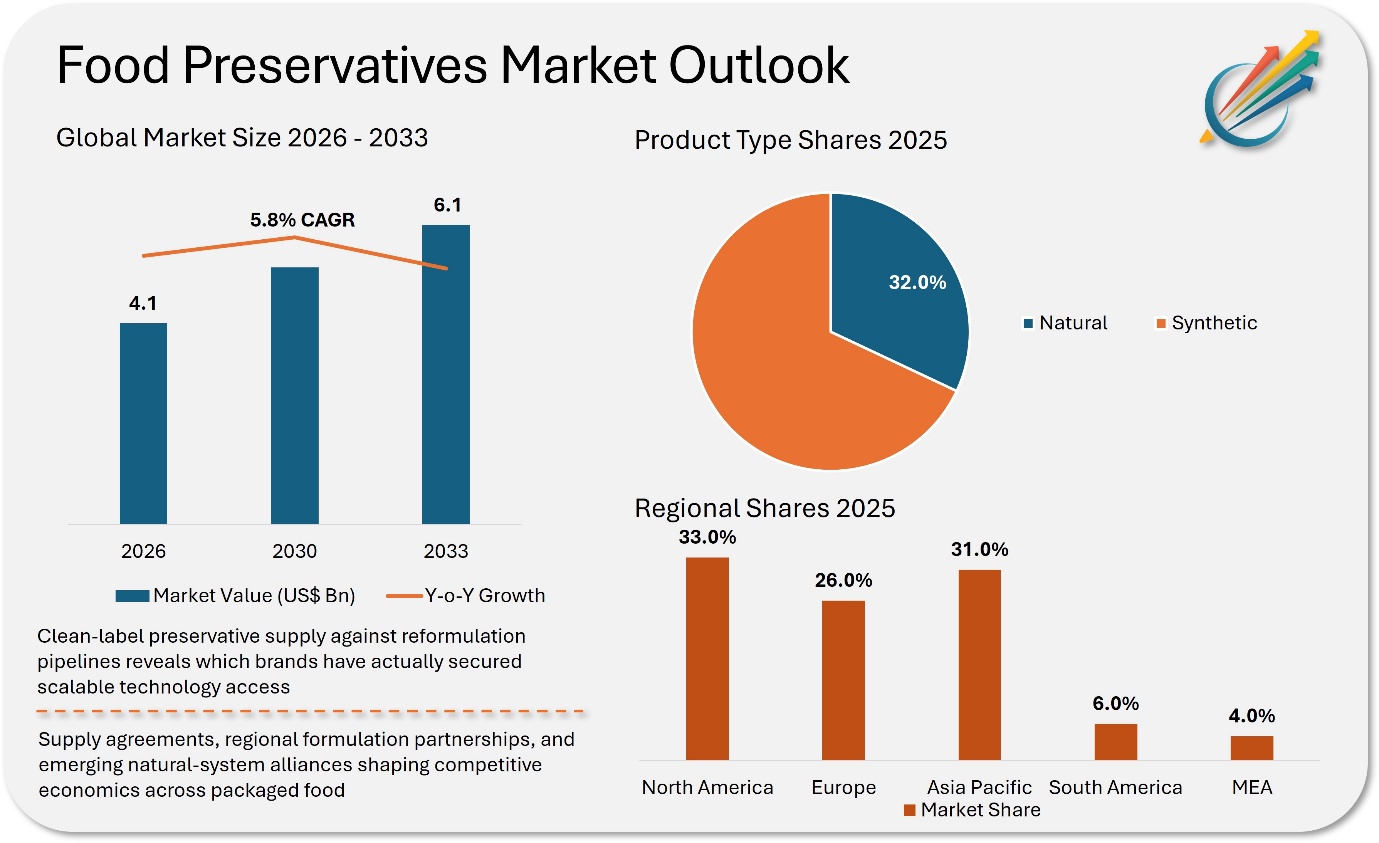
Key Takeaways from Food Preservatives Market
- The food preservatives market is valued at US$ 4.1 billion in 2026 and is projected to reach US$ 6.1 billion by 2033. Witnessing a CAGR of 5.8% between 2026 and 2033.
- Natural preservative systems are the fastest-growing product segment as reformulation accelerates.
- Clean-label demand is reshaping procurement priorities across packaged food categories.
- Meat, poultry, and bakery applications together anchor the largest share of demand across food preservatives market.
- Regulatory tightening on synthetic additives is widening the value gap toward natural alternatives all over food preservatives market.
As per Associate Vice President from Market Minds Advisory, "Preservation has stopped being a procurement footnote and become a determinant of shelf access and margin. Brands that lock in clean-label preservation partnerships over the next two years will set the cost and distribution terms their competitors are forced to accept."
Early Movers Locking in Natural Preservation Supply and Reformulation Advantage ahead of Competitors
The advantage in food preservatives market is being claimed quietly, ahead of any public signal. Reformulation cycles are long, and the firms securing technology access now will hold that position well into the next decade.
- Reformulation lead times favor early movers: Switching a preservation system across a product portfolio takes 18 to 36 months. Brands that begin now will reach shelves with credible clean-label claims before slower competitors finish testing.
- Supply of natural preservatives is tightening: Rosemary extract, natamycin, and chitosan capacity cannot scale as quickly as demand. Securing supply relationships early is becoming a binding constraint rather than a routine sourcing exercise.
- Retailer specifications are hardening: Major grocery chains are setting ingredient thresholds that effectively mandate cleaner preservation. Compliance is shifting from a marketing choice to a condition of distribution.
The Economics of Food Preservatives Market moving towards Clean-Label Technology, Shelf Stability, and Supply Assurance
The food preservatives market is no longer a single competitive field. It has split into two postures, and the gap between them is widening every quarter.
- Clean-label preservation is becoming a portfolio asset: Firms that treat natural preservation as a strategic capability rather than a per-product expense are building compounding advantages in retailer trust and reformulation speed.
- Conventional synthetic demand is consolidating, not collapsing: Sorbates, benzoates, and propionates remain essential in cost-sensitive and high-microbial-risk categories. The synthetic segment is concentrating around producers with scale and regulatory depth.
- Hybrid preservation systems are emerging as the practical middle path: Many manufacturers are blending natural anti-microbials with limited synthetic support to balance label claims, cost, and food safety. This pragmatic approach is quietly becoming the category norm.
Reformulation Roadmaps Underestimates the Speed of Structural Change across Food Preservation Systems
Clean-label will not fully displace synthetic preservatives this decade. Cost, efficacy in high-risk applications, and supply constraints on natural inputs mean synthetics retain a durable role. The more useful question is which categories convert and which do not.
The decisive competition is shifting upstream toward ingredient innovators rather than formulators. Control of proprietary natural preservation technology, not blending capability, is where defensible margin is accumulating. Brands without that access will pay a widening premium.
Regional regulatory divergence will fragment the market rather than harmonize it. Europe, North America, and parts of Asia are moving at different speeds, forcing multinationals to run parallel formulation strategies instead of a single global one.
Structural forces reshaping the food preservatives market
Consumer ingredient literacy
Shoppers now read labels with a fluency that did not exist a decade ago, and they reject additives they cannot recognize. This behavioral shift has moved preservation from an invisible technical function to a visible brand signal. Manufacturers that fail to respond risk losing placement not because their products are unsafe, but because the label no longer matches what informed consumers expect to see.
Regulatory tightening on synthetic additives
Regulators across major economies are narrowing the approved use of several synthetic preservatives and demanding clearer disclosure. This is not a single rule change but a steady directional tightening. It raises compliance cost for conventional formulations and, in the assessment of this research, structurally advantages firms that have already invested in natural preservation systems and documentation.
Cold-chain and distribution expansion
The growth of e-commerce grocery, quick commerce, and modern retail in emerging economies extends the physical journey of food products. Longer and less predictable distribution chains place real pressure on shelf stability. Preservation technology is becoming the enabling layer that allows brands to reach new geographies and channels without sacrificing safety or quality.
Food waste and sustainability pressure
Reducing spoilage is now both a cost imperative and a sustainability commitment that retailers and investors actively track. Effective preservation directly extends usable shelf life and cuts loss across the supply chain. This reframes the food preservatives market as part of the sustainability agenda rather than a contributor to the additive problem it is often assumed to be.
Ignoring Structural Risks could Delay Competitive Positioning across Packaged Food Categories
- Natural input supply volatility: Botanical extracts and other natural preservatives face agricultural and harvest variability that can disrupt availability and pricing without much warning.
- Efficacy gaps in high-risk categories: Some natural systems underperform synthetics in moisture-rich or microbially challenging applications, limiting substitution in meat and dairy.
- Cost premium resistance: Price-sensitive segments and private-label producers may resist clean-label preservation if cost differentials remain wide.
- Regulatory fragmentation: Divergent regional rules raise compliance complexity and can strand formulations developed for a single market.
- Consumer skepticism of new claims: Overuse of clean-label messaging risks consumer fatigue and scrutiny, weakening the differentiation it once provided.
- Technology imitation: As natural preservation methods mature, differentiation may erode where intellectual property protection is weak.
These risks are real and warrant active management, but none reverses the directional conclusion in the food preservatives market. The shift toward natural and clean-label preservation is structural, and the headwinds shape its pace rather than its destination.
Market Dynamics Shaping the Food Preservatives Market
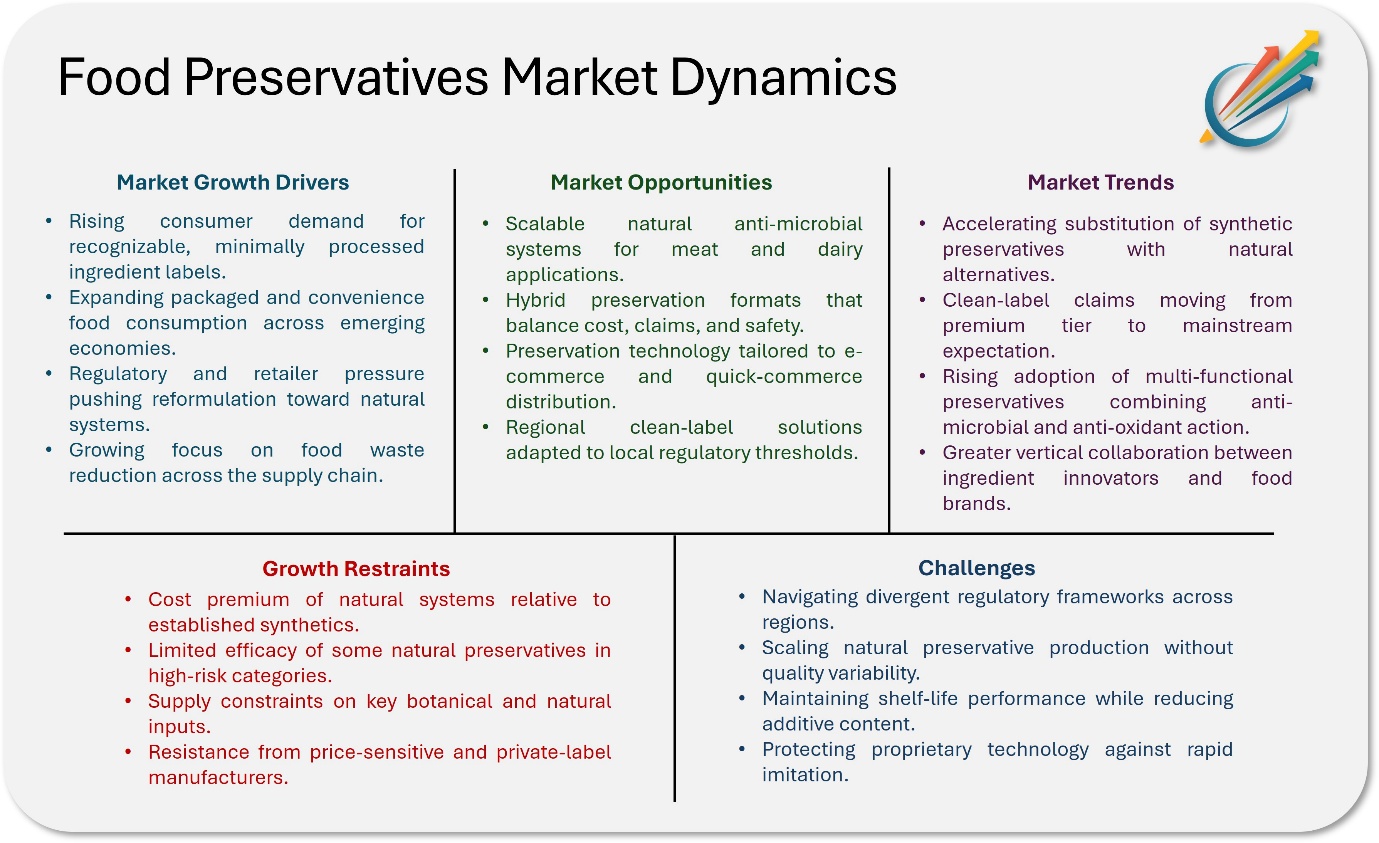
Food Preservatives Market Segmentation
By Product Type
- Natural
- Edible Oil
- Rosemary Extracts
- Natamycin
- Vinegar
- Chitosan
- Others
- Synthetic
- Propionates
- Sorbates
- Benzoates
- Others
The split between natural and synthetic products defines the central competitive tension in the food preservatives market. Natural systems are growing fastest as reformulation accelerates and retailers tighten ingredient specifications. Synthetic preservatives, however, retain a durable position in cost-sensitive and microbially demanding categories where natural alternatives cannot yet match performance economically. The decisive advantage is accruing to firms that hold proprietary natural technology while maintaining synthetic scale.
By Label
- Clean Label Preservatives
- Conventional Preservatives
Label positioning has become a strategic dividing line rather than a marketing nuance across food preservatives market. Clean-label preservatives command growing shelf priority as informed consumers and major retailers reward transparent formulations. Conventional preservatives continue to serve large volumes, particularly in value segments, but their growth is slowing relative to clean-label systems. Brands increasingly manage both tiers in parallel to protect margin while meeting evolving distribution requirements.
By Function
- Anti-microbial
- Anti-oxidant
- Others
Functional segmentation reflects the distinct preservation problems manufacturers must solve. Anti-microbial agents address spoilage and safety risk and represent the largest functional demand, particularly in meat, dairy, and bakery. Anti-oxidant preservatives protect against rancidity and color degradation in fat-containing products. Demand is rising for multi-functional systems that deliver both benefits, reducing formulation complexity and supporting cleaner ingredient declarations all over food preservatives market.
By Application
- Meat and Poultry Products
- Bakery Products
- Dairy Products
- Beverages
- Snacks
- Others
Application segmentation shows where preservation pressure is most acute. Meat, poultry, and bakery products together anchor the largest demand, given high spoilage risk and extended distribution needs. Dairy and beverages present strong opportunity as natural systems improve. Snacks rely heavily on anti-oxidant protection. Across all applications, the food preservatives market is being pulled toward solutions that extend shelf life while satisfying clean-label expectations.
Shape this report around your priorities: https://marketmindsadvisory.com/request-customization/?report_id=2295
Regional Market Outlook
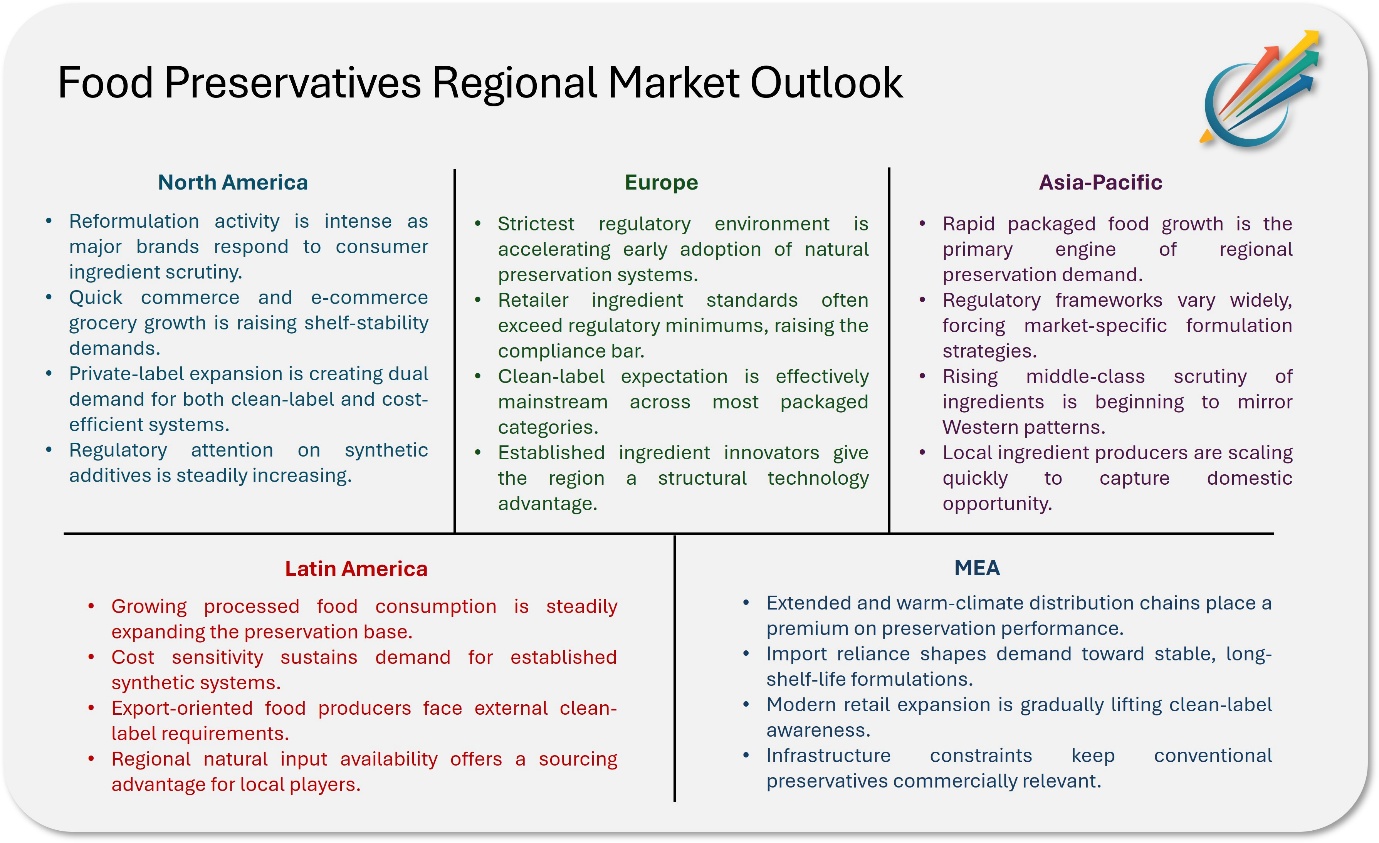
Investment Focus where the Lucrative Opportunity is Anticipated
Proprietary natural preservation technology
The most defensible positions belong to firms that control patented or hard-to-replicate natural preservation systems. As reformulation demand outpaces supply, owning the underlying technology rather than merely blending it gives durable pricing power. This is where margin is structurally advantaged rather than competed away.
Scaled natural input supply
Securing reliable, quality-consistent supply of rosemary extract, natamycin, chitosan, and similar inputs is becoming a binding constraint. Investors backing capacity in these inputs are positioned at a chokepoint of the food preservatives market, capturing value as demand tightens against limited availability.
Application-specific preservation systems
Tailored solutions for difficult categories, particularly meat, poultry, and dairy, command premium economics. Generic preservation is commoditizing, but systems engineered to solve a specific spoilage or safety problem in a high-value application retain pricing strength and customer stickiness.
Integrated formulation partnerships
Companies that move from supplier to embedded formulation partner capture value that transactional vendors cannot. By co-developing preservation strategy with food brands, these firms lock in long reformulation cycles and convert a procurement relationship into a strategic alliance with high switching costs.
What This Means for Decision-Makers
Food and Beverage Brands - Treat preservation as a strategic capability, not a procurement step. Securing clean-label technology access now protects both shelf placement and margin, since reformulation cycles are long and competitors are already moving within the food preservatives market.
Ingredient Suppliers - The value is shifting upstream toward proprietary technology and secured natural input supply. Suppliers that move from transactional vendor to embedded formulation partner will build the high-switching-cost relationships that define the next decade.
Investors - The investment thesis has matured beyond broad sector exposure. Proprietary natural preservation technology, scaled input supply, and application-specific systems offer clearer risk-return profiles than generic exposure to the food preservatives market.
Policymakers - Regulatory divergence is fragmenting the market and raising compliance cost for multinational manufacturers. Clearer, more consistent frameworks on natural preservation standards would accelerate safe reformulation and reduce avoidable food waste.
Competitive Landscape: Food Preservatives Market
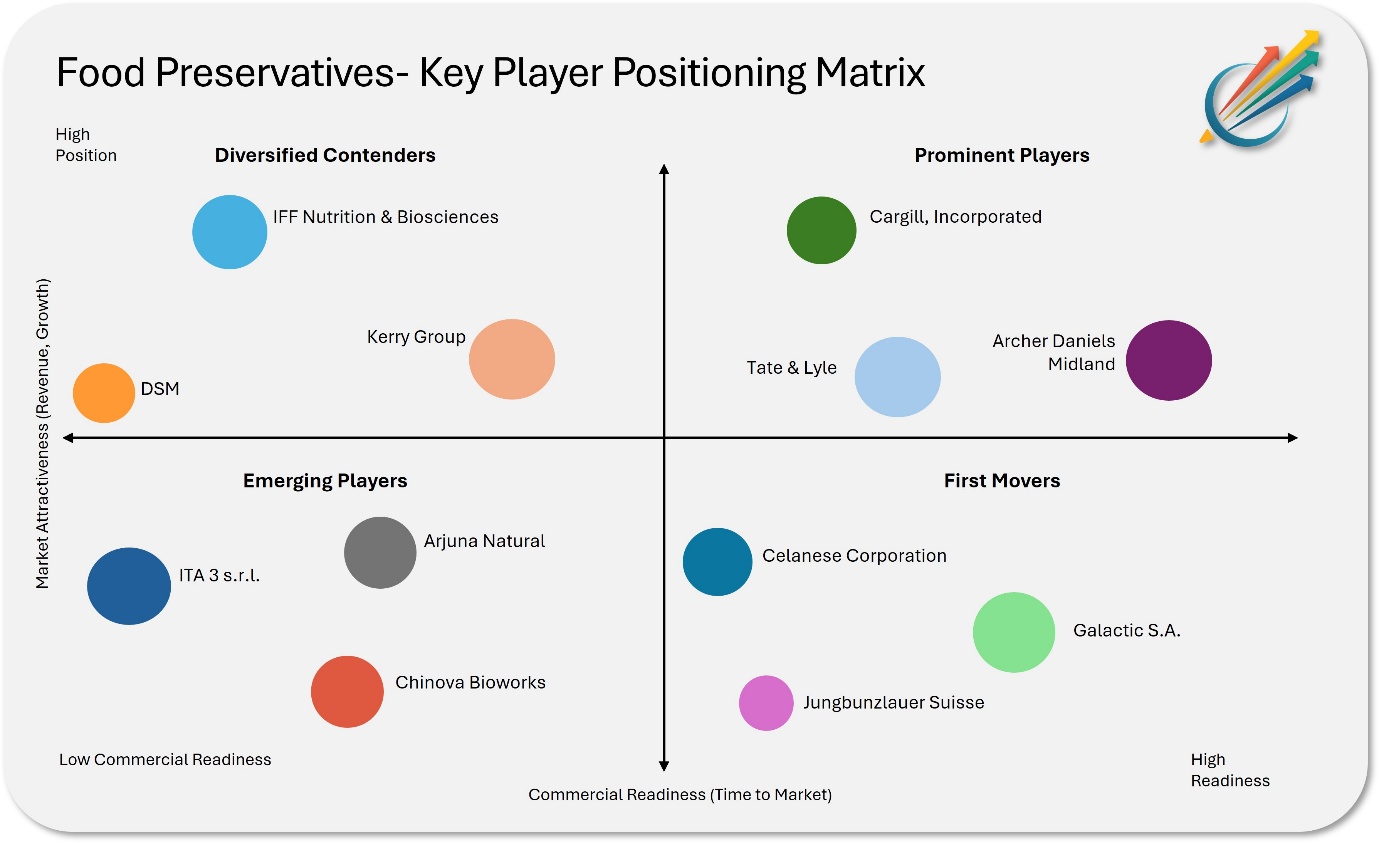
Recent Market Developments
- In April 2026, ADM expanded its portfolio of natural and clean-label ingredient solutions to support reformulation demand among packaged food manufacturers.
- In March 2026, Kerry continued investment in natural preservation and food protection capabilities aimed at extending shelf life across multiple applications.
- In February 2026, Corbion N.V. advanced its work on natural mold inhibition and food preservation technologies for bakery and meat customers.
- In January 2026, Kemin Industries reinforced its focus on natural anti-oxidant and food protection solutions through continued technical and capacity investment.
Market is segmented by Product Type (Natural, Synthetic), Label (Clean Label Preservatives, Conventional Preservatives), Function (Anti-microbial, Anti-oxidant), and Application (Meat and Poultry, Bakery, Dairy, Beverages, Snacks)
Get Access to complete Analysis: https://marketmindsadvisory.com/buy-now/?report_id=2295
Trending Reports
- Air-Dried Food Market
- Bakery Emulsions Market
- Bakery Enzymes Market
- Natural Antioxidants Market
- Antimicrobial Additives Market
- Beverage Acidulants Market
- Organic Yeast Market
- Glacial Acetic Acid Market
- Lactic Acid Bacteria Market
- Acid Citrate Dextrose Tube Market
Why choose Market Minds Advisory
Market Minds Advisory delivers decision-grade intelligence to executives across machinery, packaging, chemicals, automotive, ICT, food and beverage, consumer goods, and healthcare. We help organizations sharpen market expansion strategies, accelerate share gains, refine brand positioning, and enable account-level growth. Our forecasting integrates primary interviews, proprietary demand models, and continuous market validation, producing the kind of clarity volatile and emerging industries require. Backed by over a decade of sector expertise, our research surfaces white space, opportunity gaps, and competitive blind spots, accounting for recent developments and geopolitical risk. We help businesses see the future of their markets.
Contact Us
Market Minds Advisory
1521 Concord Pike, Suite 301
Wilmington, DE 19803
United States
Email: sales@marketmindsadvisory.com
Website: https://marketmindsadvisory.com/
