Wilmington, DE, United States, Sept. 10, 2026 (GLOBE NEWSWIRE) -- Diagnostic Providers Delaying Molecular Workflow Modernization may face Structural Competitive Disadvantages
Diagnostics has shifted from a function that confirms clinical suspicion to one that increasingly directs treatment before the first prescription is written. That repositioning is reshaping where value sits across the molecular diagnostics market, and a notable share of laboratory and provider strategy teams are still planning around an older model. The decisive contest is no longer about catalog breadth. It is about who controls the workflow.
What looks from outside like steady, incremental expansion is, underneath, a reordering of competitive advantage toward players who can compress turnaround time and embed themselves in clinical decision pathways. Reimbursement logic, payer scrutiny, and clinician trust are all consolidating around a smaller set of validated platforms. Organizations treating assay menus as the battleground are competing against organizations that have already moved one layer up.
Request a Free Sample Report: https://marketmindsadvisory.com/request-sample/?report_id=29
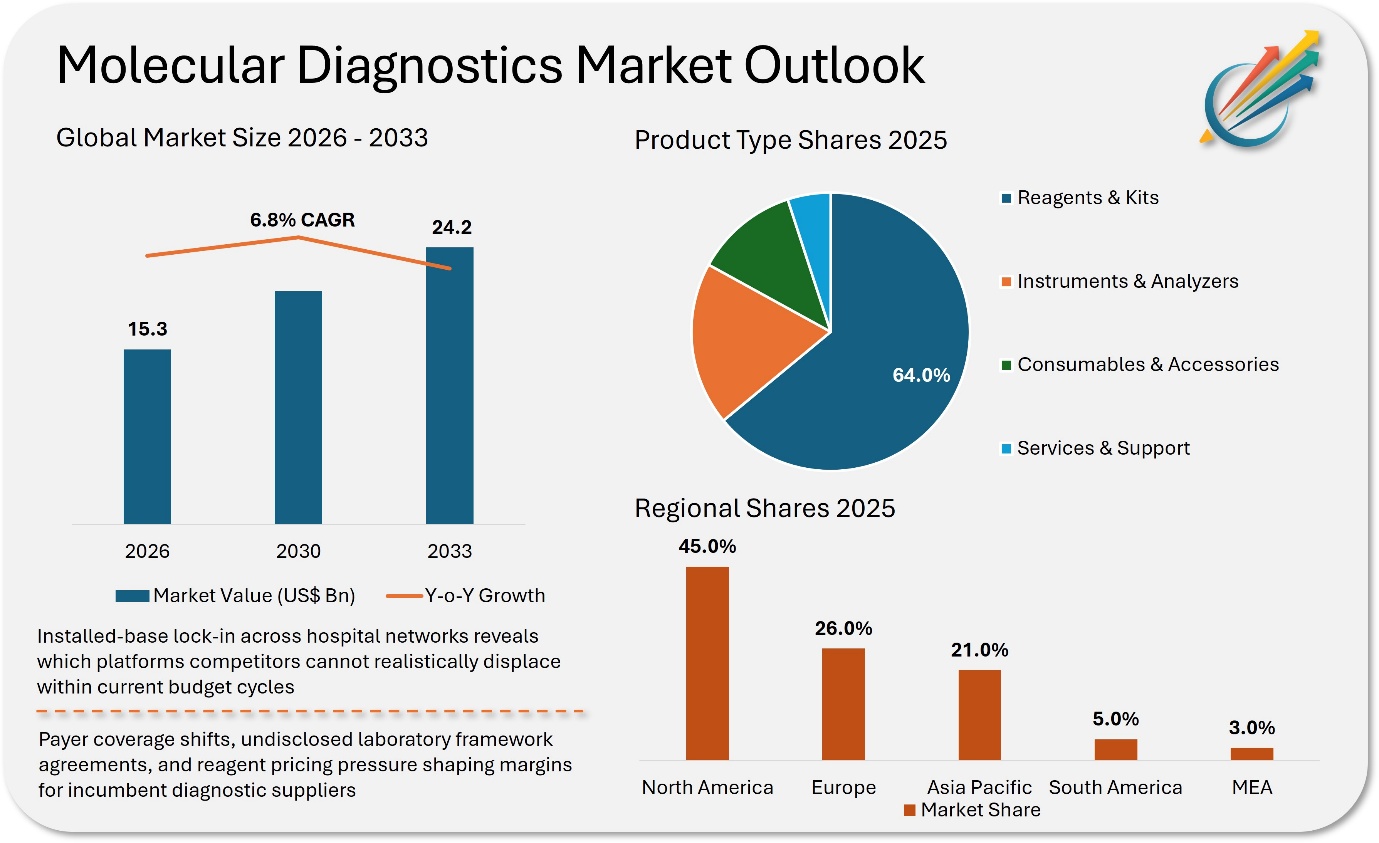
Key Takeaways from Molecular Diagnostics Market
- The molecular diagnostics market is valued at US$ 15.3 billion in 2026, with measurable momentum across decentralized testing settings and revenue is projected to reach US$ 24.2 billion by 2033 as clinical adoption broadens beyond infectious disease.
- Oncology applications are absorbing a rising share of test volume as companion diagnostics enter routine care.
- Point of care molecular platforms are migrating testing out of centralized laboratories toward the patient.
- Reagent and kit revenue is proving more durable than instrument sales across procurement cycles.
- Regulatory pathways for multiplex panels are tightening, favoring vendors with mature validation infrastructure.
As per Senior Consultant from Market Minds Advisory, "The competitive question has stopped being which assays a vendor offers and started being which clinical workflows a vendor controls. Companies that secure platform placement and reimbursement clarity in the next 12 to 18 months will set the economics that later entrants must accept."
Early Movers Locking Platform Placement and Reimbursement Advantage ahead of Competitors
The molecular diagnostics market rewards early placement more than late differentiation, and the timing logic is becoming difficult to ignore.
- Installed-base inertia is hardening: Once an instrument is validated and integrated into a laboratory's accredited workflow, switching costs climb steeply. Displacement becomes a multi-year effort rather than a procurement decision.
- Reimbursement clarity favors incumbents: Payers are concentrating coverage around platforms with established clinical evidence. New entrants face a longer, costlier path to coding and reimbursement support.
- Clinician trust compounds: Pathologists and ordering physicians build confidence around familiar systems. That trust transfers into renewal decisions and dampens the appeal of unproven alternatives.
Molecular Diagnostics Market is Moving from Instrument sales to Recurring Workflow-Driven Economics
Hardware once defined competitive standing in this sector. The center of gravity is now moving toward consumables, software, and the recurring revenue locked into daily clinical use.
- Reagents are becoming the strategic asset: Instrument placement increasingly functions as a channel to recurring reagent and kit revenue. Vendors treating reagents as a strategic asset rather than a procurement afterthought are capturing more durable margins across the molecular diagnostics market.
- Decentralization is redrawing demand: Point of care molecular testing is shifting volume away from centralized reference laboratories. This relocates revenue toward smaller, distributed settings and changes which sales and support models actually scale.
- Data integration is creating lock-in: Platforms that connect cleanly to laboratory information systems and electronic health records embed themselves deeper into clinical operations. Connectivity, not throughput alone, is becoming the harder advantage to dislodge.
Molecular Diagnostics Market is Evolving faster than most Diagnostic Strategy Models Anticipated
Instrument unit growth will understate true market health. As placement strategies shift toward reagent-driven economics, headline instrument sales will look soft even as recurring revenue strengthens. Analysts tracking hardware volume alone will misread the trajectory of the molecular diagnostics market.
Point of care expansion will pressure, not simply complement, centralized laboratories. Consensus treats decentralized testing as additive. The more likely outcome is partial substitution, with reference laboratories ceding routine high-volume assays and defending complex, esoteric testing.
CRISPR based diagnostics will matter commercially later than current enthusiasm suggests. The science is advancing quickly, but validation, regulatory clearance, and reimbursement will gate adoption. Near-term revenue will stay concentrated in PCR and sequencing.
A New Competitive Structure Is Forming Across the Molecular Diagnostics Market Ecosystem
Convergence of Diagnostics and Therapeutic Selection
Companion diagnostics now sit inside oncology treatment decisions rather than alongside them. As targeted therapies multiply, the molecular test that identifies eligible patients becomes inseparable from the prescribing pathway. Vendors positioned at this intersection capture value that neither pure diagnostic nor pure pharmaceutical players reach alone, and that position is proving difficult for later entrants to contest.
Decentralization of Testing Infrastructure
Testing is migrating from centralized laboratories toward hospitals, clinics, and point of care settings. This movement changes the economics of distribution, support, and instrument design simultaneously. Compact, easy-to-operate platforms are displacing assumptions built around high-throughput central laboratories, and the vendors that anticipated this shift are now structurally advantaged in fast-growing decentralized channels.
Consolidation of Regulatory and Reimbursement Gatekeeping
Approval pathways for multiplex and high-complexity panels are tightening across major markets. Payers are narrowing coverage toward platforms with mature clinical evidence. Together these forces raise the entry cost and favor vendors with established validation infrastructure, turning regulatory capability into a competitive moat rather than a compliance burden.
Integration of Software and Bioinformatics into Core Value
As sequencing and multiplex testing generate larger datasets, interpretation becomes the bottleneck. Bioinformatics, variant analysis, and clinical reporting software now shape platform selection as much as chemistry does. The companies treating software as central rather than ancillary are building advantages that competitors focused solely on assay performance cannot easily replicate across molecular diagnostics market.
Operational, Regulatory and Reimbursement Constraints could Reshape Adoption Timelines
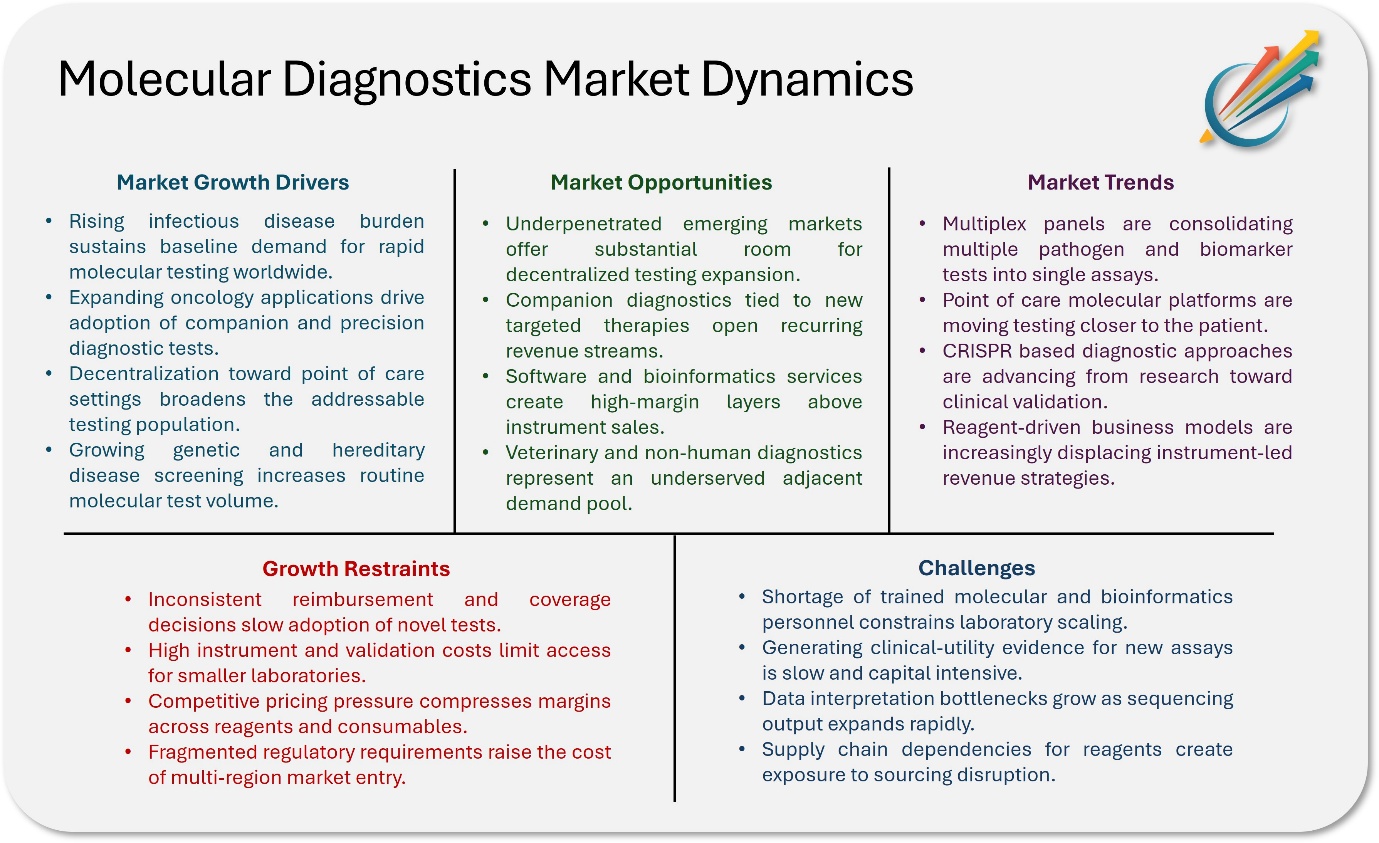
- Reimbursement uncertainty: Inconsistent coverage and coding decisions across payers can delay adoption, particularly for novel multiplex panels and emerging test categories.
- Pricing pressure: Payer scrutiny and competitive tendering are compressing reagent and test pricing, squeezing margins even as volume grows.
- Regulatory complexity: Divergent approval requirements across regions raise the cost and timeline of bringing new assays to multiple markets.
- Skilled workforce constraints: Sequencing and complex molecular testing depend on trained personnel whose availability has not kept pace with demand.
- Capital intensity: High instrument and validation costs can slow adoption among smaller laboratories and resource-limited settings.
- Reimbursement-data dependency: Adoption increasingly hinges on clinical-utility evidence, and generating that evidence is slow and expensive.
These headwinds are real and will shape the pace of deployment. They do not, in the assessment of this research, reverse the directional conclusion that diagnostic value is consolidating around workflow-integrated platforms.
Market Dynamics Shaping the Molecular Diagnostics Market
Molecular Diagnostics Market Segmentation
By Test Type
- Polymerase Chain Reaction (PCR) Tests
- Isothermal Amplification Tests
- Next Generation Sequencing (NGS) Tests
- Microarray Tests
- In situ Hybridization
- CRISPR Based Diagnostic Tests
- Point Of Care Molecular Tests
PCR remains the workhorse of the molecular diagnostics market, supported by deep installed bases and established reimbursement. NGS is the fastest-growing category as oncology and genetic applications scale. CRISPR based tests attract significant attention but face a longer commercial runway. Isothermal and point of care formats are gaining ground precisely because they relax the infrastructure demands that constrain centralized testing.
By Product Type
- Reagents & Kits
- Instruments & Analyzers
- Consumables & Accessories
- Services & Support
Reagents and kits anchor recurring revenue and have proven more resilient than instrument sales through procurement cycles in the molecular diagnostics market. Instruments increasingly function as placement vehicles rather than primary profit centers. Consumables track installed-base utilization, while services and support are emerging as a differentiator as laboratories seek uptime guarantees and integration help. The margin story sits firmly with consumables.
By Sample Type
- Blood Samples
- Urine Samples
- Saliva Samples
- Respiratory Specimens
- Stool Samples
- Tissue and Biopsy Samples
- Cerebrospinal Fluid
Blood and tissue samples dominate volume, anchored by oncology and infectious disease testing. Respiratory specimens carry seasonal demand that shapes capacity planning. Saliva-based collection is expanding because it supports decentralized and self-collection workflows. The trend across the molecular diagnostics market favors sample types that reduce collection friction without sacrificing analytical reliability.
By Therapeutic Area
- Cardiovascular Diseases
- Genetic Diseases
- Infectious Diseases
- Neurological Diseases
- Oncological Disorders
- Respiratory Disease Diagnostics
- Autoimmune Disease Diagnostics
- Others
Infectious disease testing provides the stable demand base, while oncology is the clearest growth engine as companion diagnostics enter routine care. Genetic disease screening is broadening as costs fall and clinical guidelines expand. Neurological and autoimmune applications remain earlier in adoption but represent meaningful long-term expansion within the molecular diagnostics market.
By End User
- Hospital & Clinical Laboratories
- Pharmaceutical And Biotechnology Companies
- Contract Research Organizations (CROs)
- Private Diagnostic Laboratories
- Point Of Care Facilities
- Veterinary Diagnostic Laboratories
Hospital and clinical laboratories represent the largest end-user base, though point of care facilities are the fastest-rising channel. Private diagnostic laboratories compete on turnaround and menu breadth. Pharmaceutical companies and CROs anchor demand tied to companion diagnostic development. Veterinary laboratories, often overlooked, form a quietly expanding segment within the molecular diagnostics market.
Shape this report around your priorities: https://marketmindsadvisory.com/request-customization/?report_id=29
Regional Market Outlook
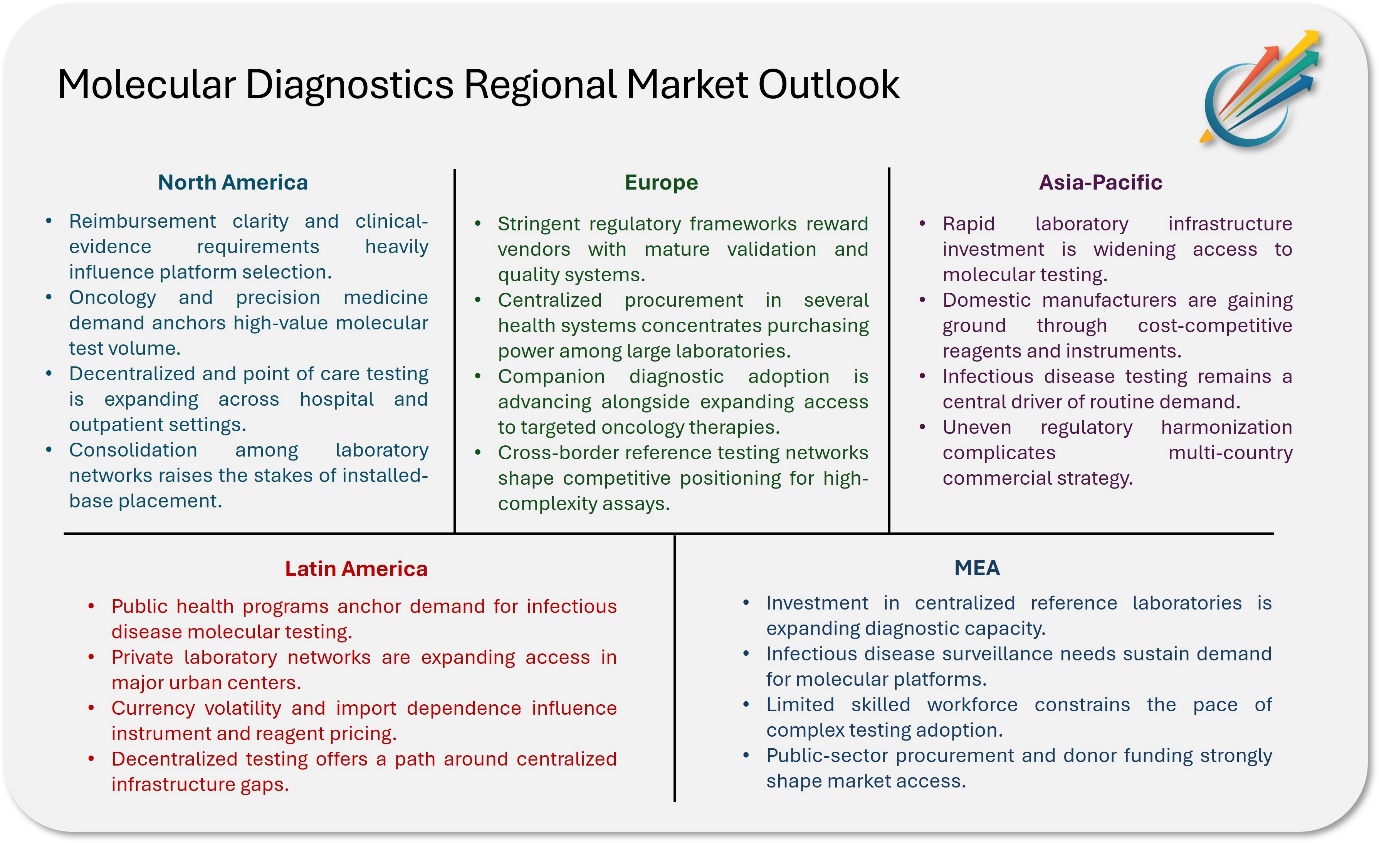
Investment Focus where the Lucrative Opportunity is Anticipated Companion Diagnostics in Oncology
The tightest link between diagnostics and revenue runs through oncology. As targeted therapies proliferate, the molecular test that defines patient eligibility becomes commercially inseparable from treatment. Vendors with validated companion assays and pharmaceutical partnerships occupy a position that is structurally advantaged and difficult for later entrants to contest.
Reagent and Consumable Franchises
Recurring reagent revenue is the most defensible economics in this sector. An installed instrument base generates predictable, high-margin consumable demand that competitors cannot easily redirect. Treating reagents as a strategic asset rather than a procurement step is where durable value is concentrating.
Decentralized and Point of Care Platforms
Point of care molecular testing is capturing volume that centralized laboratories once held by default all over molecular diagnostics market. Compact, simple-to-operate platforms unlock settings that high-throughput systems never served. Early movers in this channel are building distribution and support advantages that compound with each placement.
Bioinformatics and Clinical Reporting Software
As data volume outpaces interpretation capacity, software becomes the binding constraint. Variant analysis, reporting, and decision-support tools increasingly determine platform selection. Companies that own this layer capture recurring value and embed switching costs that pure chemistry providers cannot match.
What This Means for Decision-Makers
Diagnostic Instrument Manufacturers - The competitive payoff is shifting from hardware specifications to reagent franchises and workflow integration. Treating instrument placement as a channel to recurring revenue, rather than a standalone sale, is now the more defensible posture in the molecular diagnostics market.
Laboratory Operators - Platform selection is a multi-year commitment that locks in cost structure and menu flexibility. Decisions made on connectivity, reagent economics, and validation support will outlast the procurement cycle that produced them.
Investors - The clearer risk-return profiles sit in recurring reagent revenue, companion diagnostics, and bioinformatics rather than pure instrument plays. The molecular diagnostics market rewards durable franchises over one-time hardware sales.
Healthcare Providers - Molecular testing increasingly directs treatment rather than confirming it. Coverage and adoption decisions made now will shape clinical pathways and cost trajectories well beyond the current budget period.
Competitive Landscape: Molecular Diagnostics Market
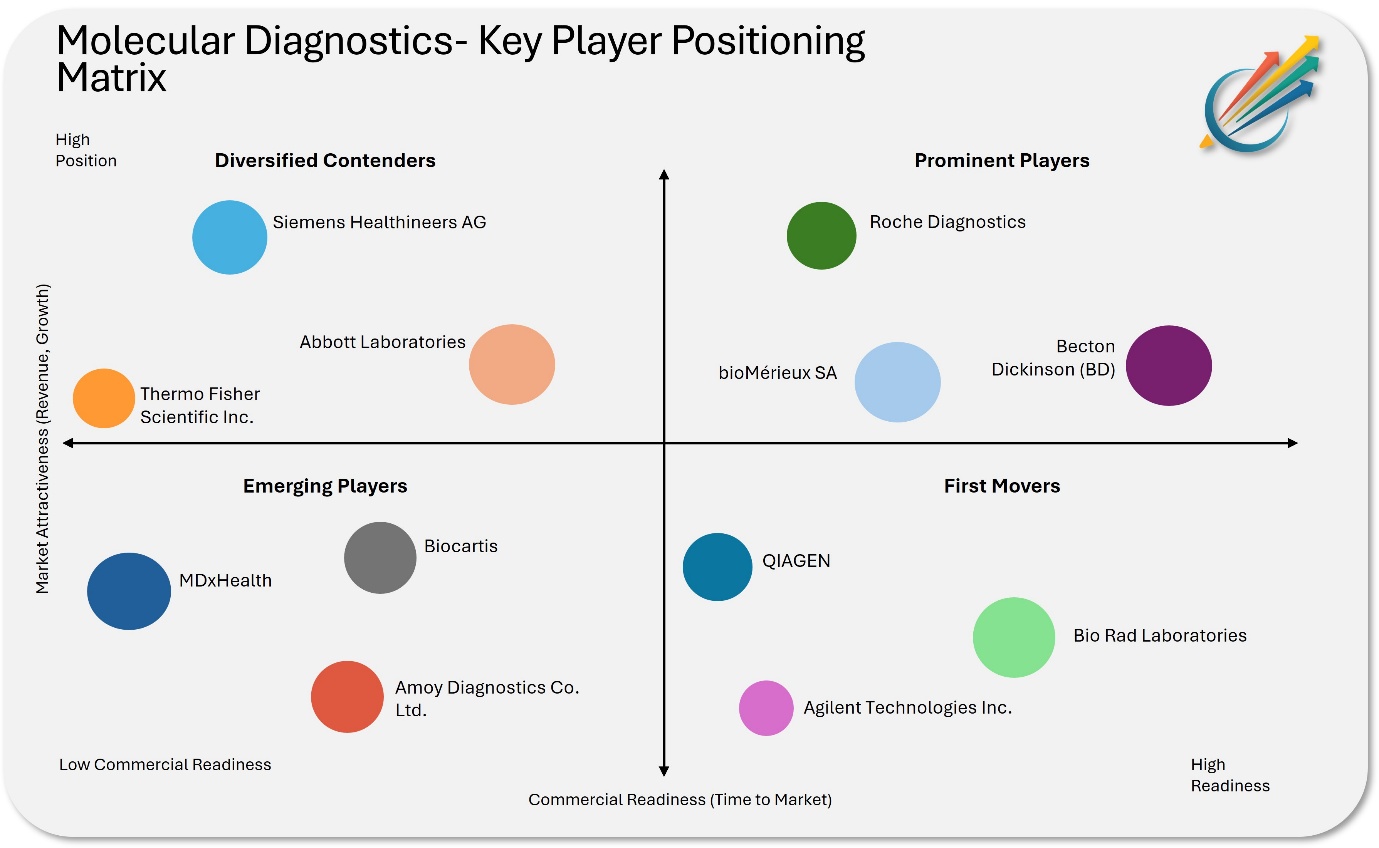
Recent Market Developments
- In April 2026, Roche Diagnostics expanded its molecular testing menu with new assays aimed at strengthening its position in decentralized and hospital-based testing.
- In March 2026, Illumina Inc. advanced its sequencing platform strategy with product updates intended to lower cost barriers for clinical oncology applications.
- In February 2026, Abbott Laboratories broadened its point of care molecular portfolio to support testing in outpatient and near-patient settings.
- In December 2025, QIAGEN extended its sample preparation and panel offerings to support multiplex molecular testing workflows.
Market is segmented by Test Type (PCR Tests, NGS Tests, CRISPR Based Diagnostic Tests), Product Type (Reagents & Kits, Instruments, Consumables & Accessories), and Therapeutic Area (Oncological Disorders, Infectious Diseases, Genetic Diseases, Neurological Diseases)
Get Access to complete Analysis: https://marketmindsadvisory.com/buy-now/?report_id=29
Trending Reports
- DNA Sequencing Services Market
- Rapid Microbiology Testing Market
- DNA Polymerase Market
- qPCR Instruments Market
- Lung Cancer PCR Panel Market
- Automated Nucleic Acid Extraction Systems Market
- DNA Sequencing Services Market
- Cancer-Focused Genetic Testing Service Market
- Infectious Disease Molecular Testing Market
- Oncology Adjuvants Market
Why choose Market Minds Advisory
Market Minds Advisory delivers decision-grade intelligence to executives across machinery, packaging, chemicals, automotive, ICT, food and beverage, consumer goods, and healthcare. We help organizations sharpen market expansion strategies, accelerate share gains, refine brand positioning, and enable account-level growth. Our forecasting integrates primary interviews, proprietary demand models, and continuous market validation, producing the kind of clarity volatile and emerging industries require. Backed by over a decade of sector expertise, our research surfaces white space, opportunity gaps, and competitive blind spots, accounting for recent developments and geopolitical risk. We help businesses see the future of their markets.
Contact Us
Market Minds Advisory
1521 Concord Pike, Suite 301
Wilmington, DE 19803
United States
Email: sales@marketmindsadvisory.com
Website: https://marketmindsadvisory.com/
