Ottawa, Dec. 23, 2025 (GLOBE NEWSWIRE) -- The global millet starch market size stood at USD 5.45 billion in 2025 and is predicted to grow from USD 5.79 billion in 2026 to reach around USD 9.95 billion by 2035, according to a report published by Towards FnB, a sister firm of Precedence Research. Countries in Europe, North America, and Asia-Pacific are witnessing a surge in millet-based product offerings, which is supporting both domestic demand and export opportunities.
The surge in millet starch adoption is closely tied to the increasing preference for clean-label products, as more consumers prioritize transparency in their food choices. This is coupled with a growing interest in gluten-free, plant-based, and vegan options, as these ingredients are seen as healthier alternatives to traditional starches. With increasing concerns about food allergies, intolerances, and dietary restrictions, millet starch has emerged as an ideal solution for vegans, flexitarians, and those with gluten sensitivities, further boosting its demand among food manufacturers seeking to cater to this diverse, health-conscious consumer base.
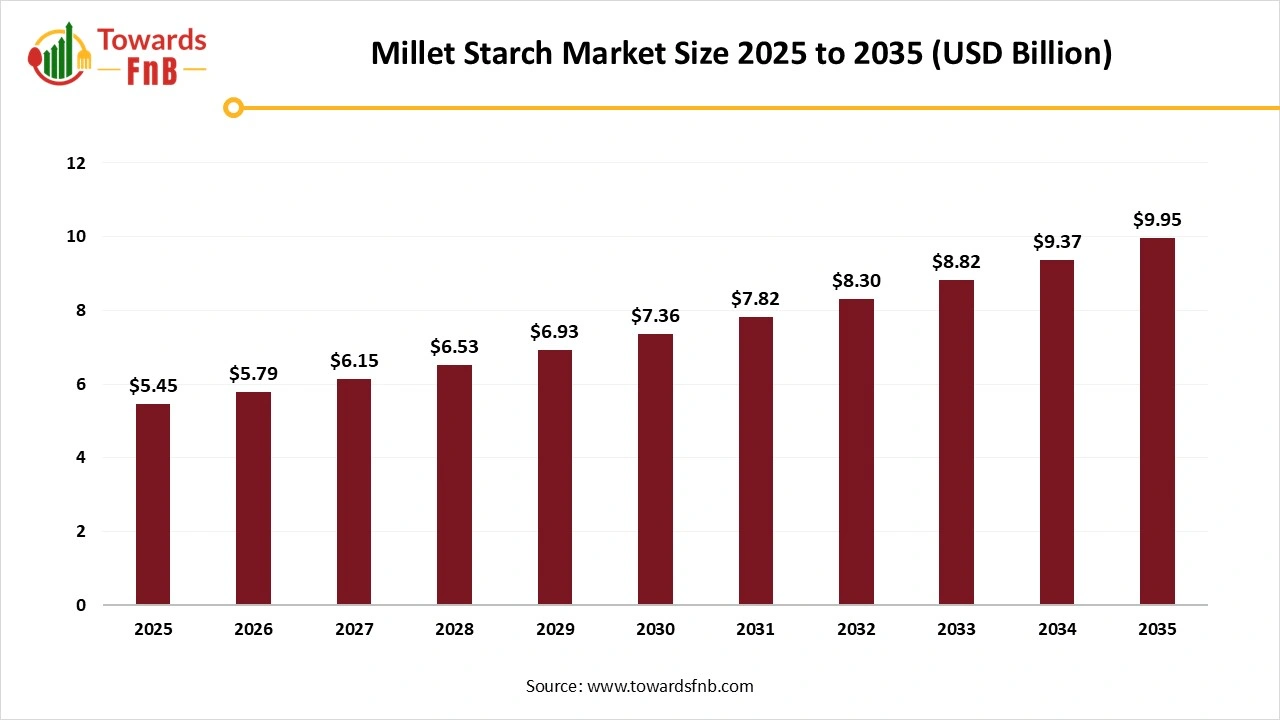
Note: This report is readily available for immediate delivery. We can review it with you in a meeting to ensure data reliability and quality for decision-making.
Access the Full Study Instantly | Download Sample Pages of the Report Now@ https://www.towardsfnb.com/download-sample/5959
Key Highlights of Millet Starch Market
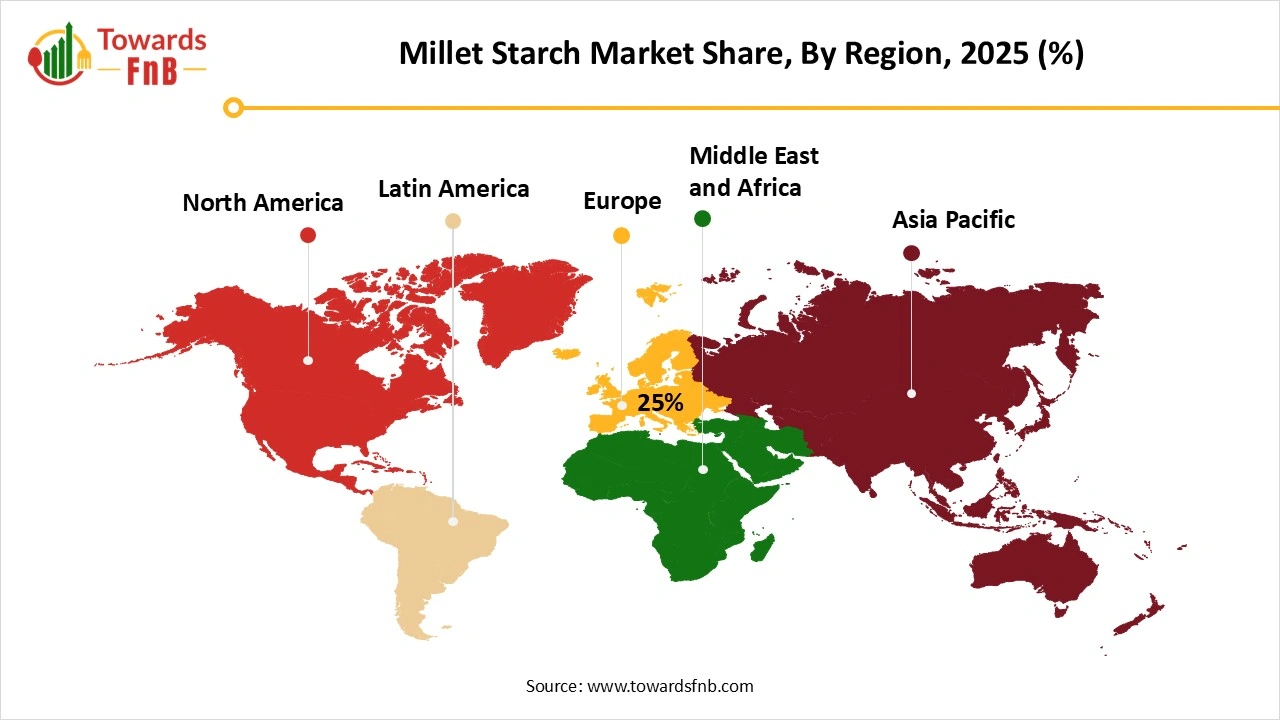
- By region, Europe led the millet starch market with highest share of 25% in 2025, while the Asia Pacific is expected to grow significantly during the forecast period.
- By source, the pearl millet led the millet starch market in 2025, whereas the finger millet is expected to grow in the foreseeable period.
- By application, the food and beverages segment led the millet starch market in 2025, whereas the industrial segment is expected to grow in the foreseeable period.
- By functionality, the thickening agent led the millet starch market in 2025, whereas the film-forming agent segment is expected to grow in the foreseen period.
- By form, the native millet starch segment led the millet starch market in 2025, whereas the modified millet starch segment is expected to grow in the foreseen period.
Higher Demand for Healthier Alternatives is helpful for the Growth of the Millet Starch Industry
The millet starch market is observed to grow due to higher demand for clean-label, plant-based, and vegan options. The market focuses on the extraction, processing, and commercialization of millet starch, further fueling the growth of the market. The whole procedure involves the use of different types of millets such as pearl millet, finger millet, and foxtail millet. Millets are highly nutritious and have multiple health benefits. They are easily digestible and keep one satiated for a longer time. Hence, it is an ideal option for weight loss to avoid the consumption of junk and unhealthy snack options.
Impact of AI in the Millet Starch Market
Artificial intelligence (AI) is influencing the millet starch market by improving raw material selection, refining extraction efficiency, and strengthening quality consistency for food and industrial applications. At the sourcing stage, AI tools analyze agronomic data such as soil condition, rainfall, temperature, and varietal traits to help producers identify millet crops with higher starch yield and more uniform granule structure. These insights support better harvest timing and reduce variability caused by differences in growing conditions across regions.
During starch extraction, AI-driven process control systems monitor soaking time, grinding intensity, slurry viscosity, and separation efficiency. Machine learning models adjust processing parameters in real time to maximize starch recovery while minimizing fiber and protein carryover. This is particularly important for millet starch, where granule integrity and purity directly affect functionality in applications such as gluten-free bakery, noodles, thickeners, and confectionery.
View Full Market Intelligence@ https://www.towardsfnb.com/insights/millet-starch-market
Recent Developments in Millet Starch Market
- In September 2025, The Millets National Media Portal launched Millet Mothers at Minerva Halls, allowing homemakers to provide nutritious millet lunch boxes to corporate employees.
New Trends in the Millet Starch Market
- Rising demand for gluten-free and clean-label ingredients by health-conscious consumers and people with gluten intolerance is supporting the growth of the millet starch market.
- Increasing use of millet starch as a functional ingredient in bakery, snacks, and processed food, due to its binding, thickening, and texturizing properties, is contributing to market expansion.
- Growing preference for plant-based, minimally processed, and sustainable raw materials by food manufacturers is further fueling adoption of millet starch across food and beverage applications.
Product Survey of the Millet Starch Market
| Product Category | Description or Function | Source Millet Type or Variant | Key Applications or End Use Segments | Representative Processors or Supplier Types |
| Native Millet Starch | Unmodified starch extracted from millet grains with natural gelatinization properties. | Pearl millet starch, finger millet starch, foxtail millet starch | Bakery, soups, sauces, traditional foods | Regional starch processors, grain millers |
| Modified Millet Starch | Chemically or physically modified starch for enhanced stability and viscosity control. | Cross-linked millet starch, acetylated millet starch | Processed foods, sauces, ready meals | Specialty starch manufacturers |
| Pregelatinized Millet Starch | Heat treated starch that disperses and thickens in cold water. | Instant millet starch powders | Instant foods, dry mixes, baby foods | Functional ingredient suppliers |
| Organic Millet Starch | Millet starch produced from certified organic millet grains. | Organic pearl millet starch | Organic foods, clean label formulations | Organic ingredient processors |
| Millet Starch for Gluten-Free Applications | Naturally gluten free starch suitable for celiac and gluten sensitive diets. | Finger millet and foxtail millet starch | Gluten free bakery, snacks, pasta | Gluten free ingredient suppliers |
| Millet Starch for Infant and Baby Foods | Easily digestible starch used as an energy and texture component. | Low amylose millet starch | Infant cereals, toddler foods | Infant nutrition ingredient suppliers |
| Millet Starch for Bakery Applications | Provides crumb softness, moisture retention, and structure. | Pearl millet starch blends | Bread, cakes, cookies, flatbreads | Bakery ingredient suppliers |
| Millet Starch for Noodles and Pasta | Used for binding, elasticity, and mouthfeel improvement. | Foxtail millet starch | Gluten free noodles, traditional pasta | Asian and specialty food processors |
| Millet Starch for Snack and Extrusion Applications | Supports expansion and crispness in extruded snacks. | Pregelatinized or modified millet starch | Puff snacks, pellets, breakfast cereals | Snack ingredient manufacturers |
| Millet Starch for Thickening and Gelling | Functions as a natural thickener and stabilizer. | Native and lightly modified starch | Gravies, soups, sauces | Foodservice and industrial kitchens |
| Resistant Millet Starch | Starch fraction with reduced digestibility offering dietary fiber benefits. | High amylose millet starch | Functional foods, low glycemic products | Functional starch developers |
| Millet Starch for Dairy and Dairy Alternatives | Improves viscosity and stability in liquid and semi solid systems. | Fine particle millet starch | Yogurt alternatives, plant based beverages | Plant based formulation suppliers |
| Millet Starch for Nutraceuticals | Used as a carrier, binder, or excipient. | Food grade millet starch | Tablets, capsules, powders | Nutraceutical excipient suppliers |
| Millet Starch for Pharmaceutical Use | Acts as a binder and disintegrant in solid dosage forms. | Pharmacopeia compliant millet starch | Tablets and capsules | Pharmaceutical excipient manufacturers |
| Millet Starch for Paper and Textile Applications | Industrial use as a sizing and binding agent. | Technical grade millet starch | Paper coating, textile sizing | Industrial starch processors |
| Blended Millet Starch Systems | Millet starch combined with other starches for performance tuning. | Millet-corn or millet-tapioca blends | Processed foods, cost optimization | Bulk starch suppliers |
| Clean Label Millet Starch | Minimally processed starch positioned for simple ingredient declarations. | Native or physically modified starch | Clean label foods | Clean label ingredient suppliers |
For Detailed Pricing and Tailored Market Report Options, Click Here: https://www.towardsfnb.com/checkout/5959
Millet Starch Market Dynamics
What Are the Growth Drivers of the Millet Starch Market?
Factors such as higher resistance to damaging climatic conditions, higher demand by the food and beverages industry and various other domains, and higher demand by non-edible industries, such as for manufacturing paper, textiles, and various other options, are helpful for the growth of the market. Hence, such factors help to aid the growth of the market. The nutritional benefits of millet starch also help to fuel the growth of the market, as it helps to keep one satiated for a longer time, is helpful for weight management, and also helps manage multiple lifestyle issues.
Processing and Technical Issues Hampering the Growth of the Market
Issues such as existing decortication machines with low recovery leave the grain unhulled and broken, hampering the growth of the market. Enzymes like lipase lead to higher enzymatic activity, leading to reduced shelf life. Hence, such factors hamper the growth of the market. Phytates also restrict nutrient absorption, further affecting the market’s growth. Damaging climatic conditions affecting the soil quality also damage the growth of the market.
Growing Awareness of Sustainability is Helpful for the Growth of the Market
Millet starch is a highly sustainable option compared to other forms of conventional starch, fueling the growth of the market. It is a biodegradable option and ideal for the manufacturing of food coating and films to maintain their safety and shelf life. Millet starch is a vegan and plant-based option with multiple nutritional health properties, further fueling the growth of the market. It is ideal for weight management, as it is an ideal replacement for unhealthy junk and oily food options. Higher usage of millet starches in various non-edible options such as textiles, paper, and biodegradable film manufacturing also aids in the hike of the market.
Millet Starch Market Regional Analysis
Europe Dominated the Millet Starch Market in 2025
Europe led the millet starch market in 2025, due to higher demand for millet starch in the food and beverage industry, along with in various non-edible domains. It is also the first choice of health-conscious consumers as it is free from gluten and ideal for vegans and flexitarians, which is helpful for the market’s growth. The UK has a major contribution to the growth of the market due to higher consumer awareness in the region regarding millet flour and its various nutritional properties.
Asia Pacific Is Observed to Be the Fastest-Growing Region in the Foreseeable Period
Asia Pacific is observed to be the fastest growing region due to the growing population of health-conscious consumers, fueling the demand for healthier choices such as gluten-free options. Higher adoption of organic farming in the region, leading to higher demand for chemical-free and preservative-free options, also helps to fuel the market’s growth in the foreseen period. India has a major contribution to the growth of the market of the region due to higher awareness of millet health benefits and its higher demand in the urban region.
North America Is Observed to Have a Notable Growth in the Foreseen Period
North America is observed to have a notable growth in the foreseen period due to higher usage of millet starch as a thickening agent in the food and beverage industry, in thickening soups, sauces, salad dressings, creamy spreads, and various similar options. It is also highly demanded by the health-conscious crowd of the region as it is vegan, high in protein, and highly nutritious, further fueling the growth of the market. The US has a major contribution to the growth of the market due to its higher demand in various industries and its higher nutritional profile.
Trade Analysis for the Millet Starch Market
What Is Actually Traded (Product Forms and HS Proxies)
- Native millet starch powders supplied in bulk bags for food processing, typically declared under HS 1108 as starches.
- Modified millet starches, including pre-gelatinised or cross-linked forms, often declared under HS 3505 when chemically modified.
- Blended starch systems incorporating millet starch with other plant starches, generally cleared under HS 1108 or HS 2106 depending on formulation.
Top Exporters (Supply Hubs)
- India: Largest producer of millets globally and the primary source of millet starch exports, supported by expanding millet-processing capacity and government-backed value-addition programs.
- China: Exporter of alternative starches including limited millet-derived starches, supported by large starch-processing infrastructure.
- European Union (Selected Member States): Small-volume exporters of specialty and modified millet starches for gluten-free and functional-food applications.
Top Importers (Demand Centres)
- European Union: Imports niche volumes of millet starch for gluten-free bakery, baby food and clean-label applications.
- United States: Imports specialty starches, including millet-based alternatives, for health-focused and allergen-free food formulations.
- East Asia: Select import demand for alternative starches used in noodles, snacks and functional foods.
Typical Trade Flows and Logistics Patterns
- Raw millet grains are processed domestically in producing countries, with starch extracted near cultivation zones to reduce transport costs.
- Millet starch is shipped as a dry, shelf-stable powder in moisture-protected bags via containerised sea freight.
- Repackaging and blending hubs in Europe and North America incorporate millet starch into multi-starch systems tailored for end users.
- Cold-chain is not required, but humidity control is critical to prevent caking and microbial growth.
Trade Drivers and Structural Factors
- Gluten-free and allergen-free demand: Millet starch serves as an alternative to wheat-based ingredients.
- Crop diversification policies: Government promotion of millets supports upstream supply for starch extraction.
- Functional performance: Differences in gelatinisation temperature and viscosity profiles influence adoption in food formulations.
- Competition with maize and tapioca starch: Price and functional parity determine substitution rates.
- Processing scale limitations: Limited large-scale extraction capacity constrains export volumes.
Regulatory, Quality and Market-Access Considerations
- Millet starch must comply with food-safety regulations covering contaminants, residues and microbiological limits.
- Modified millet starches are subject to additive and modification-specific approvals in importing markets.
- Documentation typically includes certificates of analysis, botanical origin declaration and allergen statements.
- Infant and medical nutrition applications may require additional compositional validation.
Government Initiatives and Public-Policy Influences
- National millet promotion programs in India support processing infrastructure and export readiness for millet-based ingredients.
- Food-security and climate-resilience policies encourage diversification into millet value chains.
- Export facilitation and agricultural extension services improve raw-material consistency for processors.
Millet Starch Market Report Scope
| Report Attribute | Key Statistics |
| Base Year | 2025 |
| Forecast Period | 2026 to 2035 |
| Growth Rate from 2026 to 2035 | CAGR of 6.2% |
| Market Size in 2026 | USD 5.79 Billion |
| Market Size in 2027 | USD 6.15 Billion |
| Market Size by 2035 | USD 9.95 Billion |
| Dominated Region | Europe |
| Fastest Growing Region | Asia Pacific |
| Regions Covered | North America, Europe, Asia-Pacific, Latin America and Middle East & Africa |
Millet Starch Market Segmental Analysis
Source Analysis
The pearl millet segment led the millet starch market in 2025, due to the major nutritional qualities of pearl millet, which are helpful for the growth of the market. Pearl millet is high in starch, protein, and various other health-beneficial factors helpful for the growth of the market. Its extensive cultivation and drought resistance properties also make it highly demanding among the farmers for cultivation and higher profits, further fueling the growth of the market. Supportive government initiatives and higher applicability in various domains also make the segment profitable, further fueling the growth of the millet starch industry.
The finger millet segment is observed to grow in the foreseen period, as the crop is a manageable one in harsh climatic conditions and hence is a savior for farmers in the developing countries. Hence, such factors aid the growth of the millet starch market in the foreseeable period. Finger millet is high in gluten and starch and hence is highly utilized for making edible starch coating for various food options, and is also friendly for consumers with gluten intolerance and vegans. Such factors altogether help to aid the industry’s growth in the foreseen period.
Application Analysis
The food and beverages segment led the millet starch market in 2025, due to the multiple nutritional benefits of millets and their high starch and protein content. The segment also observes growth as the gluten-free property of the crop aids the food and beverage manufacturers in the manufacturing of healthier options such as gluten-free snacks, pasta, infant formula, millet flour, thickeners, baking flours, and fermented beverages. The functional characteristics of the crop, such as swelling, solubility, thermal behavior, gelatinization, and easy digestibility, also help to fuel the growth of the market.
The industrial segment is expected to grow in the foreseen period due to the physicochemical characteristics of the starch obtained from millet, such as elevated amylose level, small granule size, and excellent gel-forming capacity. Such properties help to fuel the market’s growth in the foreseen period. Millet starch is also essential for the textile industry in the form of a sizing agent and for creating biodegradable films. Millet starch is also essential for various non-edible domains such as paper, textiles, adhesives, and biodegradable packaging because of its characteristics.
Functionality Analysis
The thickening agent segment led the millet starch market in 2025, as millet starch takes up water easily and expands seamlessly when heated. Hence, it is an idea; a thickening agent for food and beverage options such as soups, custards, and gravies, by making them thicker and creamier. The porous design of millet starch helps to hold water and provide ideal thickening in various foods and beverages in a gluten-free form, further fueling the growth of the market.
The film-forming segment is expected to grow in the foreseen period due to its properties, such as phenolics and antioxidants, which are helpful for the manufacturing of food films to maintain their safety and shelf-life, further fueling the growth of the market. Biodegradable films are highly preferred by various domains for packaging these days as they are eco-friendly and sustainable. Factors such as high availability, low cost, excellent binding properties, and excellent film-forming capabilities also help to fuel the growth of the market in the foreseeable period.
Form Analysis
The native millet starch segment led the millet starch market in 2025, as native starch is unadulterated and pure without the addition of any chemicals or preservatives. It is obtained from natural sources such as wheat, corn, potatoes, or tapioca. Higher demand for natural, unadulterated, and sustainable options is another major factor for the growth of the market. It is highly preferable compared to modified starch due to its natural properties, which are helpful for the growth of the market.
The modified millet starch segment is observed to grow in the foreseen period due to its higher and practical benefits, which are helpful for the growth of various domains. The various techniques used to enhance the properties of the millet starch to enhance its capabilities for various domains are another major factor for the growth of the market. Usage of modified starch in processed foods and ready-to-eat food manufacturing is another major factor for the growth of the market. Hence, such factors altogether fuel the growth of the market in the foreseen period.
Feel Free to Get in Touch with Us for Orders or Any Questions at: sales@towardsfnb.com
Additional Topics Worth Exploring:
- Dietary Supplements Market: The dietary supplements market size is projected to reach USD 464.58 billion by 2034, growing from USD 192.68 billion in 2025, at a CAGR of 9.2% from 2025 to 2034.
- Frozen Food Market: The global frozen food market size is expected to grow from USD 214.32 billion in 2025 to reach around USD 347.01 billion by 2034, at a CAGR of 5.5% over the forecast period from 2025 to 2034.
- Vegan Food Market: The global vegan food market size is evaluated at USD 22.38 billion in 2025 and is expected to reach USD 55.88 billion by 2034, with a CAGR of 10.7% during the forecast period from 2025 to 2034.
- Sugar-Free Food Market: The global sugar-free food market size is expected to grow from USD 48.14 billion in 2025 to USD 83.2 billion by 2034, growing at a CAGR of 6.27% during the forecast period from 2025 to 2034.
- Food Additives Market: The global food additives market size is rising from USD 128.14 billion in 2025 to USD 214.66 billion by 2034. This projected expansion reflects a CAGR of 5.9% throughout the forecast period from 2025 to 2034.
- Ethnic Food Market: The global ethnic food market size is forecasted to expand from USD 93.47 billion in 2025 to reach around USD 179.21 billion by 2034, growing at a CAGR of 7.5% during the forecast period from 2025 to 2034.
- Meal Kits Market: The global meal kits market size is projected to rise from USD 17.11 billion in 2025 to approximately USD 58.8 billion by 2034, registering a CAGR of 14.7% during the forecast period from 2025 to 2034.
- Baking Ingredients Market: The global baking ingredients market size is projected to grow from USD 18 billion in 2025 to around USD 31.72 billion by 2034, at a CAGR of 6.5% during the forecast period from 2025 to 2034.
- Fresh Produce Market: The global fresh produce market size is projected to grow from USD 3,707 billion in 2025 to approximately USD 5,653 billion by 2034. This anticipated growth represents a CAGR of 4.80% during the forecast period from 2025 to 2034.
- Beverage Packaging Market: The global beverage packaging market size is projected to reach USD 271.80 billion by 2034, growing from USD 173.71 billion in 2025, at a CAGR of 5.1% during the forecast period from 2025 to 2034.
- Coconut Products Market: The global coconut products market size is expected to climb from USD 14.18 billion in 2025 to approximately USD 33.71 billion by 2034, growing at a CAGR of 10.1% during the forecast from 2025 to 2034.
- Pet Food Market: The global pet food market size is expected to increase from USD 113.02 billion in 2025 to USD 167.97 billion by 2034, growing at a CAGR of 4.5% throughout the estimated timeframe from 2025 to 2034.
- Organic Food Market: The global organic food market size is expected to grow from USD 253.96 billion in 2025 to USD 660.25 billion by 2034, with a compound annual growth rate (CAGR) of 11.20% during the forecast period from 2025 to 2034.
Top Companies in the Millet Starch Market
- Bunge Limited
- Bayer CropScience AG
- BASF SE
- DowDuPont Inc.
- General Mills, Inc.
- Nestlé S.A.
- Sresta Natural Bioproducts Pvt. Ltd.
- SHREE BAJARANG AGRO INDUSTRIES
- Anil Nutrients Limited
- Sri Annapurna Agro Foods
- Just Organik
- Earthon Products India Pvt. Ltd.
- Organic Tattva
Segments Covered in the Report
By Source
- Pearl Millet
- Finger Millet
- Foxtail Millet
- Proso Millet
- Barnyard Millet
- Kodo Millet
- Little Millet
By Application
- Food & Beverages
- Industrial
- Pharmaceuticals
- Animal Feed
- Personal Care & Cosmetics
By Functionality
- Thickening Agent
- Binding Agent
- Gelling Agent
- Stabilizer
- Film-forming Agent
By Form
- Native Millet Starch
- Modified Millet Starch
- Physically Modified
- Chemically Modified
- Enzyme Modified
By Region
North America
- U.S.
- Canada
Asia Pacific
- China
- Japan
- India
- South Korea
- Thailand
Europe
- Germany
- UK
- France
- Italy
- Spain
- Sweden
- Denmark
- Norway
Latin America
- Brazil
- Mexico
- Argentina
Middle East and Africa (MEA)
- South Africa
- UAE
- Saudi Arabia
- Kuwait
Thank you for exploring our insights. For more targeted information, customized chapter-wise sections and region-specific editions such as North America, Europe, or Asia Pacific—are also available upon request.
For Detailed Pricing and Tailored Market Report Options, Click Here: https://www.towardsfnb.com/checkout/5959
Feel Free to Get in Touch with Us for Orders or Any Questions at: sales@towardsfnb.com
Unlock expert insights, custom research, and premium support with the Towards FnB Annual Membership. For USD 495/month (billed annually), get full access to exclusive F&B market data and personalized guidance. It’s your strategic edge in the food and beverage industry: https://www.towardsfnb.com/get-an-annual-membership
About Us
Towards FnB is a global consulting firm specializing in the food and beverage industry, providing innovative solutions and expert guidance to elevate businesses. With an in-depth understanding of the dynamic F&B sector, we deliver customized market analysis and strategic insights. Our team of seasoned professionals is committed to empowering clients with the knowledge needed to make informed decisions, ensuring they stay ahead of market trends. Partner with us as we redefine success in the rapidly evolving food and beverage landscape, and together, we’ll navigate this transformative journey.
Web: https://www.towardsfnb.com/
Our Trusted Data Partners
Precedence Research | Statifacts | Towards Packaging | Towards Chemical and Materials| Nova One Advisor | Food Beverage Strategies | FnB Market Pulse | Nutraceuticals Func Foods | Onco Quant | Sustainability Quant | Specialty Chemicals Analytics
For Latest Update Follow Us:
Discover More Market Trends and Insights from Towards FnB:
➡️Salt Market: https://www.towardsfnb.com/insights/salt-market
➡️Gluten-Free Bakery Market: https://www.towardsfnb.com/insights/gluten-free-bakery-market
➡️Canned Food Market: https://www.towardsfnb.com/insights/canned-food-market
➡️Dry Fruit Market: https://www.towardsfnb.com/insights/dry-fruit-market
➡️Frozen Meat Market: https://www.towardsfnb.com/insights/frozen-meat-market
➡️Fish Oil Market: https://www.towardsfnb.com/insights/fish-oil-market
➡️Soft Drink Concentrates Market: https://www.towardsfnb.com/insights/soft-drink-concentrates-market
➡️Coffee Beans Market: https://www.towardsfnb.com/insights/coffee-beans-market
➡️Soybean Market: https://www.towardsfnb.com/insights/soybean-market
➡️Beef Market: https://www.towardsfnb.com/insights/beef-market
➡️Cheese Market: https://www.towardsfnb.com/insights/cheese-market
