We've been working with reverse image search technology for years now, and one thing that keeps surprising us is how many industries are quietly dealing with the same problem: people submitting fake or recycled images to make money.
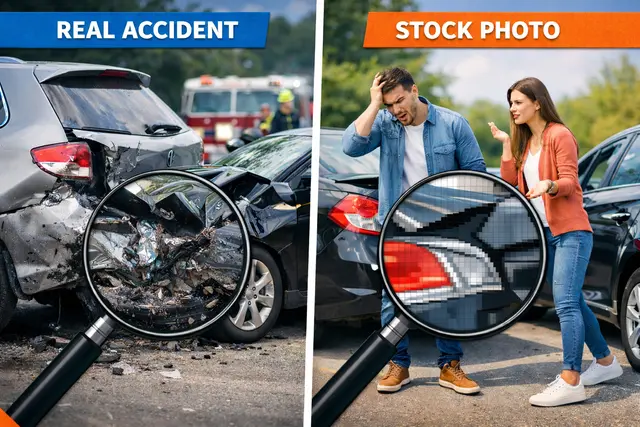
Insurance is probably the worst hit. We're not talking about small potatoes here — Forbes Advisor puts the annual cost of insurance fraud in the US at a staggering $308.6 billion. Let that sink in for a moment. That's more than the GDP of most countries, vanishing into thin air every single year.
And guess what? A huge chunk of that fraud involves images.
The Shift to Digital Claims Changed Everything
Remember when filing an insurance claim meant driving to an office, filling out paperwork, and maybe having an adjuster come inspect the damage in person? Those days are mostly gone. Now everything happens online — snap a photo of your dented bumper or water-damaged ceiling, upload it, and wait for your check.
Convenient? Absolutely. But it also opened the floodgates for fraud.
According to data from Verisk, the numbers are eye-opening:
- About 1 in every 100 claim images has suspicious metadata
- 5 out of every 1,000 images show up in multiple unrelated claims
- 1 in 10,000 images are pulled straight from the internet
That last one really gets me. People are literally downloading stock photos of car crashes and submitting them as their own damage. And until recently, it often worked.
What Kind of Fraud Are We Actually Seeing?
Having analyzed thousands of images through Copyseeker's reverse image search API, we've seen the patterns firsthand. Here's what's actually happening out there:
The recyclers — These folks find an image that worked once and just keep using it. Same photo of a broken window gets submitted to three different insurers over two years. Without cross-referencing, nobody catches it.
The stock photo gamers — Why fake damage when you can download a professional photo of it? A quick search through any major image database pulls up thousands of high-quality damage photos. Some fraudsters don't even bother removing the watermarks.
The editors — Got a small scratch? Photoshop can make it look like you drove through a war zone. These manipulated images add fake damage, change dates, or combine multiple photos into one convincing fake.
The AI artists — This is the newest and most concerning category. Tools like DALL-E and Midjourney can generate remarkably realistic images of property damage that never existed. Innoveo reports that these synthetic images are fooling traditional visual inspection methods.
Why Should Anyone Care?
Here's the thing that frustrates us most about insurance fraud: honest people pay for it. Every fraudulent claim that gets paid out eventually shows up in higher premiums for everyone else.
The FBI estimates the average American family pays an extra $400 to $700 per year in insurance premiums just to cover fraud losses. That's money straight out of your pocket because someone else decided to game the system.
The Coalition Against Insurance Fraud found that roughly 10% of all property and casualty claims contain some element of fraud. One in ten. Think about that the next time you file a legitimate claim and wonder why your rates keep climbing.
How Reverse Image Search Actually Helps
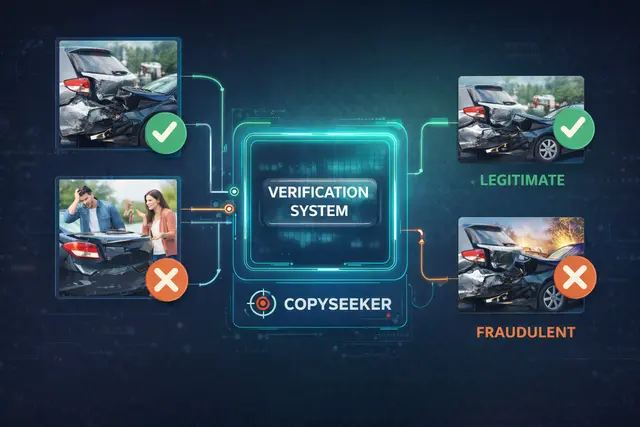
So what can actually be done about this? This is where we get excited, because image verification technology has become remarkably effective at catching fraud that would otherwise slip through.
When an insurance company runs a claim image through a reverse image search tool like Copyseeker, several things happen almost instantly:
Stock photo detection — If that "damage photo" appears on Shutterstock or Getty Images, the jig is up. We've caught claims where the submitted image was literally the first result for "broken car window" on Google.
Duplicate detection — Cross-referencing against databases of previously submitted claims reveals serial fraudsters who recycle the same evidence. This is where having access to large image databases becomes crucial.
Timeline verification — If the "accident photo" was posted to someone's social media account two years before the supposed incident, that's a problem. Image metadata and web presence can establish when photos actually entered circulation.
Source tracking — Understanding where an image originally came from provides context. A "roof damage" photo that traces back to a news article about a storm in another state tells investigators everything they need to know.
What Smart Companies Are Doing
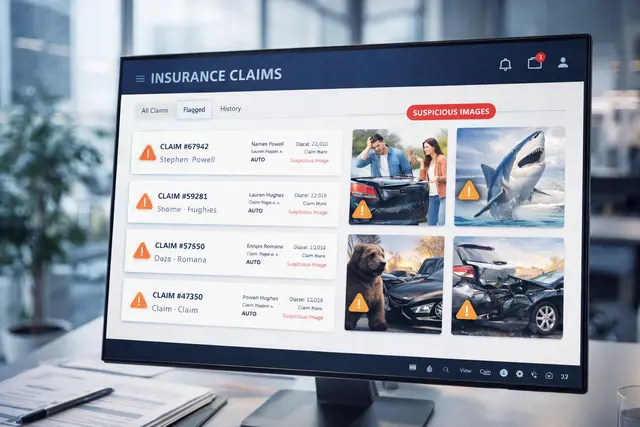
The insurance industry is waking up to this threat. According to Deloitte research, AI-driven fraud detection could save insurers up to $160 billion through 2032. That's serious money, and it's driving serious investment.
The companies getting ahead of this problem share a few common approaches:
Screening at intake — Rather than waiting until a claim looks suspicious, forward-thinking insurers run every submitted image through verification at the moment of upload. Catches problems before they become expensive.
Layered verification — No single technique catches everything. Combining reverse image search with metadata analysis, AI-generated content detection, and duplicate checking creates multiple lines of defense.
Building institutional memory — Images flagged from previous claims get added to internal databases. Over time, patterns em
erge that reveal organized fraud rings, not just individual bad actors.
Speed matters — Legitimate claimants shouldn't wait longer because fraudsters exist. Good verification systems work in seconds, not days.
The Practical Reality
We talk to a lot of businesses about image verification, and the conversation usually starts the same way: "We think we might have a fraud problem, but we're not sure how bad it is."
Here's what we tell them: if you're processing image-based claims or submissions and you're not running verification, you almost certainly have a fraud problem. The question is just how much it's costing you.
The good news is that implementing basic image verification isn't the massive undertaking it used to be. Modern APIs like Copyseeker can integrate directly into existing claims management systems. The technology does the heavy lifting — flagging suspicious submissions for human review while letting legitimate claims flow through normally.
For most organizations, the ROI is obvious within months. Catching even a handful of fraudulent claims pays for the verification system many times over.
Looking Ahead
Insurance fraud isn't going away. If anything, advances in AI are making it easier for bad actors to create convincing fakes. The industry is playing catch-up, and the stakes keep getting higher.
But the tools to fight back are improving too. Between reverse image search, AI-generated content detection, and sophisticated metadata analysis, insurers have more weapons than ever to protect themselves and their honest customers.
The companies that invest in these technologies now will come out ahead. The ones that don't will keep paying for fraud they never even knew existed.
