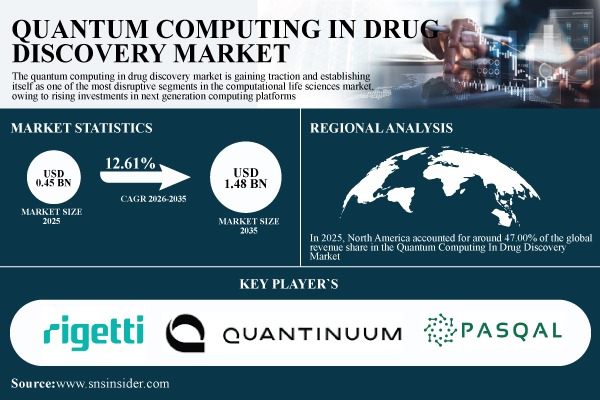
Austin, United States, June 29, 2026 (GLOBE NEWSWIRE) -- The Quantum Computing in Drug Discovery Market Size was valued at USD 0.45 Billion in 2025 and is projected to reach USD 1.48 Billion by 2035, growing at a CAGR of 12.61% during 2026–2035, according to SNS Insider. Increasing adoption of quantum computing platforms, AI-driven molecular modeling, and pharmaceutical R&D investments are accelerating market growth worldwide.
Get a Sample Copy of the Quantum Computing In Drug Discovery Market Report 2026–2035 @ https://www.snsinsider.com/sample-request/10497
Hybrid Quantum-Classical Architectures and Quantum-as-a-Service Platforms to Augment Market Expansion Globally
Hybrid quantum-classical computing architectures and cloud-based Quantum-as-a-Service platforms will drive exceptional market growth in the coming years. Hybrid models allow pharmaceutical companies to combine classical high-performance computing and quantum technologies, lowering the barriers to investment in infrastructure. As quantum ecosystems mature and scalable QaaS becomes available, adoption will quickly expand to pharmaceutical companies, biotech organisations and research institutions around the world, with AI-quantum integration enabling faster molecular simulations, better candidate selection and new therapeutic development.
Leading Market Players Listed in this Report are:
- IBM Corporation
- Google LLC (Quantum AI)
- Microsoft Corporation
- Amazon Web Services, Inc.
- D-Wave Quantum Inc.
- IonQ, Inc.
- Rigetti Computing, Inc.
- Quantinuum Ltd.
- Pasqal SAS
- Xanadu Quantum Technologies Inc.
- Zapata AI, Inc.
- QC Ware Corp.
- Classiq Technologies Ltd.
- QunaSys Inc.
- ProteinQure Inc.
- Menten AI, Inc.
- Polaris Quantum Biotech LLC
- C12 Quantum Electronics GmbH
- Riverlane Ltd.
- Oxford Quantum Circuits Ltd.
Quantum Computing in Drug Discovery Market Regional Analysis
North America held a 47.00% share of the global quantum computing in drug discovery market in 2025. This is due to the presence of leading quantum computing hardware vendors, cloud service providers, pharmaceutical companies and government supported quantum research programme. Heavy venture capital investments and technology-life science collaborations will make the region the largest market for commercial quantum computing deployment in pharmaceuticals by 2035.
The U.S. Quantum Computing in Drug Discovery Market size was valued at USD 0.20 Billion in 2025 and is expected to reach USD 0.58 Billion by 2035, at a CAGR of 11.08% during the forecast period. The country has the largest share in North America owing to the presence of major pharmaceutical and quantum computing companies, government research agencies and increasing investment in quantum chemistry software, molecular design tools and cloud enabled quantum platforms that are accelerating drug discovery activities.
The Europe Quantum Computing in Drug Discovery Market size was valued at USD 0.12 Billion in 2025 and is projected to reach USD 0.36 Billion by 2035, at a CAGR of 11.60% during 2026-2035. Germany, UK, France, Switzerland and Netherlands support the European market through strong pharma R&D investments and quantum tech programmes. Government-sponsored quantum initiatives and academia-industry collaborations are driving molecular modelling, quantum chemistry simulation and precision medicine research applications across the region.
Asia Pacific is the fastest growing regional market with a CAGR of 17.27% during 2026-2035 due to increasing investments in quantum technology infrastructure and pharmaceutical R&D in China, Japan, South Korea, India and Singapore. Biotech ecosystems are expanding, precision medicine initiatives are taking root, and technology vendors are collaborating with drug makers on quantum-AI molecular research, driving strong commercial growth momentum through 2035.
Quantum Computing in Drug Discovery Market Segmentation
By Technology
The quantum software platforms accounted for the highest market share with 26.00% revenue in 2025, attributed to the high demand for molecular simulation software, quantum chemistry tools, and workflow integration platforms among pharmaceutical and biotechnology companies. Quantum software platforms are also anticipated to witness the highest CAGR of 14.74% during 2026–2035 owing to rapid advancements in quantum algorithm development, increasing cloud quantum resource availability and expanding pharmaceutical experimentation with quantum-based molecular design techniques worldwide.
By Deployment Model
Cloud-based quantum computing held the largest share with 48.00% revenue in 2025, driven by pharmaceutical firms preferring scalable, flexible quantum access without costly on-premise infrastructure investment. Cloud-based quantum computing is also expected to register the highest CAGR of 14.36% during 2026–2035, driven by growing commercialization of Quantum-as-a-Service solutions, improved cloud security frameworks, and rising partnerships between quantum cloud providers and pharmaceutical firms accelerating molecular simulation and drug discovery research globally.
By Application
Molecular simulation & quantum chemistry dominated the market and accounted for 29.00% revenue in 2025, owing to the quantum computing technology’s enhanced precision in simulating molecular behaviour and chemical properties as compared to classical systems. Target identification & validation is projected to witness the highest CAGR of 13.36% from 2026 to 2035, owing to rising adoption of quantum computing, AI analytics, and genomic tools in early-stage drug development and growing demand for precision medicine and personalised therapeutic solutions across the globe.
By End User
Pharmaceutical companies held the largest share with 34.00% revenue in 2025 and are also expected to register the highest CAGR of 13.09% during 2026–2035, driven by sustained investment in quantum-assisted molecular simulation, AI-driven drug candidate optimization, and expanding quantum chemistry research infrastructure supporting accelerated biologics and therapeutic discovery pipelines across global pharmaceutical organizations.
Recent Developments in the Quantum Computing in Drug Discovery Market
- 2026: IBM Quantum expanded collaborations with pharmaceutical and life science organizations to advance quantum chemistry simulations, molecular interaction modeling, and hybrid quantum-classical drug discovery workflows through cloud-accessible infrastructure.
- 2026: Google Quantum AI continued enhancing quantum algorithm capabilities focused on molecular simulation, optimization, and computational chemistry applications supporting future pharmaceutical research initiatives globally.
Purchase the Quantum Computing In Drug Discovery Market Report with Detailed Competitive Analysis and Forecast to 2035 @ https://www.snsinsider.com/checkout/10497
Exclusive Sections of the Report (The USPs):
- QUANTUM HARDWARE & SOFTWARE PLATFORM PERFORMANCE METRICS – helps you understand adoption trends across quantum software platforms and algorithm efficiency across pharmaceutical and biotechnology deployments globally.
- MOLECULAR SIMULATION & QUANTUM CHEMISTRY METRICS – helps you evaluate quantum-enabled molecular simulation investment trends and specialist quantum computing provider competitive positioning across global drug discovery markets.
- HYBRID QUANTUM-CLASSICAL COMPUTING ADOPTION METRICS – helps you analyze hybrid quantum-classical architecture deployment and AI-quantum convergence platform adoption across diverse pharmaceutical and life science industry verticals globally.
- QUANTUM-AS-A-SERVICE & CLOUD DEPLOYMENT METRICS – helps you uncover growth in QaaS platform adoption, on-premise to cloud quantum workload migration patterns and enterprise flexibility-driven quantum deployment architecture preferences across global pharmaceutical research organizations.
- REGULATORY COMPLIANCE & QUANTUM RESEARCH INVESTMENT METRICS – helps you identify growth opportunities in government-backed quantum research funding and regulatory framework evolution driving quantum computing adoption across pharmaceutical and biotechnology research verticals globally.
- COMPETITIVE LANDSCAPE & QUANTUM DRUG DISCOVERY EXPANSION METRICS – helps you gauge the competitive strength of key market players based on quantum algorithm investment scale and pharmaceutical partnership development globally.
Quantum Computing in Drug Discovery Market Report Scope & Forecast
| Report Attributes | Details |
| Market Size in 2025 | USD 0.45 Billion |
| Market Size by 2035 | USD 1.48 Billion |
| CAGR | CAGR of12.61% From 2026 to 2035 |
| Base Year | 2025 |
| Forecast Period | 2026-2035 |
| Historical Data | 2022-2024 |
| Key Segments | • By Technology (Quantum Hardware Platforms, Quantum Software Platforms, Quantum Algorithms, Hybrid Quantum-Classical Computing, Quantum Cloud Services) • By Deployment Model (Cloud-Based Quantum Computing, On-Premise Quantum Infrastructure, Hybrid Quantum-Classical Platforms, Quantum-as-a-Service (QaaS)) • By Application (Target Identification & Validation, Molecular Simulation & Quantum Chemistry, Lead Discovery & Optimization, Protein Folding & Biomolecular Modeling, ADMET Prediction) • By End User (Pharmaceutical Companies, Biotechnology Companies, Contract Research Organizations (CROs), Academic & Research Institutions, Others) |
| Regional Analysis/Coverage | North America (US, Canada), Europe (Germany, UK, France, Italy, Spain, Russia, Poland, Rest of Europe), Asia Pacific (China, India, Japan, South Korea, Australia, ASEAN Countries, Rest of Asia Pacific), Middle East & Africa (UAE, Saudi Arabia, Qatar, South Africa, Rest of Middle East & Africa), Latin America (Brazil, Argentina, Mexico, Colombia, Rest of Latin America). |
Related Reports
Artificial Intelligence in Drug Discovery Market Size, 2026
Drug Discovery Market Analysis, 2026
Drug Discovery Informatics Market Trends, 2026
About Us:
SNS Insider is one of the leading market research and consulting agencies that dominates the market research industry globally. Our company's aim is to give clients the knowledge they require in order to function in changing circumstances. In order to give you current, accurate market data, consumer insights, and opinions so that you can make decisions with confidence, we employ a variety of techniques, including surveys, video talks, and focus groups around the world.
