Source: Research and Markets
Pink Hydrogen Global Strategic Business Report 2025: Nuclear Decarbonization Initiatives Throw the Spotlight on Pink Hydrogen as a Low-Emission Fuel
Pink hydrogen offers significant market opportunities by leveraging nuclear energy for stable, efficient hydrogen production. Key growth is expected in countries with strong nuclear infrastructure like France, U.S., and Canada, and in sectors like steel-making and heavy transport. It addresses grid stability and carbon neutrality while advancing hydrogen diversification.
Dublin, Aug. 04, 2025 (GLOBE NEWSWIRE) -- The "Pink Hydrogen - Global Strategic Business Report" has been added to ResearchAndMarkets.com's offering.
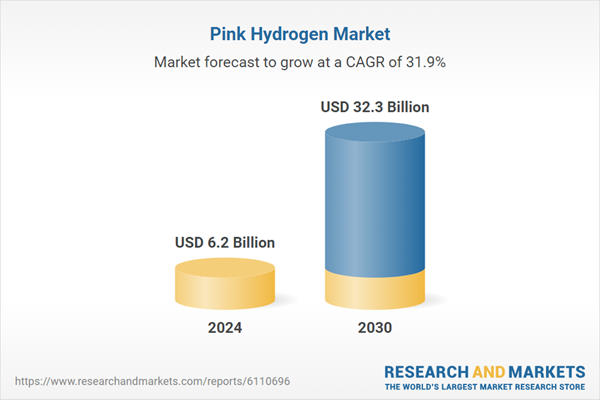
The global market for Pink Hydrogen was valued at US$6.2 Billion in 2024 and is projected to reach US$32.3 Billion by 2030, growing at a CAGR of 31.9% from 2024 to 2030.
Why Is Pink Hydrogen Emerging as a Strategic Link Between Nuclear Energy and Decarbonized Hydrogen Production?
Pink hydrogen-produced via electrolysis powered by nuclear energy-has emerged as a strategically vital subsegment of the clean hydrogen economy. Unlike green hydrogen, which is generated using renewable sources like wind or solar, pink hydrogen leverages nuclear power's consistent baseload generation to operate electrolysis units at stable, high efficiency. This positioning makes pink hydrogen particularly valuable in energy systems where nuclear capacity is significant and grid stability is a priority.
With hydrogen being increasingly recognized as a cornerstone for decarbonizing hard-to-abate sectors such as steelmaking, heavy transportation, refining, and chemical manufacturing, pink hydrogen offers an advantage in scalability, reliability, and carbon neutrality. It provides a clean hydrogen pathway with minimal land footprint and without the intermittency challenges associated with solar or wind. In countries like France, the United States, Russia, and Canada, where nuclear power already contributes significantly to the national energy mix, pink hydrogen is gaining institutional and commercial support as a complementary route to green and blue hydrogen.
Furthermore, pink hydrogen production can be aligned with off-peak nuclear power generation, optimizing reactor utilization and enhancing grid balancing. The dual benefit of decarbonizing hydrogen while improving nuclear asset economics is creating a powerful policy and market case for pink hydrogen. With global hydrogen demand expected to multiply by 2050 under net-zero scenarios, pink hydrogen is becoming a critical vector in national hydrogen roadmaps.
Which Countries and Sectors Are Likely to Drive Pink Hydrogen Adoption?
Pink hydrogen adoption is likely to be concentrated in countries with strong nuclear infrastructure and decarbonization mandates. France, with its heavy reliance on nuclear power, has positioned pink hydrogen as a pillar in its national hydrogen strategy. Its integration into industrial clusters-particularly in steel, chemicals, and transport-is being actively promoted through public-private partnerships. Canada, with its CANDU reactors and hydrogen innovation clusters, is similarly poised to become a pink hydrogen hub.
In the U.S., states like Illinois and Pennsylvania are exploring pink hydrogen pilot programs leveraging existing nuclear power plants. The Bipartisan Infrastructure Law and the Inflation Reduction Act have introduced incentives and grants for clean hydrogen projects, explicitly including nuclear-powered electrolysis. In Japan and South Korea, pink hydrogen is under evaluation for its role in hydrogen-based mobility, including fuel cell vehicles and hydrogen-powered trains.
Industrially, sectors that demand high-purity hydrogen and operate near nuclear plants-such as ammonia production, oil refining, and specialty chemicals-are expected to be early adopters. Steelmakers are also looking into pink hydrogen for replacing coking coal in direct reduced iron (DRI) processes. Given that pink hydrogen does not rely on variable renewables, it offers an operationally consistent solution for high-load, high-uptime industrial applications.
What Is Driving Growth in the Global Pink Hydrogen Market?
The growth in the global pink hydrogen market is driven by increasing focus on full-spectrum hydrogen diversification, rising investments in nuclear innovation, and policy incentives promoting low-carbon hydrogen production. As governments and industries move toward net-zero emissions targets, pink hydrogen is emerging as a pragmatic solution where nuclear energy is already a dominant or growing part of the grid.
The capacity to produce hydrogen at scale using stable, non-intermittent energy sources addresses a critical limitation of green hydrogen. Coupled with improvements in electrolysis efficiency and modularization, pink hydrogen is gaining momentum as part of multi-vector energy transition strategies. Infrastructure investments, carbon pricing mechanisms, and clean hydrogen tax credits are improving its financial viability relative to grey and blue hydrogen alternatives.
Moreover, international collaboration in nuclear-hydrogen integration-such as joint R&D between Europe, North America, and East Asia-is creating pathways for knowledge transfer and shared infrastructure. As public opinion shifts toward recognizing nuclear energy's role in climate mitigation, pink hydrogen stands to benefit from regulatory alignment, project de-risking, and global demand for decarbonized fuels. With rising global momentum, pink hydrogen is poised to secure a key position in the evolving hydrogen economy.
Key Insights:
- Market Growth: Understand the significant growth trajectory of the Liquid Form segment, which is expected to reach US$25.1 Billion by 2030 with a CAGR of a 33.7%. The Gas Form segment is also set to grow at 26.6% CAGR over the analysis period.
- Regional Analysis: Gain insights into the U.S. market, valued at $1.6 Billion in 2024, and China, forecasted to grow at an impressive 30.1% CAGR to reach $4.8 Billion by 2030. Discover growth trends in other key regions, including Japan, Canada, Germany, and the Asia-Pacific.
Report Features:
- Comprehensive Market Data: Independent analysis of annual sales and market forecasts in US$ Million from 2024 to 2030.
- In-Depth Regional Analysis: Detailed insights into key markets, including the U.S., China, Japan, Canada, Europe, Asia-Pacific, Latin America, Middle East, and Africa.
- Company Profiles: Coverage of players such as Air Liquide, Air Products and Chemicals Inc., Constellation Energy Group, Exelon Corporation, GE Hitachi Nuclear Energy and more.
This edition integrates the latest global trade and economic shifts into comprehensive market analysis.
Key updates include:
- Tariff and Trade Impact: Insights into global tariff negotiations across 180+ countries, with analysis of supply chain turbulence, sourcing disruptions, and geographic realignment. Special focus on 2025 as a pivotal year for trade tensions, including updated perspectives on the Trump-era tariffs.
- Adjusted Forecasts and Analytics: Revised global and regional market forecasts through 2030, incorporating tariff effects, economic uncertainty, and structural changes in globalization. Includes historical analysis from 2015 to 2023.
- Strategic Market Dynamics: Evaluation of revised market prospects, regional outlooks, and key economic indicators such as population and urbanization trends.
- Innovation & Technology Trends: Latest developments in product and process innovation, emerging technologies, and key industry drivers shaping the competitive landscape.
- Competitive Intelligence: Updated global market share estimates for 2025 (E), competitive positioning of major players (Strong/Active/Niche/Trivial), and refined focus on leading global brands and core players.
- Expert Insight & Commentary: Strategic analysis from economists, trade experts, and domain specialists to contextualize market shifts and identify emerging opportunities.
Key Attributes:
| Report Attribute | Details |
| No. of Pages | 139 |
| Forecast Period | 2024 - 2030 |
| Estimated Market Value (USD) in 2024 | $6.2 Billion |
| Forecasted Market Value (USD) by 2030 | $32.3 Billion |
| Compound Annual Growth Rate | 31.9% |
| Regions Covered | Global |
Key Topics Covered:
MARKET OVERVIEW
- World Market Trajectories
- Tariff Impact on Global Supply Chain Patterns
- Pink Hydrogen - Global Key Competitors Percentage Market Share in 2025
- Competitive Market Presence - Strong/Active/Niche/Trivial for Players Worldwide in 2025
MARKET TRENDS & DRIVERS
- Nuclear Decarbonization Initiatives Throw the Spotlight on Pink Hydrogen as a Low-Emission Fuel
- Government Investments in Hydrogen Economy Strategies Propel Nuclear-Electrolytic Hydrogen Production
- Integration of Electrolyzers With Nuclear Plants Expands Feasibility of 24/7 Hydrogen Generation
- Need for Baseload Low-Carbon Hydrogen Sources Strengthens Business Case for Pink Hydrogen
- Development of High-Temperature Electrolysis (HTE) Systems Enhances Energy Efficiency
- Strategic Focus on Energy Diversification in Net-Zero Plans Accelerates Pink Hydrogen Research
- Global Push for Energy Security Spurs Investment in Domestic Hydrogen Production Routes
- Rising Demand for Green Industrial Feedstocks Expands Use Cases for Pink Hydrogen in Steel and Chemicals
- Nuclear Plant Life Extension Programs Create Long-Term Stability for Hydrogen Co-Production
- Technology Neutral Hydrogen Roadmaps in North America and Europe Support Pink Hydrogen Parity
- Stakeholder Debate Over Color Taxonomy Promotes Awareness and Differentiation of Hydrogen Types
- Collaborations Between Utility Providers and Electrolyzer OEMs Accelerate Pilot Project Deployments
- International Climate Finance Mechanisms Begin to Recognize Nuclear-Linked Hydrogen as Zero-Carbon
- Expansion of Hydrogen Hubs and Multi-Carrier Infrastructure Supports Scalability of Pink Hydrogen
- Need for Grid Flexibility and Curtailment Mitigation Promotes Hydrogen as Storage for Nuclear Output
- Public Sentiment and Policy Debate Over Nuclear Power Impact Long-Term Pink Hydrogen Acceptance
- Fuel Cell Adoption in Rail and Maritime Transport Generates Demand for Scalable Hydrogen Supply
- Rising Electrolyzer Efficiency and Cost Declines Improve LCOH Metrics for Nuclear-Sourced Hydrogen
- Cross-Border Hydrogen Trade Agreements Stimulate Demand for Technology-Agnostic Hydrogen Supply
- Decentralization of Hydrogen Production Supports Co-Siting With Advanced Modular Reactors (SMRs)
FOCUS ON SELECT PLAYERS
Some of the 37 companies featured in this Pink Hydrogen market report include:
- Air Liquide
- Air Products and Chemicals Inc.
- Constellation Energy Group
- Exelon Corporation
- GE Hitachi Nuclear Energy
- Hydrogen Systems (Denmark)
- Iberdrola SA
- ITM Power plc
- Linde Plc
- Nel ASA
- NuScale Power
- OKG Aktiebolag
- Plug Power Inc.
- Rolls-Royce Holdings plc
- Sembcorp Industries
- SGH2 Energy
- Siemens Energy
- SK Ecoplant
- Toshiba Corporation
- Toshiba Energy Systems & Solutions Corp.
For more information about this report visit https://www.researchandmarkets.com/r/r1tx68
About ResearchAndMarkets.com
ResearchAndMarkets.com is the world's leading source for international market research reports and market data. We provide you with the latest data on international and regional markets, key industries, the top companies, new products and the latest trends.
Attachment
