Source: DelveInsight Business Research LLP
Vitiligo Clinical Trial Pipeline Accelerates as 18+ Pharma Companies Rigorously Develop Drugs for Market Entry | DelveInsight
The vitiligo treatment landscape is evolving with a shift towards targeted therapies, which have shown encouraging results in promoting repigmentation. Current pipeline developments reflect a move beyond conventional options like corticosteroids and phototherapy. With significant unmet medical needs and increasing disease awareness, emerging therapies have the potential to transform the standard of care.
New York, USA, Aug. 14, 2025 (GLOBE NEWSWIRE) -- Vitiligo Clinical Trial Pipeline Accelerates as 18+ Pharma Companies Rigorously Develop Drugs for Market Entry | DelveInsight
The vitiligo treatment landscape is evolving with a shift towards targeted therapies, which have shown encouraging results in promoting repigmentation. Current pipeline developments reflect a move beyond conventional options like corticosteroids and phototherapy. With significant unmet medical needs and increasing disease awareness, emerging therapies have the potential to transform the standard of care.
DelveInsight’s 'Vitiligo Pipeline Insight 2025' report provides comprehensive global coverage of pipeline vitiligo therapies in various stages of clinical development, major pharmaceutical companies are working to advance the pipeline space and future growth potential of the vitiligo pipeline domain.
Key Takeaways from the Vitiligo Pipeline Report
- DelveInsight’s vitiligo pipeline report depicts a robust space with 18+ active players working to develop 20+ pipeline vitiligo drugs.
- Key vitiligo companies such as Vyne Therapeutics Inc., AbbVie, Teva Branded Pharmaceutical Products R&D, Inc., Pfizer, Incyte Corporation, Merck Sharp & Dohme LLC, Forte Biosciences, Dren Bio, Edesa Biotech, Suzhou Zelgen Biopharmaceuticals Co., Ltd., Genrix (Shanghai) Biopharmaceuticals, Odyssey Therapeutics, Clinuvel, and others are evaluating new vitiligo drugs to improve the treatment landscape.
- Promising pipeline vitiligo therapies, such as VYN201, Upadacitinib, TEV-53408, Ritlecitinib, Povorcitinib, MK-6194, FB102, DR-01, EB06, Gecacitinib, GR2301, OD-00910, Afamelanotide, and others, are in different phases of vitiligo clinical trials.
- In May 2025, CLINUVEL met its recruitment target in its Phase III trial (CUV105) of SCENESSE® (afamelanotide 16mg) in vitiligo, with more than 200 patients enrolled. The last patient to enter the study is scheduled to complete screening in May 2025. First results from the study are expected in the second half of 2026.
- In May 2025, VYNE Therapeutics announced its financial results as of and for the quarter ended March 31, 2025, and provided a business update, including that top-line results from the Phase IIb trial for the treatment of vitiligo are expected in mid-2025.
- In May 2025, Edesa Biotech announced the completion of a USD 15 million equity financing from healthcare-focused institutional investors, existing Edesa shareholders, and insiders to support the development of the company’s vitiligo drug candidate EB06, anti-CXCL10 monoclonal antibody. The company has subsequently initiated outreach to potential investigators and manufacturing-related activities to support the US regulatory approval for a Phase 2 study in moderate-to-severe nonsegmental vitiligo patients.
- In May 2025, Forte Biosciences announced that they have dosed the first patient in the FB102 vitiligo trial.
- In March 2025, AbbVie presented new findings on Upadacitinib’s effects in nonsegmental vitiligo through a biomarker-driven approach at the 2025 American Academy of Dermatology (AAD) annual meeting.
- In January 2025, VYNE Therapeutics, a clinical-stage biopharmaceutical company focused on developing differentiated therapies to treat chronic inflammatory and immune-mediated conditions with high unmet need, announced completion of enrollment in the Phase IIb trial evaluating VYN201 gel for the treatment of nonsegmental vitiligo.
Request a sample and discover the recent advances in vitiligo drugs @ Vitiligo Pipeline Report
The vitiligo pipeline report provides detailed profiles of pipeline assets, a comparative analysis of clinical and non-clinical stage vitiligo drugs, inactive and dormant assets, a comprehensive assessment of driving and restraining factors, and an assessment of opportunities and risks in the vitiligo clinical trial landscape.
Vitiligo Overview
Vitiligo is a non-contagious skin condition marked by the progressive loss of melanocytes—the cells responsible for skin pigmentation, leading to distinct, well-demarcated white patches or macules. These depigmented areas often manifest symmetrically and are especially noticeable in individuals with darker skin. The disorder frequently coexists with autoimmune diseases, most notably thyroid abnormalities. Lesions often first appear on the face, hands, feet, or in regions prone to friction or trauma, and may follow the Koebner phenomenon. Clinical subtypes include trichrome, inflammatory, and segmental variants. Though the exact underlying cause remains unclear, the disease’s unpredictable progression and psychosocial burden can substantially affect patients’ quality of life.
Vitiligo typically presents as pale or milky-white patches that contrast sharply with unaffected skin. These patches commonly emerge in sun-exposed areas, around body orifices, and within the mouth and nose. Hair growing from these regions may also lose pigment, turning white or gray. In some instances, depigmentation extends to the mucous membranes, including the lips, nose, and genitals. Although the condition is generally painless, some individuals may experience itching, redness, or minor alterations in eye color. The disease tends to evolve over time, with the size and number of patches increasing, and the severity varying greatly between individuals.
Considered a multifactorial polygenic disorder, vitiligo involves a combination of genetic and environmental influences that lead to the gradual destruction of melanocytes. Several mechanisms have been proposed, including autoimmune activity, cytotoxic responses, inherent melanocyte vulnerabilities, neural factors, and oxidative stress. For example, neurochemical substances may damage melanocytes, oxidative stress can impair pigment production pathways, and autoimmune processes may prompt the immune system to target these cells. Among these, autoimmune dysfunction is most prominently linked to vitiligo, especially the non-segmental type, which is frequently associated with other autoimmune conditions such as thyroid disease.
Treatment options for vitiligo are diverse and tailored to the disease extent and stability. Common approaches include topical therapies, such as corticosteroids, calcineurin inhibitors, and vitamin D analogs, especially in mild or early-stage cases. Narrowband UV-B phototherapy (311–312 nm) is now a mainstay for repigmentation, offering fewer side effects compared to psoralen UVA therapy. The excimer laser is useful for treating small, stable lesions, while combination therapies like tacrolimus with oral corticosteroids are considered for stubborn segmental cases. Newer treatments under investigation, including afamelanotide and JAK inhibitors like topical ruxolitinib, have shown encouraging outcomes. Surgical techniques such as punch grafts and epidermal cell suspensions are typically reserved for stable, localized patches, especially in areas that respond poorly to conventional therapy, such as the fingers, forehead, and ankles.
Find out more about vitiligo treatment market @ Vitiligo Treatment
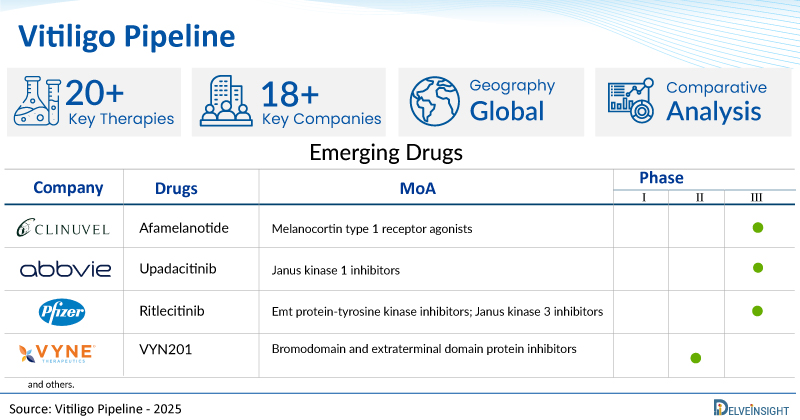
A snapshot of the Pipeline Vitiligo Drugs mentioned in the report:
| Drugs | Company | Phase | MoA | RoA |
| Afamelanotide | Clinuvel, Inc. | III | Melanocortin type 1 receptor agonists | Subcutaneous |
| Upadacitinib | AbbVie | III | Janus kinase 1 inhibitors | Oral |
| Ritlecitinib | Pfizer | III | Emt protein-tyrosine kinase inhibitors; Janus kinase 3 inhibitors | Oral |
| VYN201 | Vyne Therapeutics Inc. | II | Bromodomain and extraterminal domain protein inhibitors | Topical |
| FB102 | Forte Biosciences, Inc. | I | Interleukin-2 receptor beta subunit antagonists | Intravenous |
| TEV-53408 | Teva Pharmaceutical Industries | I | Interleukin 15 inhibitors | Subcutaneous |
Learn more about the emerging vitiligo therapies @ Vitiligo Clinical Trials
Vitiligo Therapeutics Assessment
The vitiligo pipeline report proffers an integral view of the emerging Vitiligo therapies segmented by stage, product type, molecule type, route of administration, and mechanism of action.
Scope of the Vitiligo Pipeline Report
- Coverage: Global
- Therapeutic Assessment By Product Type: Mono, Combination, Mono/Combination
- Therapeutic Assessment By Clinical Stages: Discovery, Pre-clinical, Phase I, Phase II, Phase III
- Therapeutics Assessment By Route of Administration: Oral, Intravenous, Subcutaneous, Parenteral, Topical
- Therapeutics Assessment By Molecule Type: Recombinant fusion proteins, Small molecule, Monoclonal antibody, Peptide, Polymer, Gene therapy
- Therapeutics Assessment By Mechanism of Action: Melanocortin type 1 receptor agonists, Bromodomain and extraterminal domain protein inhibitors, Interleukin-2 receptor beta subunit antagonists, Janus kinase 1 inhibitors, Interleukin 15 inhibitors, Emt protein-tyrosine kinase inhibitors; Janus kinase 3 inhibitors
- Key Vitiligo Companies: Vyne Therapeutics Inc., AbbVie, Teva Branded Pharmaceutical Products R&D, Inc., Pfizer, Incyte Corporation, Merck Sharp & Dohme LLC, Forte Biosciences, Dren Bio, Edesa Biotech, Suzhou Zelgen Biopharmaceuticals Co., Ltd., Genrix (Shanghai) Biopharmaceuticals, Clinuvel, and others.
- Key Vitiligo Pipeline Therapies: VYN201, Upadacitinib, TEV-53408, Ritlecitinib, Povorcitinib, MK-6194, FB102, DR-01, EB06, Gecacitinib, GR2301, Afamelanotide, and others.
Dive deep into rich insights for new vitiligo treatments, visit @ Vitiligo Drugs
Table of Contents
| 1. | Vitiligo Pipeline Report Introduction |
| 2. | Vitiligo Pipeline Report Executive Summary |
| 3. | Vitiligo Pipeline: Overview |
| 4. | Analytical Perspective In-depth Commercial Assessment |
| 5. | Vitiligo Clinical Trial Therapeutics |
| 6. | Vitiligo Pipeline: Late-Stage Products (Pre-registration) |
| 7. | Vitiligo Pipeline: Late-Stage Products (Phase III) |
| 8. | Vitiligo Pipeline: Mid-Stage Products (Phase II) |
| 9. | Vitiligo Pipeline: Early-Stage Products (Phase I) |
| 10. | Vitiligo Pipeline Therapeutics Assessment |
| 11. | Inactive Products in the Vitiligo Pipeline |
| 12. | Company-University Collaborations (Licensing/Partnering) Analysis |
| 13. | Key Companies |
| 14. | Key Products in the Vitiligo Pipeline |
| 15. | Unmet Needs |
| 16. | Market Drivers and Barriers |
| 17. | Future Perspectives and Conclusion |
| 18. | Analyst Views |
| 19. | Appendix |
For further information on the vitiligo pipeline therapeutics, reach out @ Vitiligo Treatment Market
Related Reports
Vitiligo Epidemiology Forecast
Vitiligo Epidemiology Forecast – 2034 report delivers an in-depth understanding of the disease, historical and forecasted vitiligo epidemiology in the 7MM, i.e., the United States, EU5 (Germany, Spain, Italy, France, and the United Kingdom), and Japan.
Vitiligo Market Insights, Epidemiology, and Market Forecast – 2034 report delivers an in-depth understanding of the disease, historical and forecasted epidemiology, as well as the market trends, market drivers, market barriers, and key vitiligo companies, including Incyte Corporation, Amgen, Boston Pharmaceuticals, Arcutis Biotherapeutics, Pfizer, Dermavant Sciences, Clinuvel Pharmaceuticals, Celgene, TWi Biotechnology, AXIM Biotechnologies, Arrien Pharmaceuticals, among others.
Atopic Dermatitis Market Insights, Epidemiology, and Market Forecast – 2034 report delivers an in-depth understanding of the disease, historical and forecasted epidemiology, as well as the market trends, market drivers, market barriers, and key atopic dermatitis companies, including Bausch Health Companies Inc., GlaxoSmithKline PLC, Nestle SA, Pfizer Inc., Regeneron Pharmaceuticals Inc., Evelo Biosciences, AbbVie Inc., Allergan PLC, Cara Therapeutics, Bristol-Myers Squibb Company, Sanofi S.A., LEO Pharma, among others.
Psoriasis Market Insights, Epidemiology, and Market Forecast – 2034 report delivers an in-depth understanding of the disease, historical and forecasted epidemiology, as well as the market trends, market drivers, market barriers, and key psoriasis companies, including UCB Pharma, Novartis, Alumis, SFA Therapeutics, Amgen, AbbVie, Can-Fite BioPharma, Johnson & Johnson, among others.
Plaque Psoriasis Market Insights, Epidemiology, and Market Forecast – 2034 report delivers an in-depth understanding of the disease, historical and forecasted epidemiology, as well as the market trends, market drivers, market barriers, and key plaque psoriasis companies, including Dermavant Sciences GmbH, IQVIA Biotech, UCB Biopharma SRL, Parexel, Samsung Bioepis Co., Ltd., Durect, Astellas, Biogen, Dow Pharmaceutical Sciences, Shire, Zalicus, AbbVie, Santalis Pharmaceuticals Inc., Maruho Co. Ltd, Novartis, AstraZeneca, Pfizer, among others.
DelveInsight’s Pharma Competitive Intelligence Service: Through its CI solutions, DelveInsight provides its clients with real-time and actionable intelligence on their competitors and markets of interest to keep them stay ahead of the competition by providing insights into the latest therapeutic area-specific/indication-specific market trends, in emerging drugs, and competitive strategies. These services are tailored to the specific needs of each client and are delivered through a combination of reports, dashboards, and interactive presentations, enabling clients to make informed decisions, mitigate risks, and identify opportunities for growth and expansion.
Other Business Pharmaceutical Consulting Services
Healthcare Conference Coverage
Discover how a mid-pharma client gained a level of confidence in their soon-to-be partner for manufacturing their therapeutics by downloading our Due Diligence Case Study
About DelveInsight
DelveInsight is a leading Business Consultant and Market Research firm focused exclusively on life sciences.
Connect with us at LinkedIn
