Dublin, Nov. 28, 2025 (GLOBE NEWSWIRE) -- The "North America Nucleic Acid Amplification Testing Market Report by Type, Application, End Use, Country and Company Analysis, 2025-2033" report has been added to ResearchAndMarkets.com's offering.
The North America Nucleic Acid Amplification Testing Market is expected to reach US$ 7.64 billion by 2033 from US$ 3.28 billion in 2024, with a CAGR of 9.87% from 2025 to 2033.
The market for nucleic acid amplification testing in North America is anticipated to increase steadily due to rising diagnostic demand, advances in technology, and broad use in clinical, research, and public health applications. The North American market demonstrates robust growth, led by the United States' advanced healthcare infrastructure and Canada's expanding diagnostic ecosystem, with both countries investing heavily in molecular testing innovation and disease surveillance programs.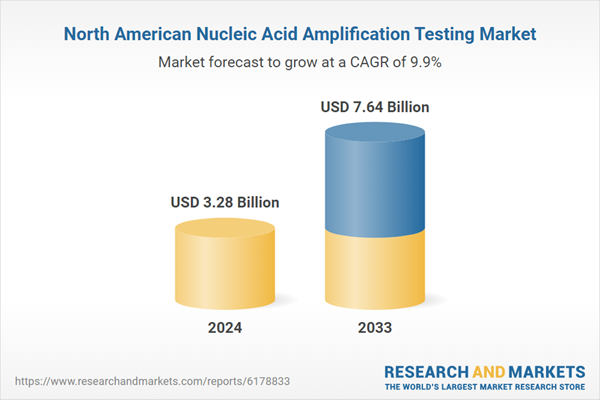
The North America nucleic acid amplification testing (NAAT) industry is witnessing consistent expansion, driven by rising healthcare awareness and the growing need for accurate, rapid molecular diagnostics. NAAT plays a crucial role in identifying infectious diseases, genetic mutations, and oncology biomarkers. Its ability to detect pathogens with high sensitivity and specificity has positioned it as a preferred diagnostic tool across hospitals, laboratories, and research institutions. The region's strong healthcare infrastructure and widespread availability of advanced testing systems have accelerated adoption. Furthermore, ongoing investments in biotechnology and molecular diagnostics continue to foster innovation, expanding NAAT's scope across medical, forensic, and veterinary applications.
Technological progress has significantly enhanced NAAT's efficiency, reliability, and versatility. The introduction of automated platforms, multiplex assays, and portable testing solutions is transforming laboratory workflows and point-of-care diagnostics. The integration of NAAT in personalized medicine and precision oncology further underscores its clinical importance. Governments and private organizations across North America are supporting diagnostic modernization through funding initiatives and regulatory approvals. Additionally, rising awareness of early disease detection and outbreak surveillance has reinforced NAAT's relevance in healthcare strategies. The growing use of real-time PCR and isothermal amplification methods is enhancing throughput while maintaining diagnostic accuracy across a wide range of conditions.
Looking ahead, the North America NAAT market is expected to expand through advancements in assay design, automation, and data integration. However, high testing costs, stringent regulatory frameworks, and supply chain complexities remain key challenges. Efforts to improve affordability, accessibility, and turnaround time are driving collaborations between technology developers, diagnostic laboratories, and healthcare providers. As precision diagnostics and molecular testing continue to shape modern healthcare, NAAT will remain central to clinical decision-making and disease control across the North American region.
Key Factors Driving the North America Nucleic Acid Amplification Testing Market Growth
Rising Demand for Accurate and Rapid Diagnostics
The growing need for precise and rapid diagnostic solutions is a key factor driving the North America NAAT market. With increasing incidences of infectious diseases, genetic disorders, and oncology cases, healthcare providers rely on molecular techniques for early and accurate detection. NAAT offers superior sensitivity compared to conventional methods, enabling identification of low pathogen loads and asymptomatic carriers. Its rapid turnaround time enhances clinical decision-making and infection control.
The growing emphasis on preventive care and personalized medicine has further boosted test utilization across hospitals and laboratories. Moreover, the adoption of point-of-care NAAT devices supports decentralized testing, improving access in remote or high-demand settings. As diagnostic accuracy becomes critical for patient management and public health surveillance, NAAT continues to gain traction as a gold-standard testing solution across North America's healthcare landscape.
Technological Advancements and Automation
Technological innovation and automation are significantly propelling growth in the North America NAAT market. The development of fully automated systems has streamlined workflows, minimized manual errors, and enhanced throughput for high-volume laboratories. Integration of multiplexing capabilities allows simultaneous detection of multiple pathogens, improving testing efficiency and cost-effectiveness. Real-time PCR, digital PCR, and isothermal amplification technologies have expanded the range of diagnostic applications.
Additionally, advancements in reagents, software integration, and cloud-based result management are enhancing accuracy and traceability. Portable and user-friendly devices are also driving adoption in decentralized and field-testing environments. The emphasis on miniaturization and connectivity supports real-time data sharing and surveillance. Continuous innovation, supported by strong R&D investments and regulatory approvals, ensures that automation remains a key enabler of speed, scalability, and reliability in the evolving North American NAAT market.
Increased Focus on Public Health and Disease Surveillance
Growing public health initiatives and the emphasis on early detection are major growth drivers for the North America NAAT market. Governments and health agencies are increasingly deploying molecular diagnostics for outbreak monitoring, pandemic preparedness, and routine surveillance. NAAT's accuracy in detecting emerging and re-emerging pathogens has made it indispensable in managing infectious disease threats. Collaborations between public institutions and private diagnostic companies are strengthening testing capacity and infrastructure.
Furthermore, screening programs for sexually transmitted infections, respiratory illnesses, and genetic conditions are expanding across regional healthcare systems. NAAT's adaptability to high-throughput platforms supports mass testing and real-time reporting, crucial for epidemic control. With policy-level focus on precision healthcare and early intervention, the integration of NAAT into public health frameworks continues to grow. This sustained emphasis on proactive diagnostics ensures long-term market stability and advancement.
Challenges in the North America Nucleic Acid Amplification Testing Market
High Cost of Testing and Equipment
The high cost associated with NAAT remains a major constraint in market expansion across North America. Advanced molecular testing platforms require substantial capital investment, limiting accessibility for smaller laboratories and rural healthcare facilities. The expense of specialized reagents, consumables, and quality control materials adds to overall operational costs. Furthermore, skilled personnel are required to manage and interpret complex assays, increasing training expenditures.
Reimbursement limitations and variability among payers further hinder widespread adoption. Although technological advancements are improving cost-efficiency, price sensitivity continues to influence decision-making in resource-constrained environments. Efforts to develop low-cost assays and portable testing solutions are underway, yet scalability remains a challenge. Addressing affordability while maintaining accuracy and reliability will be essential for ensuring equitable access and broader utilization of nucleic acid amplification testing across North America.
Regulatory Complexity and Standardization Issues
Stringent regulatory frameworks and the lack of standardized testing protocols pose challenges for the North America NAAT market. Diagnostic manufacturers must navigate extensive approval processes from agencies such as the FDA and Health Canada, which can delay product launches and increase compliance costs. Differences in regulatory requirements across countries and states add to operational complexity. Additionally, variability in assay performance and interpretation can affect result consistency, particularly in decentralized or point-of-care settings.
Standardization efforts are ongoing but require alignment between regulators, laboratories, and industry stakeholders. Ensuring data reliability, quality assurance, and interoperability across platforms remains a critical concern. Addressing these issues through harmonized guidelines and validation frameworks is essential to enhance market transparency and foster trust among end-users. Streamlined regulatory pathways will be key to supporting innovation and accelerating adoption in the region.
Key Attributes:
| Report Attribute | Details |
| No. of Pages | 200 |
| Forecast Period | 2024 - 2033 |
| Estimated Market Value (USD) in 2024 | $3.28 Billion |
| Forecasted Market Value (USD) by 2033 | $7.64 Billion |
| Compound Annual Growth Rate | 9.8% |
| Regions Covered | North America |
Company Analysis:
- F. Hoffmann-La Roche Ltd
- Becton, Dickinson and Company
- Danaher Corporation
- Abbott Laboratories
- Illumina, Inc.
- Siemens Healthineers
- bioMerieux SA
- Novartis AG
- Bio-Rad Laboratories, Inc.
- Seegene Inc.
Market Segmentations
Type
- Polymerase Chain Reaction (PCR) Tests
- Isothermal Nucleic Acid Amplification Technology (INAAT) Tests
- Ligase Chain Reaction (LCR) Tests
Application
- Infectious Disease Testing
- Oncology Testing
- Others
End Use
- Central & Reference Laboratories
- Hospitals
- Others
Country
- United States
- Canada
For more information about this report visit https://www.researchandmarkets.com/r/6hkx44
About ResearchAndMarkets.com
ResearchAndMarkets.com is the world's leading source for international market research reports and market data. We provide you with the latest data on international and regional markets, key industries, the top companies, new products and the latest trends.
Attachment
