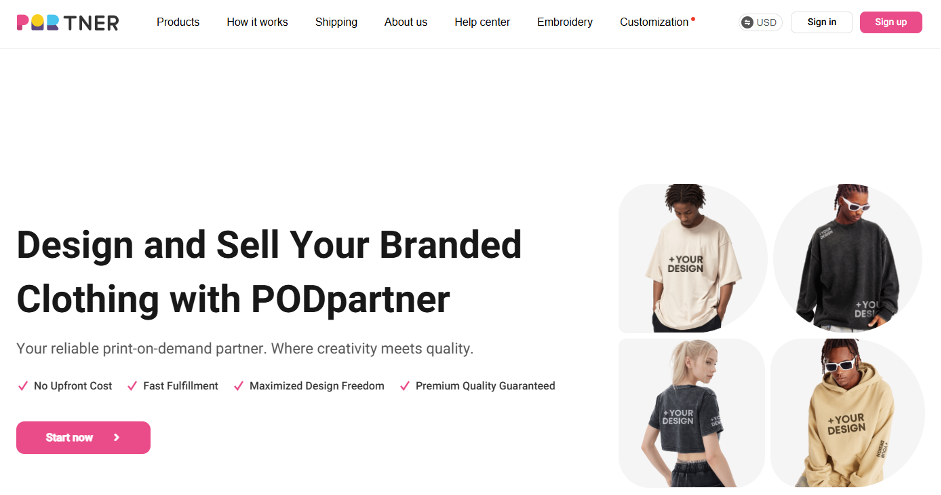
SHENZHEN, China, Dec. 09, 2025 (GLOBE NEWSWIRE) -- PODpartner has enhanced its Shenzhen production operation to give creators the flexibility and control needed to build real fashion brands on demand. For years, designers have asked simple questions like, “Can I print on this part of the garment?” or “Can I mix embroidery with a printed design?” and the industry’s usual reply has been a list of limits. Most POD services restrict print areas, rely on slow workflows or offer only one decoration method per garment. PODpartner’s upgraded facility answers these challenges head-on by widening print coverage, supporting more advanced design techniques and delivering premium apparel with no minimums, giving creators the freedom to bring their ideas to life without compromise.
The expanded operation supports up to 18 print positions on a single garment, opening space for pockets, cuffs, hems and other areas that traditional POD providers rarely touch. It also makes it possible to place DTG printing and embroidery within the same design area, something many competitors still label as “not possible” due to their fragmented setup and reliance on outsourced blanks. These upgrades speak directly to the needs of designers who want layered textures, multi-directional layouts and fashion-grade detailing rather than basic merch.
PODpartner notes that its refined production workflow removes friction that typically slows down POD fulfillment. With faster movement between garment preparation, printing, embroidery and finishing, orders progress more quickly, giving brands the reaction speed required in fast-moving digital commerce environments.
Addressing Structural Constraints in the POD Industry
Print-on-demand has grown rapidly over the last decade due to its low barriers to entry and appeal to online sellers seeking to avoid inventory risk. Most conventional POD providers operate as print shops that source blank apparel from third-party manufacturers, applying either printing or embroidery as a final step. While this approach has enabled scale, it has also introduced inherent constraints.
Outsourcing blank garments limits control over fabric selection, garment construction, and consistency. In addition, production workflows are often separated across multiple facilities, making it difficult or impractical to combine different decoration methods on the same product. As a result, many POD services restrict design placements to a small number of standard positions and ship products with extended fulfillment timelines.
PODpartner’s vertically integrated model was designed to address these structural issues by rethinking how on-demand apparel is manufactured and decorated.
Manufacturing Roots Inform a Different Approach
Unlike many POD platforms that evolved from software or marketplace models, PODpartner was founded by a team with extensive experience in garment manufacturing. Rather than adding manufacturing capabilities after launching a POD operation, the company was built by adapting an existing factory infrastructure to support individualized, on-demand production.
The core challenge, according to the company, was aligning traditional bulk manufacturing systems with the fragmented and real-time demand patterns of digital commerce. Conventional garment factories are optimized for large production runs of identical items, while POD workflows require rapid execution of single, highly customized orders.
PODpartner spent several years redesigning its production logic, inventory planning, and workflow systems to enable this transition. The result is a model that applies industrial-scale manufacturing expertise to on-demand fulfillment without sacrificing speed or flexibility.
48-Hour Production Enabled by Vertical Integration
One of the outcomes of the integrated factory model is PODpartner’s ability to produce most orders within 48 hours. The company attributes this improvement to the elimination of what it describes as “dead time” in traditional POD workflows.
In conventional models, the majority of fulfillment time is spent waiting for blank garments to be shipped from external suppliers and transferred between printing and embroidery facilities. By co-locating garment inventory, printing equipment, embroidery stations, and quality control processes in the same physical environment, PODpartner removes these delays.
The facility is supported by proprietary workflow software that assigns incoming orders to specific production lines based on fabric type, print method, and decoration requirements at the moment they are received. This dynamic routing allows the factory to respond more efficiently to sudden increases in demand, such as those driven by viral social media trends or time-sensitive product launches.
Expanded Design Capabilities Through 18 Print Positions
PODpartner’s integrated setup supports up to 18 print positions per garment, significantly expanding the creative range available to designers. In addition to standard placements such as the front, back, and sleeves, the system allows printing on areas including interior labels, pockets, cuffs, shoulders, hems, and other non-traditional locations.
This flexibility enables brands to approach garment design holistically rather than treating printing as an afterthought applied to a limited canvas. According to the company, the goal is to allow creators to design products from all angles, closer to how garments are developed in traditional fashion houses.
Combined Print and Embroidery Using Hybrid Workflow Technology
A key feature of the expanded facility is the ability to apply both DTG printing and embroidery to the same garment, including within the same design area. Achieving this capability requires careful sequencing, equipment calibration, and curing processes to avoid damage to materials or machinery.
PODpartner refers to its approach as a “Hybrid Workflow,” which treats the garment as a single production unit rather than as a sequence of unrelated decoration steps. In traditional environments, embroidering a garment before printing can raise thread surfaces that interfere with print heads, while printing before embroidery can introduce curing and alignment challenges.
By controlling the entire workflow and employing proprietary sequencing and calibration processes, PODpartner reports it is able to safely and consistently combine these techniques, opening the door to layered, three-dimensional design effects typically associated with premium streetwear and luxury apparel.
Support for Professional Embroidery Standards
The expanded factory also enhances embroidery capabilities. PODpartner accepts industry-standard DST embroidery files and allows up to 15 thread colors per design, compared to the more limited file formats and color options common among many POD providers.
This approach is intended to better support professional designers and brands that require precision, depth, and color complexity in their embroidered elements. According to PODpartner, embroidery is not treated as a secondary add-on but as a core design medium equal in importance to printing.
Jumbo DTG Printing for Full-Garment Designs
As part of its manufacturing expansion, PODpartner has introduced jumbo DTG printing with a maximum print area of 24 inches by 24 inches. This capability allows designers to create large-scale graphics that cover substantial portions of a garment, rather than the smaller rectangular prints that have become standard across much of the POD market.
The company states that jumbo DTG printing enables full-garment visuals with consistent color saturation, even on dark or heavyweight fabrics. This aligns with feedback from streetwear brands seeking designs that resemble traditional cut-and-sew fashion rather than promotional merchandise.
Zero-Inventory Branding and On-Demand Customization
Beyond garment production itself, PODpartner’s model extends to branding and packaging. The company offers on-demand hang tags, custom labels, and packaging elements produced per order, without requiring pre-purchased inventory or minimum quantities.
This approach allows small businesses and individual creators to present fully branded products without significant upfront investment. According to PODpartner, the ability to include custom branding elements has proven to be a key factor in helping sellers perceive their operations as legitimate fashion brands rather than simple merch stores.
The platform also provides free Shopify customization tools that allow end customers to personalize products during the purchasing process. These tools are intended to increase customer engagement and reduce post-purchase uncertainty by involving buyers directly in the creation of their items.
Quality Control Embedded at Every Stage
To maintain consistency across customized, single-unit orders, PODpartner employs a multi-stage quality control process referred to internally as a “Gatekeeper” system. Inspections are conducted at several points, including fabric sourcing, blank preparation, post-production review, and final packaging.
The company combines manual inspection with automated analysis to identify defects or inconsistencies before products are shipped. In the event of production errors or carrier-related delays, PODpartner states that it absorbs associated costs under its delay compensation policy to protect sellers’ reputations.
Competitive Context
PODpartner emphasizes that traditional POD providers operate effectively within their own models but that those models impose unavoidable limitations. By contrast, owning the full production pipeline allows PODpartner to address design and fulfillment challenges as engineering problems rather than logistical barriers.
Key differences cited by the company include control over fabric sourcing, expanded print placement options, combined decoration processes, larger print formats, and faster production times.
| Feature | PODpartner | Typical Competitors |
| Supply Chain | Owned Garment + Print Factory | Print Factory + Outsourced Blanks |
| Print Positions | Up to 18 | Usually 4 |
| Process Combo | Print + Embroidery | Single process only |
| Embroidery | JPG & DST, 15 colors | JPG only, 6 colors |
| Branding | On-demand per order | Pre-purchase required |
| Shopify Tools | Free customization layers | Often charge extra |
| Max Print Size | 24" x 24" (Jumbo DTG) | 12" x 16" |
| Production | 48 hours | 7-10 days |
| Tech | HTV support | Not offered |
Ongoing Product Development
Innovation remains an ongoing focus for PODpartner. In addition to jumbo DTG printing, the company has announced plans to introduce heat transfer vinyl (HTV) capabilities, enabling textured finishes and alternative surface effects not achievable through DTG alone.
According to PODpartner, these features are being developed in response to direct feedback from the more than 3,000 international brands currently using the platform.
Expanding Access to Fashion Manufacturing
PODpartner states that its long-term objective is to reduce the barriers traditionally associated with launching a fashion brand. By eliminating inventory risk, minimum order quantities, and supply chain opacity, the company aims to make professional-grade apparel manufacturing accessible to a broader range of creators.
The company believes that as production constraints are removed, creative differentiation becomes the primary competitive factor for emerging fashion brands.
About PODpartner
Founded in 2019, PODpartner serves over 3,000 international clothing brands with comprehensive print-on-demand and dropshipping solutions. The team consists of apparel industry veterans who understand the challenges brands face and are committed to leveraging cutting-edge technology to revolutionize traditional manufacturing processes.
With industry expertise and advanced manufacturing facilities, PODpartner delivers high-quality products and exceptional service to sellers worldwide. The team's technology investments unlock creative potential, enabling sellers to build and grow their own apparel brands.
For more information, visit www.podpartner.com.
Professional embroidery: podpartner.com/embroidery
Free Shopify tools: podpartner.com/customization
Try Jumbo DTG for your next collection:podpartner.com/jumbo-dtg-apparel
Media Contact:
Elvin Zhang
elvinzhang@podpartner.com
Disclaimer: This content is provided by sponsor. The statements, views, and opinions expressed in this content are solely those of the content provider and do not necessarily reflect the views of this media platform or its publisher. We do not endorse, verify, or guarantee the accuracy, completeness, or reliability of any information presented. This content is for informational purposes only and should not be considered financial, investment, or business advice. All business and investment activities involve risks, including the potential loss of capital. Readers are strongly encouraged to perform their own due diligence and consult with a qualified advisor before making any financial decisions. Neither the media platform nor the publisher shall be held responsible for any inaccuracies, misrepresentations, or financial losses resulting from the use or reliance on the information in this press release. Speculate only with funds you can afford to lose. In the event of any legal claims or concerns regarding this article, we accept no liability or responsibility. Globenewswire does not endorse any content on this page.
Legal Disclaimer: This media platform provides the content of this article on an "as-is" basis, without warranties or representations of any kind, express or implied. We assume no responsibility or liability for the accuracy, content, images, videos, licenses, completeness, legality, or reliability of the information contained herein. Any complaints, copyright issues, or inquiries regarding this article should be directed to the content provider listed above.
A photo accompanying this announcement is available at https://www.globenewswire.com/NewsRoom/AttachmentNg/b49e88e4-e505-47b0-900f-3600470b065f
