Dublin, Dec. 09, 2025 (GLOBE NEWSWIRE) -- The "Spectrum Analyzer Market Size, Growth Trends Forecast Report and Companies Analysis 2025-2033" has been added to ResearchAndMarkets.com's offering.
The Global Spectrum Analyzer Market is expected to reach US$ 2.28 billion by 2033 from US$ 1.35 billion in 2024, with a CAGR of 5.98% from 2025 to 2033. The increased emphasis on bolstering the military and defense sector, the growing telecommunications sector, and the availability of 5G connections, as well as the growing need for high-frequency electronic equipment are all contributing factors to the market's continuous rise.
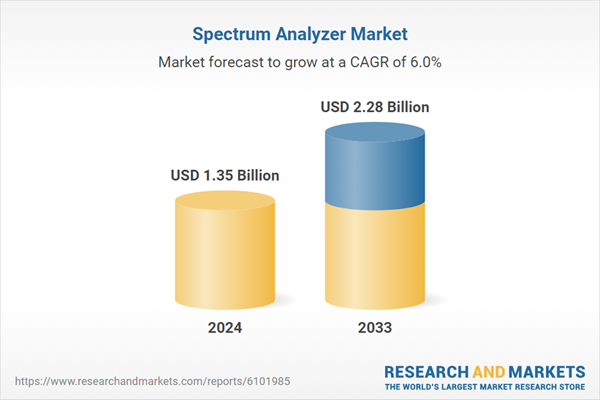
Global Spectrum Analyzer Industry Overview
The increasing need for sophisticated testing and measuring tools in the electronics, defense, aerospace, and telecommunications industries is driving the steady growth of the worldwide spectrum analyzer market. In order to examine signal frequencies and make sure wireless systems are operating efficiently and legally, spectrum analyzers are necessary. Key factors propelling market expansion include the introduction of 5G, the rise of IoT applications, and the expansion of consumer electronics. Spectrum analyzers that are software-based, smaller, and more portable are the result of technological breakthroughs. Although market share is dominated by North America and Asia-Pacific, usage is rising in emerging nations. The future of the industry is being shaped by ongoing innovation and integration with cloud platforms and artificial intelligence.
The market for spectrum analyzers has also been driven by the rise in the usage of electronic devices in a number of sectors. Modern testing and measuring tools are required to guarantee the functioning of more intricate and complex electrical systems. In order to preserve the high quality and dependability of electrical equipment, spectrum analyzers are widely used in manufacturing to find and fix any flaws or issues. One major factor preventing the industry from growing is the high cost of spectrum analyzers. Small and medium-sized enterprises want more access to spectrum analyzers because of their high cost and knowledge requirements. Furthermore, the growing usage of software-defined radios and other software-based signal analysis technologies is expected to provide long-term challenges to the spectrum analyzer industry.
Key Factors Driving the Spectrum Analyzer Market Growth
Developments in Technology
The market is expanding due to continuous developments in spectrum analyzer technology, including better real-time analysis, higher resolution, and wider frequency ranges. This approach is also being influenced by advancements in software-defined radio and digital signal processing. For example, the market share of spectrum analyzers increased in June 2021 when Signal Hound, a maker of RF test and measurement equipment, unveiled the BB60D, a six GHz real-time spectrum analyzer that significantly outperformed the industry standard BB60C.
Emergence of 5G Networks
The market is growing as a result of the rollout of 5G networks. For example, throughout 2023, 5G became available throughout India. In only one year, 5G availability jumped from around 28% in Q1 to 52% in Q4 2023, a gain of 23.9 percentage points. Spectrum analyzers are necessary for testing and improving new equipment when 5G networks are widely deployed. These gadgets provide signal integrity, frequency allocation management, and network performance enhancement. In the upcoming years, these factors are anticipated to drive the spectrum analyzer market.
Defense and Aerospace Needs
To guarantee the operation and security of vital systems including communication networks, radar, navigation, and electronic warfare instruments, the military and aerospace industries mainly depend on accurate and trustworthy signal analysis. In order to detect interference, maintain secure communication channels, and maximize system performance, spectrum analyzers are essential tools for detecting, measuring, and analyzing electromagnetic signals. Accurate spectrum monitoring is crucial in military operations since any disturbance in the signal might jeopardize the effectiveness of the mission. Radar and navigation systems in aircraft applications also need to function perfectly in a variety of environmental circumstances. The need for sophisticated spectrum analyzers in these high-stakes sectors is still being driven by the complexity of contemporary military technology and the expanding usage of wireless communication in strategic operations.
Challenges in the Spectrum Analyzer Market
High Cost of Advanced Equipment
The high price of sophisticated, high-frequency devices is one of the main obstacles facing the spectrum analyzer business. These gadgets frequently include state-of-the-art capabilities like wide bandwidth coverage, real-time analysis, and greater resolution, which raises their cost considerably. For small and mid-sized firms or university research organizations, investing in such pricey equipment might be financially demanding. The price generally includes extra software, upkeep, and training in addition to the gadget itself. This limits access for many groups who may benefit from such technologies but lack the resources to acquire them. As a result, the market sees delayed adoption in budget-conscious sectors, despite increased demand for signal analysis in various applications.
Complexity of Operation
Spectrum analyzers, particularly the more sophisticated types, are extremely complex devices that need specific skills to operate and interpret data correctly. It takes extensive training and experience to install these devices, interpret the data, and resolve problems since they examine a wide variety of signals. This becomes a major obstacle to utilize for companies without qualified staff. Inaccurate measurements or overlooked interference problems might emerge from improper usage, which compromises the validity of test results. This lack of technical know-how can cause projects to be delayed or increase dependency on outside services in industries where accuracy is crucial, such as telecommunications, aerospace, or military. Manufacturers are creating more user-friendly interfaces in an effort to remedy this, but many end users still find the learning curve difficult to overcome.
Key Attributes:
| Report Attribute | Details |
| No. of Pages | 200 |
| Forecast Period | 2024 - 2033 |
| Estimated Market Value (USD) in 2024 | $1.35 Billion |
| Forecasted Market Value (USD) by 2033 | $2.28 Billion |
| Compound Annual Growth Rate | 5.9% |
| Regions Covered | Global |
Companies Featured
- ADVANTEST CORPORATION
- AVCOM
- B&K Precision Corporation
- Cobham Limited
- Fortive Corporation
- Rohde & Schwarz
- Teledyne Technologies
- Yokogawa Electric Corporation
For more information about this report visit https://www.researchandmarkets.com/r/lvz1wj
About ResearchAndMarkets.com
ResearchAndMarkets.com is the world's leading source for international market research reports and market data. We provide you with the latest data on international and regional markets, key industries, the top companies, new products and the latest trends.
Attachment
