Dublin, Dec. 09, 2025 (GLOBE NEWSWIRE) -- The "Refractory Epilepsy Treatment Market - A Global and Regional Analysis: Focus on Treatment Type, Patient Type, Seizure Type, Distribution Channel, and Regional Analysis - Analysis and Forecast, 2025-2035" has been added to ResearchAndMarkets.com's offering.
Introduction of Refractory Epilepsy Treatment
Refractory epilepsy treatment utilizes an individual's distinct clinical, molecular, and lifestyle data to inform the diagnosis, treatment, and prevention of cancer, inherited diseases, and other complex conditions. Refractory epilepsy treatment represents a transformative shift in healthcare, moving away from the traditional one-size-fits-all approach to a more tailored and targeted therapeutic strategy. By leveraging advancements in genomics, molecular diagnostics, and data analytics, Refractory epilepsy treatment enables healthcare providers to craft personalized treatment plans based on an individual's genetic, environmental, and lifestyle factors. This approach not only promises to enhance the effectiveness of treatments but also reduces unnecessary trial-and-error, leading to better patient outcomes and reduced healthcare costs. As the field continues to evolve, large-scale population studies and cutting-edge technologies are paving the way for more accurate disease predictions, early diagnoses, and optimized therapeutic interventions. 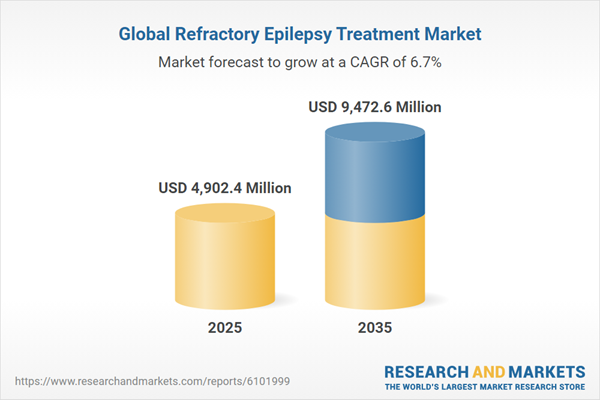
Market Introduction
The global refractory epilepsy treatment market is expected to witness substantial growth, projected to reach $9.47 billion by 2035. The global refractory epilepsy treatment market is experiencing consistent growth, driven by the increasing prevalence of epilepsy and the limitations of conventional anti-seizure medications, which fail to control seizures in approximately 30-40% of patients. This significant unmet clinical need is transforming the market landscape, spurring demand for advanced treatment options such as neurostimulation therapies (including VNS, RNS, and DBS), surgical interventions, and innovative therapeutics like cannabidiol and next-generation anti-seizure medications. Growth is further supported by rising awareness, enhanced diagnostic capabilities, and broader healthcare access in emerging markets. Nonetheless, barriers such as high treatment costs, complex regulatory requirements, and uneven access to specialized care continue to hinder widespread adoption. As the field moves toward more personalized, device-integrated, and precision-targeted solutions, the refractory epilepsy treatment market stands at the forefront of urgent clinical need and evolving commercial potential.
Refractory epilepsy, also known as drug-resistant epilepsy (DRE), affects approximately 30% of all epilepsy patients, who do not respond adequately to at least two anti-seizure medications (ASMs). This condition represents a high unmet clinical need, driving both pharmaceutical and device innovation. Refractory epilepsy, affects roughly 30% of the global epilepsy population, representing a significant unmet medical need. This subset of patients fails to achieve seizure control despite trials of two or more anti-seizure medications (ASMs), driving demand for innovative therapies. The competitive landscape is diverse and rapidly evolving, spanning pharmaceutical, device, and emerging gene therapy sectors. Traditional ASMs, such as UCB Pharma's brivaracetam and SK Life Science's cenobamate, continue to advance with a focus on improved efficacy and tolerability, exemplified by cenobamate's clinical trials showing notable seizure freedom rates. Meanwhile, neuromodulation devices - like LivaNova's vagus nerve stimulation and NeuroPace's responsive neurostimulation system - offer alternative approaches targeting neural circuits, particularly for patients with focal epilepsy not amenable to surgery.
Additionally, cell and gene therapies, though still in early stages, promise transformative potential for rare genetic epilepsies such as Dravet syndrome, reflecting a shift towards precision medicine. Market growth is supported by regulatory incentives and increasing payer acceptance, particularly as real-world data validate the long-term benefits of these advanced therapies. Overall, the refractory epilepsy treatment landscape resembles a multi-modal transportation system navigating difficult terrain: conventional drugs serve broad populations but with limited efficacy, neuromodulation provides more precise control albeit at higher cost, and emerging genetic therapies hold the promise of a targeted, curative path for select patients.
Key Attributes:
| Report Attribute | Details |
| No. of Pages | 147 |
| Forecast Period | 2025 - 2035 |
| Estimated Market Value (USD) in 2025 | $4902.4 Million |
| Forecasted Market Value (USD) by 2035 | $9472.6 Million |
| Compound Annual Growth Rate | 6.7% |
| Regions Covered | Global |
**Company Profiles**
- Biocodex-SP
- Eisai, Inc.
- GSK plc.
- LivaNova PLC
- NeuroPace, Inc.
- Novartis AG
- Teva Pharmaceutical Industries Ltd.
- UCB S.A.
- SK Biopharmaceuticals
- Janssen Global Services, LLC
For more information about this report visit https://www.researchandmarkets.com/r/j9gpem
About ResearchAndMarkets.com
ResearchAndMarkets.com is the world's leading source for international market research reports and market data. We provide you with the latest data on international and regional markets, key industries, the top companies, new products and the latest trends.
Attachment
