Dublin, Dec. 10, 2025 (GLOBE NEWSWIRE) -- The "Electric Pumps for Rocket Market - A Global and Regional Analysis: Focus on End User, Rocket Class, Product Pump, and Country Level Analysis - Analysis and Forecast, 2025-2035" has been added to ResearchAndMarkets.com's offering.
The Electric Pumps for Rocket Market was valued at USD 45.9 Million in 2025, and is projected to reach USD 71 Million by 2035, rising at a CAGR of 4.46%. 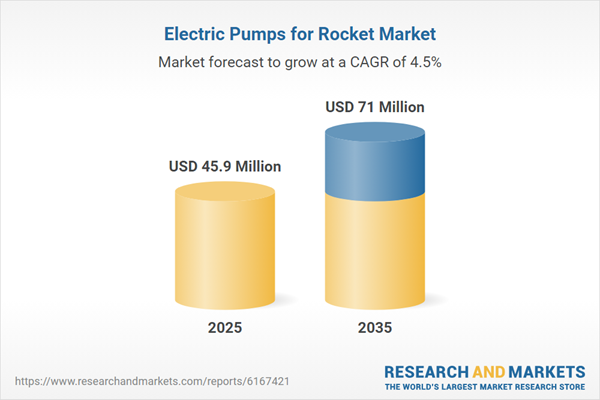
Market Demand Drivers: Constellations, Upper-Stage Maneuvering, and Modularization
The primary pull is constellation logistics, frequent, precise insertions, and phasing maneuvers that reward restartable, throttleable upper stages. Electric pumps simplify engine plumbing, reduce moving-part counts, and support multi-burn operations without hot-gas turbines, which is compelling for small-lift and OTV missions where packaging space, fast turnarounds, and mission agility dominate. For manufacturers, AM-enabled impellers/housings, COTS-hardened drives, and pre-qualified subassemblies compress schedule risk, allowing faster debug cycles and more launches per year. As agencies and primes prioritize responsive launch, electric pumps' plug-and-play behavior fits quick-turn stage ops and modular upper-stage stacks that can be mixed, matched, and serviced with minimal re-engineering.
The second driver is modularity, Modular motor-pump units and clean, electrically driven plumbing reduce refurbishment touch labor between sorties. Combined with maturing thermal mitigation and controller health monitoring, programs can extend useful life and restart counts, improving economics for high-cadence commercial services and deepening the business case for electric pumps in upper-stage fleets.
Market Challenges: Pack-Level Energy Density, Thermal Management, and Turbopump Heritage
The binding constraint remains pack-level specific energy; while cell chemistries trend upward, complete battery packs (cooling, containment, safety, BMS) lag, limiting burn duration and thrust scalability for larger cores. High-rate discharge drives thermal and lifetime stresses that must be mitigated by cooling and protective structures, adding mass and eroding the benefits at higher thrust classes. In parallel, entrenched turbopump heritage with decades of flight records and a deep vendor ecosystem sets a formidable benchmark for reliability, especially in medium/heavy-lift environments where energy density shortfalls are most acute. In the near term, this confines most electric-pump roles to small-lift vehicles and upper stages while the tech matures.
Engineering headwinds also include cavitation control at cryogenic inlets, high-speed bearing durability, and controller fault-tolerance across long burns. Each solution tends to trade mass for margin (e.g., additional cooling, shielding, or redundancy), which can dilute the system-level gains for bigger vehicles unless pack performance advances in tandem.
Market Opportunities: Small-Lift Standardizations, Hybrid-Electric Upper Stages, and Regional Ecosystems
Standardized small-lift motor-pump kits with proven cryo performance, restart matrices, and life-test artifacts can be replicated across families and block upgrades, amplifying fleet commonality and spare pooling. In upper stages, hybrid-electric concepts (electric feeds + regenerative cooling or hybrid motors) offer a tractable bridge into higher-energy missions while pack technologies catch up, enabling precise delta-V trim, long loiter, and multi-destination profiles. Regionally, North America's large test base and AM footprint, Europe's cryogenic pump R&D, and Asia-Pacific's growing small-lift cohort open JV and licensing pathways that share NRE and accelerate commercialization of cryo-capable electric pumps through 2035. These partnerships are already visible in the supplier and program maps captured in the report's regional and product breakouts.
Key Attributes
| Report Attribute | Details |
| No. of Pages | 124 |
| Forecast Period | 2025-2035 |
| Estimated Market Value (USD) in 2025 | $45.9 Million |
| Forecasted Market Value (USD) by 2035 | $71 Million |
| Compound Annual Growth Rate | 4.4% |
| Regions Covered | Global |
Companies Profiled
- Rocket Lab USA, Inc.
- Impraise Systems
- Ebara Corporation
- Sierra Space Corporation
- Innospace Co., Ltd.
- Kratos Defense & Security Solutions, Inc.
- Nammo AS
- P3 Technologies, LLC
- Concept NREC
- Gilmour Space Technologies
For more information about this report visit https://www.researchandmarkets.com/r/7q9ct8
About ResearchAndMarkets.com
ResearchAndMarkets.com is the world's leading source for international market research reports and market data. We provide you with the latest data on international and regional markets, key industries, the top companies, new products and the latest trends.
Attachment
