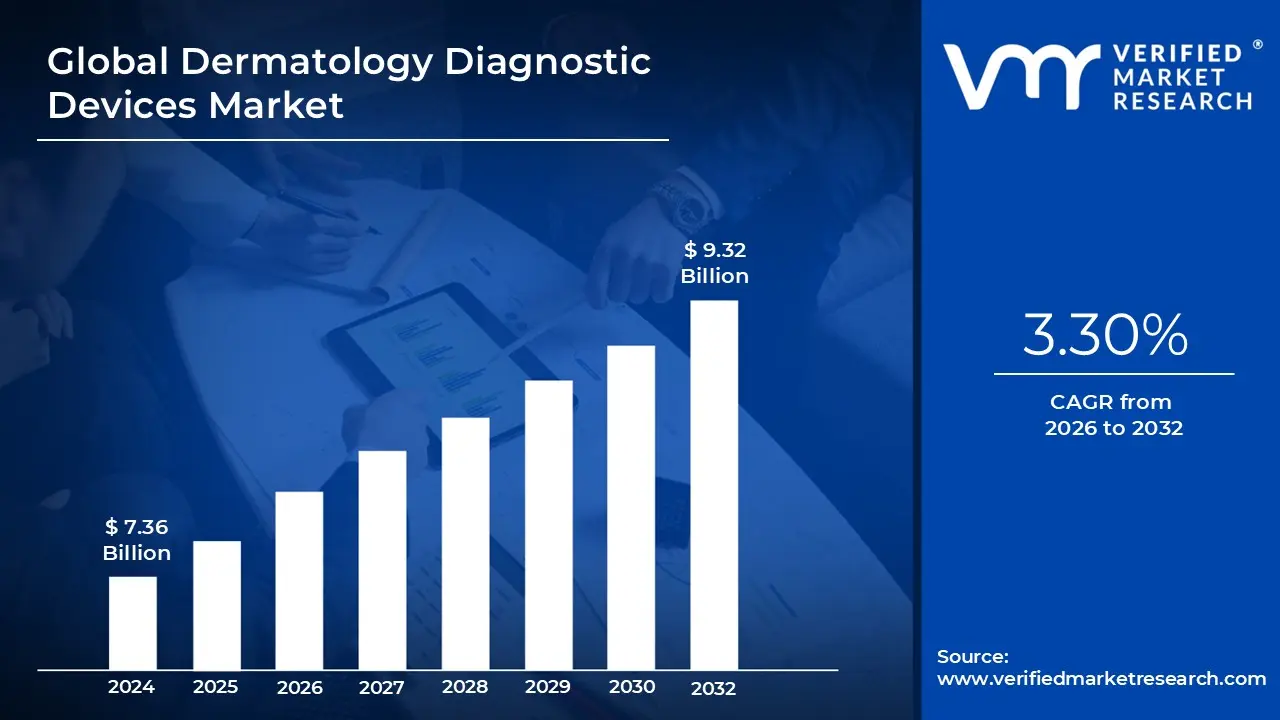
Lewes, Delaware, Dec. 11, 2025 (GLOBE NEWSWIRE) -- The Global Dermatology Diagnostic Devices Market Size projected to grow at a CAGR of 3.30% from 2026 to 2032, according to a new report published by Verified Market Research®. The report reveals that the market was valued at USD 7.36 Billion in 2024 and expected to reach USD 9.32 Billion by the end of the forecast period.
 For a detailed analysis of Industry Trends And Growth Drivers, Explore The Full Dermatology Diagnostic Devices Market.
Browse in-depth TOC
202 - Pages
126 – Tables
37 – Figures
Global Dermatology Diagnostic Devices Market Overview
Market Driver
1. Rising Global Burden of Skin Disorders
- The global rise in skin cancer, eczema, psoriasis, dermatitis, and chronic cosmetic skin conditions continues to strengthen demand for dermatology diagnostic devices.
- Healthcare providers increasingly prioritize early detection, which accelerates the adoption of advanced tools such as digital dermoscopy, high-resolution imaging systems, and AI-enabled lesion analysis platforms.
- As dermatology clinics, hospitals, and specialty centers expand diagnostic capacities, vendors see stronger purchasing intent, higher device replacement cycles, and broader market coverage.
- This growing patient volume ultimately boosts the need for accurate, fast, and scalable diagnostic equipment, making it a strategic driver for companies aiming to generate long-term revenue and capture emerging opportunities in the global dermatology devices ecosystem.
2. Rapid Technological Advancements in Dermatology Imaging
- Continuous innovations in imaging technologies directly support market expansion, especially with the rising use of multispectral imaging, confocal microscopy, optical coherence tomography, and AI-driven diagnostic algorithms.
- These advancements enable dermatologists to diagnose complex skin abnormalities with greater accuracy, speed, and reliability.
- Healthcare institutions are actively upgrading to new-generation diagnostic systems to streamline workflows, reduce manual interpretation errors, and improve patient outcomes.
- For manufacturers, this technological progress unlocks lucrative opportunities to commercialize premium devices, penetrate high-value medical markets, and offer integrated solutions that enhance operational efficiency, making this trend a strong revenue catalyst.
3. Growing Adoption of Teledermatology and Digital Health Platforms
- The rapid digital transformation across healthcare strongly accelerates demand for portable, connected, and telemedicine-friendly dermatology diagnostic devices.
- Providers and telehealth platforms require high-quality imaging systems that support remote diagnosis, automated lesion scoring, and seamless cross-platform data sharing.
- This shift enhances access to dermatology care in rural and underserved regions while also increasing patient engagement through virtual consultations.
- For B2B buyers and technology partners, the adoption of teledermatology introduces scalable subscription models, cross-border service expansion, and improved device utilization, positioning this trend as a powerful long-term market driver.

Download a free sample to access exclusive Insights, Data Charts, And Forecasts From The Dermatology Diagnostic Devices Market Sample Report.
Market Restraints
1. High Initial Installation and Maintenance Costs
- The substantial capital investment required for advanced dermatology diagnostic devices acts as a major barrier, particularly for small clinics, independent dermatologists, and mid-size healthcare networks.
- Premium imaging systems, AI-enabled platforms, and precision diagnostic tools require significant upfront payments, annual maintenance contracts, and periodic upgrades.
- These costs limit procurement flexibility, extend decision-making timelines, and reduce market penetration in price-sensitive countries.
- As a result, many healthcare providers delay purchasing or opt for low-cost alternatives, which ultimately impacts vendors’ revenue cycles and slows short-term adoption rates across emerging markets.
2. Shortage of Skilled Dermatology Professionals
- A persistent global shortage of trained dermatologists and imaging technicians restricts the effective adoption of advanced diagnostic devices.
- Many systems require specialized interpretation skills, structured training programs, and consistent clinical experience, which creates operational challenges in regions with limited dermatology infrastructure.
- Healthcare institutions often hesitate to invest in high-end systems when skilled manpower is insufficient to ensure accurate diagnosis and optimal equipment use.
- This talent gap reduces device utilization, lowers return on investment for buyers, and forces vendors to increase training and support services, all of which slow overall market expansion.
3. Regulatory Hurdles and Lengthy Device Approval Processes
- Regulatory bodies across North America, Europe, and Asia impose stringent safety, accuracy, and clinical validation requirements for dermatology diagnostic devices, leading to long and costly approval cycles.
- Manufacturers must invest heavily in compliance, documentation, clinical trials, and quality testing, which extends time-to-market and affects competitive positioning.
- These delays create uncertainties for both producers and B2B buyers, influencing procurement strategies and slowing the adoption of innovative diagnostic solutions.
- The evolving global regulatory landscape increases development risk and challenges manufacturers seeking rapid commercialization and geographic expansion.
Geographical Dominance: North America dominates the Dermatology Diagnostic Devices Market, supported by advanced healthcare infrastructure, high adoption of digital dermoscopy, and strong investments in AI-driven imaging solutions. Europe follows with robust regulatory support and rising skin cancer screening programs. Meanwhile, Asia-Pacific emerges as a fast-growing region driven by expanding healthcare access, increasing dermatology clinics, and rising demand for non-invasive diagnostic technologies across China, India, and Japan.
Key Players
The “Global Dermatology Diagnostic Devices Market” study report will provide a valuable insight with an emphasis on the global market. The major players in the market are Welch Allyn, Carl Zeiss Meditec, AMD Global Telemedicine, Inc., Toshiba Medical Systems, Siemens Healthcare, FEI Company, Heine Optotechnik, Fotofinder Systems GMBH, Philips Healthcare, Leica Microsystems.
Dermatology Diagnostic Devices Market Segment Analysis
Based on the research, Verified Market Research has segmented the global market into Type, End User, and Geography.
- Dermatology Diagnostic Devices Market, by Type
- Dermatoscopes
- Imaging Equipment
- Microscopes & Trichoscopes
- Biopsy Devices
- Bottom of Form
- Dermatology Diagnostic Devices Market, by End User
- Hospitals
- Speciality Dermatology Clinics
- Private Clinics
- Dermatology Diagnostic Devices Market, by Geography
- North America
- U.S
- Canada
- Mexico
- Europe
- Germany
- France
- U.K
- Rest of Europe
- Asia Pacific
- China
- Japan
- India
- Rest of Asia Pacific
- ROW
- Middle East & Africa
- Latin America
- North America
Strategic Insight:
The Dermatology Diagnostic Devices Market is gaining momentum as rising skin disorders, rapid imaging innovations, and the expansion of teledermatology accelerate global demand. However, high device costs, skilled workforce shortages, and strict regulatory pathways remain key restraints shaping adoption. North America leads with strong technological uptake, while Asia-Pacific presents high-growth, investment-ready opportunities. For B2B buyers and market entrants, leveraging AI-driven diagnostics, targeting emerging regions, and offering value-focused pricing can strengthen competitive positioning. These insights empower stakeholders to make data-backed decisions and unlock profitable market expansion.
To gain complete access with Corporate Or Enterprise Licensing, Visit The Dermatology Diagnostic Devices Market.
Key Highlights of the Report:
- Market Size & Forecast: In-depth analysis of current value and future projections
- Segment Analysis: Breaks down the market by Type, and End User for focused strategy development.
- Regional Insights: Comprehensive coverage of North America, Europe, Asia-Pacific, and more
- Competitive Landscape: Profiles key players, their strategic initiatives, and innovation-driven growth approaches.
- Growth Drivers & Challenges: Analyzes the forces accelerating growth and the restraints hindering large-scale adoption.
- Challenges and Risk Assessment: Evaluates ethical debates, off-target effects, and regulatory complexities.
Why This Report Matters?
This report equips B2B buyers, strategic planners, and industry stakeholders with actionable intelligence to evaluate market dynamics, benchmark competitors, and explore high-value growth opportunities. It offers in-depth segmentation, technology insights, and data-driven forecasts to support confident decision-making and profitable investments.
Who Should Read This Report?
- Market research professionals evaluating dermatology trends
- Medical device manufacturers and innovators
- Healthcare investors and venture capital firms
- Hospital procurement teams and dermatology clinics
- Strategic consulting firms and regulatory advisors
- Distributors exploring expansion in diagnostic technologies
Browse Related Reports:
Global Onychomycosis Treatment Lasers Equipment Market Size By Type (Mobile, Fixed), By Laser Type (Nd YAG Lasers, Diode Lasers), By Application (Podiatry Clinics, Aesthetic Clinics, Dermatology Clinics, Hospitals), By Geographic Scope and Forecast
Global Facial Beauty Devices Market Size By Product Type (Cleansing Devices, Anti-aging Devices, Acne Treatment Devices, Hair Removal Devices), By Application (Home Use, Salon & Spa, Dermatology Clinics), By End-User (Personal, Professional), By Geographic Scope and Forecast
Global Acne Treatment Devices Market Size By Product Type (Light Therapy Devices, Laser & Radiofrequency Devices, Microdermabrasion Devices), By Application (Facial Acne, Body Acne, Scar Reduction), By End-User (Dermatology Clinics, Home Users, Beauty & Wellness Centers), By Geographic Scope and Forecast
Global Non-Invasive Lipolysis Device Market Size By Technology (Cryolipolysis, Laser Lipolysis, Radiofrequency Lipolysis, High-Intensity Focused Ultrasound), By Application (Abdomen, Thighs, Upper Arms, Chin, Flanks), By End-User (Hospitals, Dermatology Clinics, Medical Spas), By Geographic Scope And Forecast
7 Leading Dermatology EMR Software enhancing patient engagement
Visualize Dermatology Diagnostic Devices Market using Verified Market Intelligence -:
Verified Market Intelligence is our BI Enabled Platform for narrative storytelling in this market. VMI offers in-depth forecasted trends and accurate Insights on over 20,000+ emerging & niche markets, helping you make critical revenue-impacting decisions for a brilliant future.
VMI provides a holistic overview and global competitive landscape with respect to Region, Country, Segment, and Key players of your market. Present your Market Report & findings with an inbuilt presentation feature saving over 70% of your time and resources for Investor, Sales & Marketing, R&D, and Product Development pitches. VMI enables data delivery In Excel and Interactive PDF formats with over 15+ Key Market Indicators for your market.
About Us
Verified Market Research® stands at the forefront as a global leader in Research and Consulting, offering unparalleled analytical research solutions that empower organizations with the insights needed for critical business decisions. Celebrating 10+ years of service, VMR has been instrumental in providing founders and companies with precise, up-to-date research data.
With a team of 500+ Analysts and subject matter experts, VMR leverages internationally recognized research methodologies for data collection and analyses, covering over 15,000 high impact and niche markets. This robust team ensures data integrity and offers insights that are both informative and actionable, tailored to the strategic needs of businesses across various industries.
VMR's domain expertise is recognized across 14 key industries, including Semiconductor & Electronics, Healthcare & Pharmaceuticals, Energy, Technology, Automobiles, Defense, Mining, Manufacturing, Retail, and Agriculture & Food. In-depth market analysis cover over 52 countries, with advanced data collection methods and sophisticated research techniques being utilized. This approach allows for actionable insights to be furnished by seasoned analysts, equipping clients with the essential knowledge necessary for critical revenue decisions across these varied and vital industries.
Verified Market Research® is also a member of ESOMAR, an organization renowned for setting the benchmark in ethical and professional standards in market research. This affiliation highlights VMR's dedication to conducting research with integrity and reliability, ensuring that the insights offered are not only valuable but also ethically sourced and respected worldwide.
Follow Us On: LinkedIn | Twitter | Threads | Instagram | Facebook
Attachment
