Dublin, Dec. 22, 2025 (GLOBE NEWSWIRE) -- The "Wireless Mesh Network Market - Global Forecast 2025-2032" report has been added to ResearchAndMarkets.com's offering.
Wireless mesh networks have become foundational for enterprises seeking flexible, resilient digital infrastructure. These advanced networks allow senior leaders to implement secure, adaptive connectivity aligned with organizational transformation priorities.
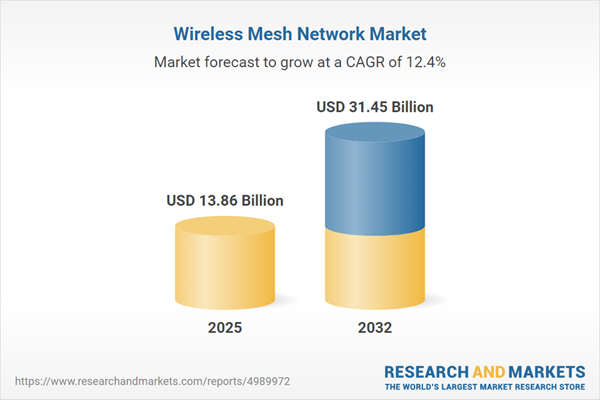
Market Snapshot: Wireless Mesh Network Market Growth
Strong growth is forecast for the wireless mesh network market between 2024 and 2025, propelled by increasing enterprise adoption and pressing needs for adaptive digital infrastructure. Accelerated digitization across manufacturing, commercial services, and sectors with mission-driven demands is spurring deeper market penetration.
Organizations are prioritizing solutions that secure business continuity and streamline network expansion. Unlike traditional networks, wireless mesh systems remove single points of failure, enabling self-healing, distributed coverage. These features are particularly valued in sectors where continuous operations and distributed connectivity are crucial, further driving the market's evolution.
Scope & Segmentation
- Component: The core of wireless mesh networks includes gateways, nodes, routers, switches, and specialized management and security software. Professional services are essential for deployment and performance optimization in complex settings.
- Type: Enterprise deployment options include client, hybrid, and infrastructure mesh architectures. Each supports customizable scalability, built-in security, and regulatory compliance, responding to dynamic site and operational requirements.
- Technology: Key platforms such as Wi-Fi, ZigBee, LoRaWAN, and Bluetooth mesh are selected for tasks requiring specific coverage, power efficiency, or data throughput. These technologies support diverse use cases in industrial automation, large public venues, and smart retail environments, offering flexibility across operational scenarios.
- Application: Wireless mesh is used in settings ranging from manufacturing, mining, oil and gas, and defense to public safety and challenging residential environments. Organizations benefit from reliable coverage where conventional network approaches are impractical, ensuring adaptable and persistent connectivity.
- End User: Sectors including education, public administration, utilities, healthcare, energy, and retail implement wireless mesh for their unique regulatory, scalability, and continuity demands, addressing sector-specific operational and risk requirements.
- Geographic Coverage: Adoption rates differ by region, influenced by local infrastructure and regulations. Notable market traction occurs in the Americas-particularly the United States, Canada, Mexico, Brazil, Argentina, Chile, Colombia, and Peru-as well as Europe, the Middle East, Africa, and throughout Asia-Pacific, especially in China, India, Japan, Southeast Asia, and Oceania. Regional investment and digital readiness shape deployment strategies.
Key Takeaways: Strategic Insights for Enterprise Networking
- Decentralized mesh architectures give organizations greater agility, supporting adaptable operations and maintaining steady network performance as locations and demands shift.
- Streamlined onboarding and deployment reduce time-to-value, enabling rapid scaling of network capabilities to support digital initiatives and dynamic workforce needs.
- Mesh solutions extend secure, reliable coverage into remote or infrastructure-limited areas, facilitating uninterrupted operations in environments where traditional networks falter.
- For mission-driven sectors like automated manufacturing, logistics, and emergency services, mesh frameworks offer self-healing and failover functions to sustain operational continuity and minimize downtime.
- Managed mesh platforms ease compliance, supporting organizations in meeting evolving regulations and swiftly adapting IT priorities through centralized administration tools.
- Centralized network management enhances scalability, providing leaders with the oversight needed to align connectivity infrastructure with ongoing digital transformation objectives.
Wireless Mesh Network Market: Why This Report Matters
- Enables leadership teams to steer digital acceleration and meet Internet of Things demands by deploying secure, scalable enterprise networks.
- Provides actionable recommendations for investment in wireless mesh solutions, supporting compliance and risk management across diverse sectors.
- Clarifies evolving technology and regulatory developments so organizations can craft resilient network strategies for future growth.
Key Attributes
| Report Attribute | Details |
| No. of Pages | 198 |
| Forecast Period | 2025-2032 |
| Estimated Market Value (USD) in 2025 | $13.86 Billion |
| Forecasted Market Value (USD) by 2032 | $31.45 Billion |
| Compound Annual Growth Rate | 12.3% |
| Regions Covered | Global |
Market Insights
- Deployment of Wi-Fi 6E compatible mesh nodes to support ultra-high throughput and low latency connectivity
- Adoption of cloud-native management platforms for remote orchestration and analytics of mesh network performance
- Implementation of blockchain-based security frameworks for decentralized authentication and data integrity in mesh deployments
- Rising demand for smart city IoT integrations using scalable mesh topologies for traffic monitoring and public safety
- Emergence of energy harvesting mesh sensor nodes to enable battery-free operations in industrial automation networks
- Expansion of 5G connected mesh backhaul solutions to deliver resilient and high-capacity broadband in rural areas
- Development of edge AI inference modules within mesh routers for real-time video analytics and anomaly detection
- Integration of software-defined networking protocols for policy-driven traffic segmentation and dynamic load balancing
The companies profiled in this Wireless Mesh Network market report include:
- Cisco Systems, Inc.
- Hewlett Packard Enterprise Company
- Ubiquiti Inc.
- CommScope, Inc.
- Huawei Technologies Co., Ltd.
- Juniper Networks, Inc.
- Fortinet, Inc.
- Extreme Networks, Inc.
- Cambium Networks, Ltd.
- NETGEAR, Inc.
For more information about this report visit https://www.researchandmarkets.com/r/9k5b7y
About ResearchAndMarkets.com
ResearchAndMarkets.com is the world's leading source for international market research reports and market data. We provide you with the latest data on international and regional markets, key industries, the top companies, new products and the latest trends.
Attachment
