Dublin, Jan. 06, 2026 (GLOBE NEWSWIRE) -- The "Japan Laundry Appliances Market Report by Type, Product, Technology, Distribution Channel and Company Analysis, 2025-2033" has been added to ResearchAndMarkets.com's offering.
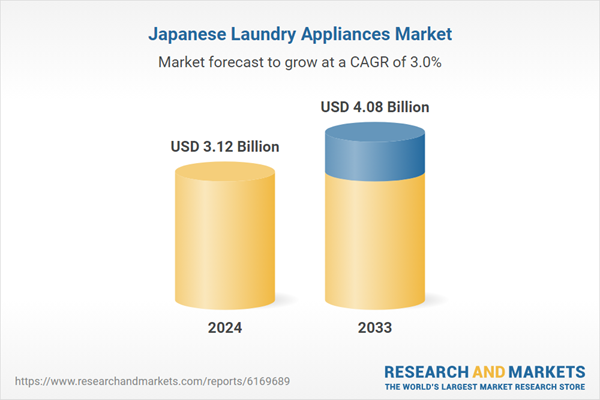
Japan Laundry Appliances Market is expected to reach US$ 4.08 billion by 2033 from US$ 3.12 billion in 2024, with a CAGR of 3.02% from 2025 to 2033. The market expansion is mostly being driven by the growing advancements in laundry appliance technology, which include features like smart connectivity, energy efficiency, and enhanced washing/drying performance.
Key Factors Driving the Japan Laundry Appliances Market
Urbanization and Small Apartments: Japanese consumers' preferences for small, multipurpose washing machines have been greatly impacted by the country's dense urban population, especially in places like Tokyo and Osaka. Space-saving options like washer-dryer combos and front-loading machines with compact profiles are highly sought after as many households now reside in tiny apartments. These appliances are made to be compact without compromising on functionality or capacity. Additionally, young professionals and nuclear families are starting to favor built-in alternatives and stackable units. Innovation in silent, vibration-free devices that are appropriate for apartment life is also fueled by the trend toward smaller living areas. Manufacturers are concentrating on small, easy-to-use appliances that meet the functional limitations of contemporary Japanese houses as urbanization continues.
Innovation in Technology and Intelligent Features: Japan's reputation for technological innovation carries over into the laundry appliance industry, where market expansion is mostly driven by innovation. Smart features including AI-based load sensing, app-controlled operation, IoT connectivity, and automatic detergent dispensing systems are being incorporated by manufacturers. Tech-savvy customers that appreciate ease, automation, and efficiency will find these features appealing. Furthermore, developments in water and energy efficiency technology complement Japan's environmental objectives and customer demands for environmentally friendly equipment. Hygiene-conscious consumers are served by innovations including fabric care modes, steam washing, and allergy removal. The need for linked laundry appliances is further supported by the expanding use of smart home ecosystems. In addition to adding value, these technological advancements promote upgrades and reduce the replacement cycle.
The need for user-friendly designs due to an aging population: In the market for laundry appliances, Japan's aging population is influencing product functionality and design. Elderly homes and seniors place a high value on accessible, user-friendly devices that lessen physical strain. Appliances with ergonomic loading doors, user-friendly controls, and automated features that reduce manual input are in high demand as a result. Older people can operate machines more comfortably thanks to features like voice assistance, larger display panels, and simplified wash cycles. Additionally, senior consumers who are looking for low-maintenance and convenient solutions place a high value on time-saving and self-cleaning features. In response, producers are creating inclusive product designs that appeal to a larger range of consumers. Appliances that combine cutting-edge technology with simplicity will be essential to maintaining market growth as Japan's population ages.
Challenges in the Japan Laundry Appliances Market
Saturation of the Market and Slow Volume Growth: Since the great majority of Japanese families already own a washing machine or washer-dryer set, the market for laundry appliances is quite saturated. Due to the limited prospects for initial sales caused by this high penetration, the market is mostly dependent on upgrades or replacements. Because of the comparatively flat growth in unit sales, manufacturers are being forced to concentrate on increasing value through high-end, feature-rich devices. However, in the absence of notable technological advancements, persuading customers to change their functional appliances might be challenging. The lengthy lifespan of Japanese appliances further reduces the frequency of replacements. Differentiation is more difficult and competition is fiercer in such an established setting. Both domestic and foreign brands are under pressure to innovate significantly while controlling marketing expenses and preserving consumer interest as a result of this saturation.
Population Aging and Declining: The market for laundry equipment in Japan faces structural issues due to the country's elderly population and diminishing birth rate. Large-capacity or numerous appliances are less in demand overall as there are fewer young families and smaller households. The growing number of senior people, on the other hand, frequently favors robust, basic devices with few features, which restricts the uptake of high-end, high-tech models in some markets. The availability of workers in the manufacturing and service industries is also impacted by the declining working-age population, which could raise costs and restrict the scalability of output. Demand is concentrated in urban regions as fewer new households are created, particularly in rural areas, which exacerbates regional rivalry. Brands must modify their product designs and marketing tactics to appeal to senior citizens in order to maintain growth, while also taking into account the future household expansion's restricted potential.
Key Attributes
| Report Attribute | Details |
| No. of Pages | 200 |
| Forecast Period | 2024-2033 |
| Estimated Market Value (USD) in 2024 | $3.12 Billion |
| Forecasted Market Value (USD) by 2033 | $4.08 Billion |
| Compound Annual Growth Rate | 3% |
| Regions Covered | Japan |
Key Topics Covered
1. Introduction
2. Research & Methodology
3. Executive Summary
4. Market Dynamics
4.1 Growth Drivers
4.2 Challenges
5. Japan Laundry Appliances Market
5.1 Historical Market Trends
5.2 Market Forecast
6. Market Share Analysis
6.1 By Type
6.2 By Product
6.3 By Technology
6.4 By Distribution Channel
7. Type
7.1 Freestanding Laundry Appliances
7.2 Built-in Laundry Appliances
8. Product
8.1 Washing Machine
8.2 Dryers
8.3 Electric Smoothing Irons
8.4 Others
9. Technology
9.1 Automatic
9.2 Semi-Automatic/Manual
9.3 Others
10. Distribution Channel
10.1 Specialty Stores
10.2 Supermarkets and Hypermarkets
10.3 Department Stores
10.4 E-Commerce
10.5 Others
11. Value Chain Analysis
12. Porter's Five Forces Analysis
12.1 Bargaining Power of Buyers
12.2 Bargaining Power of Suppliers
12.3 Degree of Competition
12.4 Threat of New Entrants
12.5 Threat of Substitutes
13. SWOT Analysis
13.1 Strength
13.2 Weakness
13.3 Opportunity
13.4 Threats
14. Pricing Benchmark Analysis
15. Key Players Analysis
15.1 Hitachi
15.2 Panasonic
15.3 Toshiba
15.4 Sharp
15.5 Whirlpool Corporation
15.6 Electrolux Group
15.7 Miele
15.8 Haier Inc.
15.9 LG Electronics
15.10 Midea Group Co.
For more information about this report visit https://www.researchandmarkets.com/r/by7ox5
About ResearchAndMarkets.com
ResearchAndMarkets.com is the world's leading source for international market research reports and market data. We provide you with the latest data on international and regional markets, key industries, the top companies, new products and the latest trends.
Attachment
