Dublin, Jan. 21, 2026 (GLOBE NEWSWIRE) -- The "U.S. Bispecific Antibodies Market Forecast to 2033" report has been added to ResearchAndMarkets.com's offering.
The U.S. bispecific antibodies market size was estimated at USD 11.78 billion in 2024 and is projected to reach USD 271.95 billion by 2033, growing at a CAGR of 40.1% from 2025 to 2033. The U.S. bispecific antibodies industry is undergoing remarkable growth, driven by the rising burden of cancer and autoimmune diseases and a strong demand for therapies with more precise targeting. 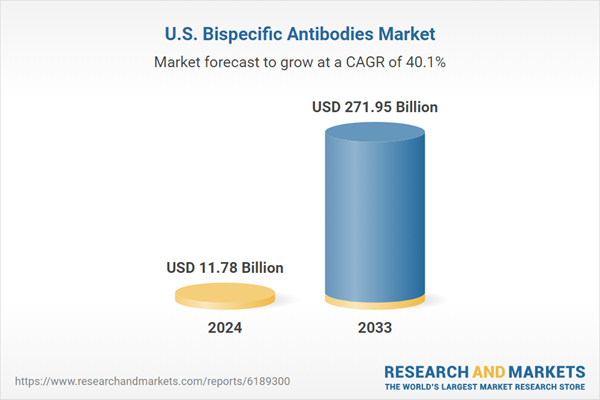
A Nature Reviews Clinical Oncology article (2024) states that over 200 bispecific antibodies are in preclinical or clinical development. Most of these antibodies are designed as immune-cell engagers targeting two antigens, highlighting their potential for precision oncology through dual-target mechanisms.
Furthermore, the rising approval by the U.S. Food and Drug Administration for various bispecific antibodies contributes to the growth of investment in research and development activities. For instance, in May 2025, Pfizer entered a high-value licensing agreement with 3SBio for SSGJ 707, including a USD1.25 billion upfront payment and up to USD 4.8 billion in milestone-based payouts.
Similarly, in June 2025, Bristol Myers Squibb partnered with BioNTech in a deal worth up to USD 11.1 billion for the co-development and co-commercialization of BioNTech's investigational bispecific antibody BNT327 for various solid tumor types, comprising USD 1.5 billion upfront, USD 2 billion in guaranteed payments, and as much as USD 7.6 billion in additional development, regulatory, and commercial milestones.
In the U.S., bispecific antibodies are becoming increasingly popular due to the rising number of cancer cases nationwide. A 2024 study published by the American Society of Hematology reported on 564 patients with relapsed or refractory multiple myeloma. Out of these patients, 202 were treated with bispecific antibodies, including teclistamab (91%), talquetamab (14%), and elranatamab (3%).
The adoption of these treatments grew dramatically, from just one patient treated in 2022 to 45% of eligible patients in 2023 and reached 54% by mid-2024. This swift adoption corresponds with the FDA approvals of teclistamab in October 2022 and elranatamab in August 2023.
Why You Should Buy This Report
- Comprehensive Market Analysis: Gain detailed insights into the market across major regions and segments.
- Competitive Landscape: Explore the market presence of key players.
- Future Trends: Discover the pivotal trends and drivers shaping the future of the market.
- Actionable Recommendations: Utilize insights to uncover new revenue streams and guide strategic business decisions.
Key Attributes:
| Report Attribute | Details |
| No. of Pages | 100 |
| Forecast Period | 2024 - 2033 |
| Estimated Market Value (USD) in 2024 | $11.78 Billion |
| Forecasted Market Value (USD) by 2033 | $271.95 Billion |
| Compound Annual Growth Rate | 40.1% |
| Regions Covered | United States |
Key Topics Covered:
Chapter 1. Methodology and Scope
Chapter 2. Executive Summary
2.1. Market Snapshot
2.2. Segment Snapshot
2.3. Competitive Landscape Snapshot
Chapter 3. U.S. Bispecific Antibodies Market Variables, Trends & Scope
3.1. Market Lineage Outlook
3.1.1. Parent Market Outlook
3.1.2. Related Market Outlook
3.2. Market Dynamics
3.2.1. Market Driver Analysis
3.2.2. Market Restraint Analysis
3.2.3. Industry Challenges
3.2.4. Industry Opportunities
3.3. Industry Analysis Tools
3.3.1. Porter's Five Forces Analysis
3.4. Market Entry Strategies
Chapter 4. U.S. Bispecific Antibodies Market: Type Estimates & Trend Analysis
4.1. U.S. Bispecific Antibodies Market Type: Key Takeaways
4.2. Type Movement Analysis & Market Share, 2024 & 2033
4.3. U.S. Bispecific Antibodies Market Estimates & Forecast, by Type, 2021 to 2033 (USD Million)
4.3.1. Inflammatory & Autoimmune Disorders
4.3.1.1. Market Estimates & Forecasts, 2021 to 2033 (USD Million)
4.3.2. Cancer
4.3.3. Others
Chapter 5. U.S. Bispecific Antibodies Market - Competitive Landscape
5.1. Recent Developments & Impact Analysis by Key Market Participants
5.2. Company Categorization
5.3. Financial Performance
5.4. Product Benchmarking
5.5. Company Heat Map/ Positioning Analysis
5.6. Strategy Mapping
5.7. Company Profiles
5.7.1. Company Overview
5.7.2. Financial Performance
5.7.3. Product Benchmarking
5.7.4. Strategic Initiatives
- Amgen
- Roche
- Genentech
- Janssen
- Immunocore
For more information about this report visit https://www.researchandmarkets.com/r/suuxcc
About ResearchAndMarkets.com
ResearchAndMarkets.com is the world's leading source for international market research reports and market data. We provide you with the latest data on international and regional markets, key industries, the top companies, new products and the latest trends.
Attachment
