Dublin, March 04, 2026 (GLOBE NEWSWIRE) -- The "Blood Collection Tube Assembly Production Line Market - Global Forecast 2026-2032" report has been added to ResearchAndMarkets.com's offering.
The Blood Collection Tube Assembly Production Line Market expanded from USD 742.91 million in 2025 to USD 812.56 million in 2026 and is projected to grow at a compound annual growth rate (CAGR) of 10.41%, reaching USD 1.48 billion by 2032.
The Blood Collection Tube Assembly Production Line Market is evolving rapidly, shaped by advancing automation, stringent regulatory obligations, and shifting global procurement strategies. Senior manufacturing and supply chain leaders face an environment that demands production agility, cost control, and unwavering compliance.
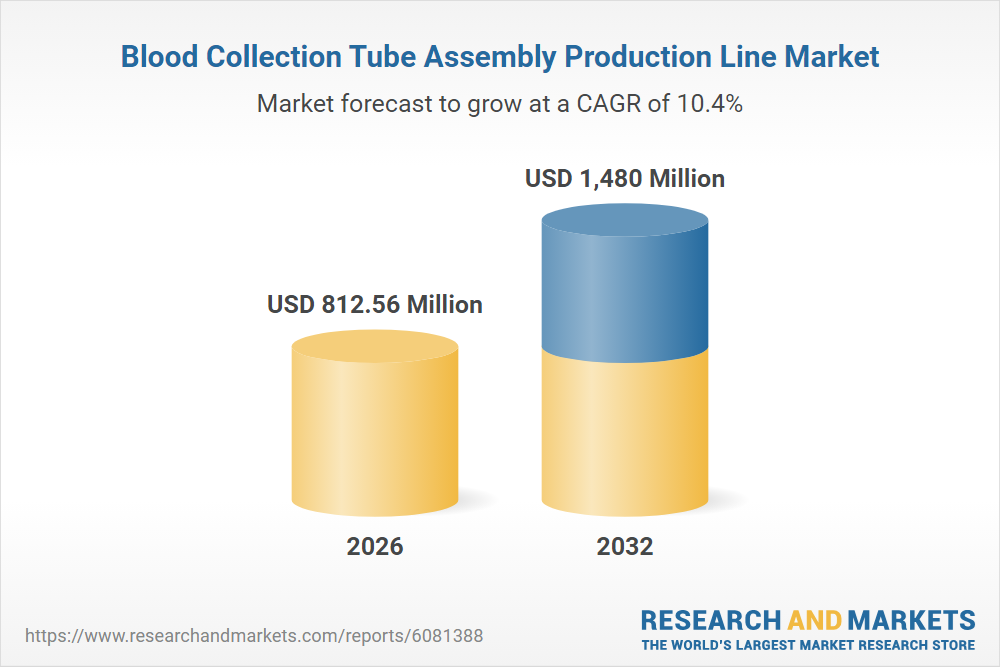
This trajectory underscores strong demand drivers, innovation in assembly automation, and heightened end-user expectations across healthcare and laboratory sectors. Regulatory pressures and tariff changes are influencing sourcing and investment strategies, while technology upgrades and material advances support the industry's response to operational and compliance challenges.
Key Takeaways: Strategic Insights for Decision Makers
- Automation adoption in blood collection tube assembly is reducing manual inputs, elevating product consistency, and enabling precise control over additive formulations.
- Material innovation and sustainability priorities are shifting product development toward options that improve durability and cold-chain compatibility, while supporting sterility standards.
- Regional and regulatory factors compel manufacturers to tailor documentation, labeling, and certification pathways to a diverse set of end markets and compliance regimes.
- Supply chains are increasingly diversified, with domestic and nearshore sourcing and tiered safety stock policies employed to mitigate risks from tariffs and global disruptions.
- Digital traceability and documentation systems are critical for batch-level responsiveness, quality investigations, and compliance with changing trade and regulatory environments.
- Segmentation across end users, materials, additives, and distribution channels directly impacts assembly line configuration, inspection protocols, and service models.
Scope & Segmentation of the Blood Collection Tube Assembly Production Line Market
- End Users: Ambulatory care clinics, hospitals, diagnostic laboratories, molecular laboratories, and blood banks with varied sample volumes, integration needs, and workflow protocols.
- Product Types: Syringe tubes and vacuum tubes, differentiated by evacuated and non-evacuated formats requiring distinct assembly and quality assurance features.
- Material Types: Borosilicate and soda-lime glass, polypropylene, polystyrene; each material mandates unique molding, annealing, and inspection protocols for sterility and durability.
- Additives: Citrate, EDTA (including K2 and K3 variants), fluoride, heparin (lithium and sodium), and serum additives, each needing precise dosing and rigorous contamination controls.
- Distribution Channels: Direct sales, manufacturer or wholesaler, online company storefronts, ecommerce marketplaces, and third-party distributors, all influencing packaging, fulfillment, and service expectations.
- Regions: Americas, Europe Middle East & Africa, and Asia-Pacific, with production decisions affected by local healthcare infrastructure, regulatory heterogeneity, and logistical frameworks.
- Technologies: Automation, robotics, validated sterilization, machine vision, digital tracking, and modular line design enhancing production flexibility and traceability.
Tariff Impact
Recent tariff introductions in the United States have reshaped sourcing patterns, shifted lead times, and increased landed costs for raw materials such as specialty glass and polymers. In response, many manufacturers are expanding supplier geographies, investing in local partnerships, and optimizing safety stock.
These changes reinforce the need for flexible procurement strategies and automation investments, as well as transparent documentation to demonstrate compliance across increasingly scrutinized production flows.
Why This Report Matters
- Provides actionable intelligence for investment, procurement, and process optimization in a rapidly evolving regulatory and sourcing landscape.
- Enables strategic alignment across engineering, operations, and commercial teams by mapping key production, compliance, and supply chain drivers.
- Supports leaders in navigating global expansion, risk management, and technology adoption for competitive differentiation.
Conclusion
Manufacturers must act with agility and coordination across engineering, procurement, and commercial teams to enhance resilience, regulatory compliance, and operational flexibility. Unified, insight-driven strategies will position leaders to outperform amid regulatory and trade headwinds, translating industry insight into sustained market advantage.
Key Attributes:
| Report Attribute | Details |
| No. of Pages | 194 |
| Forecast Period | 2026 - 2032 |
| Estimated Market Value (USD) in 2026 | $812.56 Million |
| Forecasted Market Value (USD) by 2032 | $1480 Million |
| Compound Annual Growth Rate | 10.4% |
| Regions Covered | Global |
Companies Featured
- Abbott Laboratories
- Baxter International Inc.
- Becton, Dickinson and Company
- Bio-Rad Laboratories, Inc.
- Cardinal Health, Inc.
- Danaher Corporation
- F.L. Medical S.r.l.
- Fresenius SE & Co. KGaA
- Greiner Bio-One International GmbH
- Haemonetics Corporation
- McKesson Corporation
- Medline Industries, Inc.
- Nipro Corporation
- PerkinElmer, Inc.
- Roche Holding AG
- Sarstedt AG & Co. KG
- Siemens Healthineers AG
- Smiths Medical
- Terumo Corporation
- Thermo Fisher Scientific Inc.
For more information about this report visit https://www.researchandmarkets.com/r/zap2mm
About ResearchAndMarkets.com
ResearchAndMarkets.com is the world's leading source for international market research reports and market data. We provide you with the latest data on international and regional markets, key industries, the top companies, new products and the latest trends.
Attachment
