Dublin, March 05, 2026 (GLOBE NEWSWIRE) -- The "High Altitude Pseudo Satellite Market - Global Forecast 2026-2032" has been added to ResearchAndMarkets.com's offering.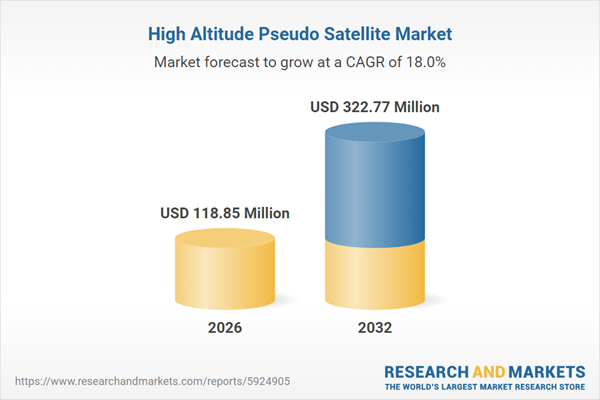
The High Altitude Pseudo Satellite (HAPS) Market demonstrates a robust growth trajectory, expanding from USD 101.39 million in 2025 to USD 118.85 million in 2026, with projected further growth to USD 322.77 million by 2032.
This market research report delves into the strategic impact of HAPS as advanced platforms for continuous connectivity and surveillance, operating at stratospheric altitudes. By blending satellite and unmanned aerial vehicle characteristics, HAPS enable persistent coverage with superior payload versatility, addressing the need for comprehensive communication and environmental monitoring.
Transformative Role of High Altitude Pseudo Satellites in Connectivity and Surveillance
High altitude pseudo satellites are poised as critical assets within the digital infrastructure development sphere. These platforms provide low-latency broadband access in remote areas, supplementing terrestrial networks. Their agility and adaptability for surveillance and monitoring reinforce their strategic importance. Technological evolutions, such as enhancements in materials and propulsion, are critical, with stakeholders recognizing their role in strategic planning and competitive advantage.
Advancements in Technology and Regulatory Maturity
Technological strides in lightweight composites, propulsion, and data analytics are revolutionizing HAPS capabilities. Solar electric propulsion and energy systems reduce reliance on ground infrastructure, while progressive data processing enhances mission execution. Regulatory frameworks are evolving to accommodate stratospheric operations, with international cooperation boosting deployment efficiency. These developments offer significant insights for market entry strategies and risk mitigation.
Tactical Analysis of United States Tariff Policies Impact
U.S. tariffs on aerospace and electronic components have reverberated across the HAPS value chain. With tariffs on solar panels and fiber optics, sourcing complexities have grown, impacting cost structures and procurement strategies. This necessitates alternative sourcing strategies and localized manufacturing to mitigate logistical and financial pressures. Such external economic influences emphasize the importance of strategic alliances and segmentation analysis.
Key Takeaways from This Report
- The high altitude pseudo satellite market is on a significant growth curve, driven by advancements in technology and strategic connectivity roles.
- Innovations in propulsion and energy systems, alongside payload miniaturization, are critical to enhancing endurance and deployment capabilities.
- Tariffs underscore the importance of diversified supply chains and local manufacturing in navigating trade barriers.
- Regional dynamics demand tailored strategies for market penetration, emphasizing localization and adaptive collaboration.
- Competitive advantage lies in strategic collaborations and technological leadership, with a focus on sustainable R&D investment.
- Understanding market segmentation allows for targeted tactical deployment across varied domains such as military operations, disaster management, and rural broadband solutions.
Competitive Landscape
- Market Concentration Analysis, 2025
- Concentration Ratio (CR)
- Herfindahl Hirschman Index (HHI)
- Recent Developments & Impact Analysis, 2025
- Product Portfolio Analysis, 2025
- Benchmarking Analysis, 2025
- AeroVironment, Inc.
- Airbus SE
- Altaeros Energies, Inc.
- Aurora Flight Sciences by Boeing Company
- BAE Systems PLC
- Cloudline Inc.
- Maraal Aerospace Pvt Ltd.
- Mira Aerospace by Space 42 Company
- Sceye Inc.
- Skydweller Aero Inc.
- Swift Engineering Inc.
- TAO-Group
- Thales Group
- World View Enterprises, Inc.
Key Attributes:
| Report Attribute | Details |
| No. of Pages | 184 |
| Forecast Period | 2026 - 2032 |
| Estimated Market Value (USD) in 2026 | $118.85 Million |
| Forecasted Market Value (USD) by 2032 | $322.77 Million |
| Compound Annual Growth Rate | 17.9% |
| Regions Covered | Global |
Key Topics Covered:
1. Preface
1.1. Objectives of the Study
1.2. Market Definition
1.3. Market Segmentation & Coverage
1.4. Years Considered for the Study
1.5. Currency Considered for the Study
1.6. Language Considered for the Study
1.7. Key Stakeholders
2. Research Methodology
2.1. Introduction
2.2. Research Design
2.2.1. Primary Research
2.2.2. Secondary Research
2.3. Research Framework
2.3.1. Qualitative Analysis
2.3.2. Quantitative Analysis
2.4. Market Size Estimation
2.4.1. Top-Down Approach
2.4.2. Bottom-Up Approach
2.5. Data Triangulation
2.6. Research Outcomes
2.7. Research Assumptions
2.8. Research Limitations
3. Executive Summary
3.1. Introduction
3.2. CXO Perspective
3.3. Market Size & Growth Trends
3.4. Market Share Analysis, 2025
3.5. FPNV Positioning Matrix, 2025
3.6. New Revenue Opportunities
3.7. Next-Generation Business Models
3.8. Industry Roadmap
4. Market Overview
4.1. Introduction
4.2. Industry Ecosystem & Value Chain Analysis
4.2.1. Supply-Side Analysis
4.2.2. Demand-Side Analysis
4.2.3. Stakeholder Analysis
4.3. Porter's Five Forces Analysis
4.4. PESTLE Analysis
4.5. Market Outlook
4.5.1. Near-Term Market Outlook (0-2 Years)
4.5.2. Medium-Term Market Outlook (3-5 Years)
4.5.3. Long-Term Market Outlook (5-10 Years)
4.6. Go-to-Market Strategy
5. Market Insights
5.1. Consumer Insights & End-User Perspective
5.2. Consumer Experience Benchmarking
5.3. Opportunity Mapping
5.4. Distribution Channel Analysis
5.5. Pricing Trend Analysis
5.6. Regulatory Compliance & Standards Framework
5.7. ESG & Sustainability Analysis
5.8. Disruption & Risk Scenarios
5.9. Return on Investment & Cost-Benefit Analysis
6. Cumulative Impact of United States Tariffs 2025
7. Cumulative Impact of Artificial Intelligence 2025
8. High Altitude Pseudo Satellite Market, by Platform Type
8.1. Airship
8.2. Fixed Wing
8.3. Unmanned Aerial Vehicles (UAVs)
9. High Altitude Pseudo Satellite Market, by Payload Type
9.1. Communication Payloads
9.2. Environmental Monitoring Sensors
9.3. Imaging Payloads
9.3.1. Multispectral/hyperspectral Sensors
9.3.2. Optical Cameras
9.4. ISR Payloads
9.5. Navigation Payloads
10. High Altitude Pseudo Satellite Market, by Propulsion Method
10.1. Fuel Cell
10.1.1. Hydrogen Fuel Cell
10.1.2. Methanol Fuel Cell
10.2. Solar Electric
10.2.1. Battery Storage
10.2.2. Energy Harvesting
11. High Altitude Pseudo Satellite Market, by Application
11.1. Disaster Management
11.2. Earth Observation
11.2.1. Agricultural monitoring
11.2.2. Environmental & Weather Monitoring
11.2.3. Mapping & Imaging
11.3. Military Operations
11.4. Surveillance & Reconnaissance
11.4.1. Border Security
11.4.2. Maritime Domain Awareness
11.5. Telecommunications & Connectivity
11.5.1. Emergency/Disaster Recovery Networks
11.5.2. Rural/Remote Broadband
12. High Altitude Pseudo Satellite Market, by Region
12.1. Americas
12.1.1. North America
12.1.2. Latin America
12.2. Europe, Middle East & Africa
12.2.1. Europe
12.2.2. Middle East
12.2.3. Africa
12.3. Asia-Pacific
13. High Altitude Pseudo Satellite Market, by Group
13.1. ASEAN
13.2. GCC
13.3. European Union
13.4. BRICS
13.5. G7
13.6. NATO
14. High Altitude Pseudo Satellite Market, by Country
14.1. United States
14.2. Canada
14.3. Mexico
14.4. Brazil
14.5. United Kingdom
14.6. Germany
14.7. France
14.8. Russia
14.9. Italy
14.10. Spain
14.11. China
14.12. India
14.13. Japan
14.14. Australia
14.15. South Korea
For more information about this report visit https://www.researchandmarkets.com/r/9fe8zh
About ResearchAndMarkets.com
ResearchAndMarkets.com is the world's leading source for international market research reports and market data. We provide you with the latest data on international and regional markets, key industries, the top companies, new products and the latest trends.
Attachment
