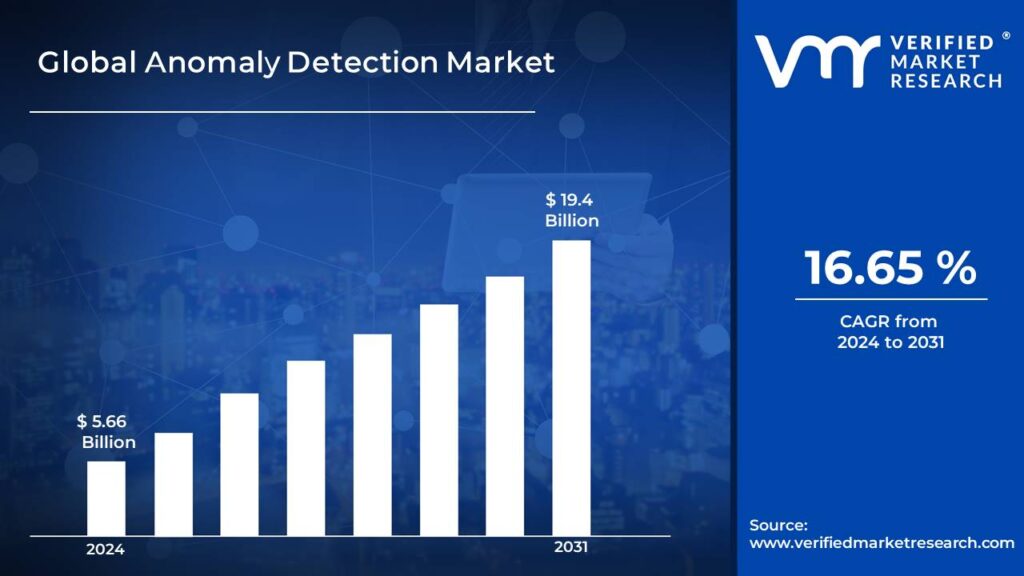
Lewes, Delaware, March 05, 2026 (GLOBE NEWSWIRE) -- Verified Market Research® indicates that the Global Anomaly Detection Market was valued at USD 5.66 Billion in 2024 and is projected to reach USD 19.4 Billion by 2031, expanding at a CAGR of 16.65% during the forecast period from 2024 to 2031. The market’s expansion is attributed to growing enterprise investments in AI-enabled monitoring systems, expanding application across digital security frameworks, and accelerating demand for automated threat detection solutions.
 Download a free sample to access exclusive Insights, Data Charts, And Forecasts From The Anomaly Detection Sample Report
Explore the full Anomaly Detection Market
• Table of Contents (TOC): 210 Pages
• Tables: 145
• Figures: 98
Anomaly Detection Market Overview
1. Escalating Cybersecurity Risks and Fraud Complexity
The surge in sophisticated cyberattacks, insider threats, and digital fraud schemes is compelling organizations to deploy anomaly detection solutions capable of identifying subtle deviations across vast datasets. Enterprises operating within highly regulated sectors increasingly rely on these technologies to strengthen compliance, mitigate financial losses, and enhance threat intelligence capabilities. For market research buyers, this driver signals sustained budget allocation trends, evolving vendor competition, and long-term revenue opportunities across security analytics and behavioral monitoring platforms.
2. Proliferation of AI, Machine Learning, and Big Data Architectures
Continuous improvements in AI algorithms and scalable cloud-based analytics infrastructure are enabling anomaly detection systems to process high-volume, high-velocity data streams with greater precision. Enterprises adopting digital transformation strategies are embedding these tools into network monitoring, predictive maintenance, and customer behavior analysis workflows. Strategic implications include vendor differentiation based on model accuracy, computational efficiency, and deployment flexibility, factors that significantly influence procurement decisions and investment strategies.
3. Expanding Enterprise Use Cases Beyond Security Applications
Anomaly detection technologies are increasingly applied across operational intelligence, quality assurance, supply chain monitoring, and healthcare diagnostics. This diversification of applications enhances cross-industry adoption while reshaping buyer priorities toward interoperability and scalability. Market research stakeholders benefit from insights into evolving demand patterns, pricing models, and vertical-specific solution innovation, which collectively determine growth potential and competitive positioning within adjacent analytics markets.
Download a free sample to access exclusive Insights, Data Charts, And Forecasts From The Anomaly Detection Sample Report.
Market Restraints
1. Data Privacy Regulations and Compliance Complexity
Strict regulatory frameworks governing data usage and cross-border data flows impose operational challenges for anomaly detection vendors and enterprise adopters. Compliance obligations may limit model training capabilities and increase legal risks, particularly in regions with evolving digital governance policies. Buyers must carefully evaluate vendor data handling practices, encryption mechanisms, and regulatory alignment to mitigate exposure.
2. Integration Barriers Across Legacy Infrastructure
Many enterprises face technical and financial constraints when integrating anomaly detection solutions into fragmented legacy systems. Compatibility issues, extended deployment timelines, and resource-intensive customization processes can delay ROI realization. This restraint highlights strategic risks for buyers assessing modernization priorities, vendor support capabilities, and total cost of ownership.
3. High Implementation and Maintenance Costs
Despite strong long-term benefits, upfront deployment expenditures and ongoing model maintenance requirements present adoption hurdles, particularly for mid-sized organizations. Budget sensitivity and uncertain performance outcomes may influence procurement cycles. Market participants must address cost-efficiency, modular deployment options, and measurable performance benchmarks to sustain adoption momentum.
Anomaly Detection Market Geographical Dominance
North America maintains dominance within the anomaly detection market, supported by advanced cybersecurity infrastructure, high enterprise digitalization levels, and early adoption of AI-driven analytics solutions. The United States leads regional demand, driven by financial services, defense, and technology sector investments. Europe represents a significant secondary market, propelled by regulatory-driven compliance initiatives and expanding industrial automation. Asia-Pacific is emerging as a high-growth region, fueled by digital transformation, rising cyber risks, and expanding cloud adoption across major economies such as China, India, and Japan. Emerging markets across Latin America and the Middle East & Africa present future opportunities as awareness and digital security investments increase.
Anomaly Detection Market Key Players
Competitive intelligence remains essential for stakeholders seeking to assess innovation pipelines, partnership strategies, and market positioning. Prominent participants in the anomaly detection market include Dell Technologies, Inc., Hewlett Packard Enterprise Company, International Business Machines Corporation, Cisco Systems, Inc, SAS Institute, Inc., Symantec Corporation, Trend Micro, Inc., Wipro Limited, Securonix, Inc., Splunk, Inc., Amazon Web Services, Inc., Broadcom, Inc., Dynatrace, Inc., Happiest Minds Technologies Limited, IBM Corporation, Microsoft Corporation.
Anomaly Detection Market Segmentation
The anomaly detection market is broadly segmented based on:
By Component:
- Solutions
- Services
By Technology:
- Commercial & Industrial
- Big Data Analytics
- Data Mining and Business Intelligence
- Machine Learning and Artificial Intelligence
By Vertical:
- Banking, Financial Services, and Insurance (BFSI)
- Retail
- Manufacturing
- IT and Telecom
- Defense and Government
- Healthcare
By Service:
- Professional services
- Managed services
By Geography
• North America
• Europe
• Asia-Pacific
• Latin America
• Middle East & Africa
To gain complete access with Corporate Or Enterprise Licensing, Visit The Anomaly Detection Market.
Anomaly Detection Market Strategic Insights
Market attractiveness remains strongest in technologically mature regions with established cybersecurity ecosystems and cloud infrastructure readiness. Entry barriers are shaped by algorithmic sophistication, data access, and compliance requirements. Pricing dynamics are influenced by deployment scale, analytics complexity, and service integration models. Vendors emphasizing regulatory alignment, ecosystem partnerships, and vertical specialization are better positioned to capture enterprise demand. Investors and enterprise buyers should monitor acquisition trends, AI model differentiation strategies, and sector-specific adoption drivers.
Key Highlights of the Report
• Comprehensive market size and forecast analysis
• In-depth segment-level evaluation
• Regional demand and investment insights
• Competitive landscape and vendor profiling
• Detailed assessment of drivers, challenges, and risks
Why This Report Matters?
This report equips decision-makers with critical intelligence required to evaluate growth opportunities, benchmark competitive positioning, and refine investment strategies. Enterprises gain actionable insights into technology adoption patterns, vendor capabilities, and regulatory considerations. The analysis supports revenue planning, risk assessment, and long-term expansion initiatives.
Who Should Read This Report?
• Market research professionals
• Industry manufacturers and technology providers
• Enterprise buyers and digital strategy leaders
• Investors, consultants, and corporate planners
Related Reports
Global Anomaly Detection Solution Market Size By Type (Statistical Anomaly Detection, Machine Learning Anomaly Detection), By Application (Network Security, Fraud Detection), By Industry Vertical (Banking, Financial Services, And Insurance (BFSI)), By Geographic Scope And Forecast
Global Deep Learning In Security Market Size By Component (Hardware, Software, Services), By Application (Intrusion Detection And Prevention Systems, Malware Detection, Anomaly Detection, Fraud Detection, Identity And Access Management, Face/Speech/Behavioural Recognition, Threat Intelligence And Prediction), By Deployment Mode (On-Premise, Cloud-Based, Hybrid), By Geographic Scope And Forecast
Global AI And Machine Learning Operationalization Software Market Size By Application (Predictive Analytics, Natural Language Processing, Computer Vision, Speech Recognition, Anomaly Detection), By Deployment (On-Premises, Cloud-Based, Hybrid), By Functionality (Model Deployment And Management, Data Preprocessing And Feature Engineering, Model Monitoring And Performance Evaluation, Integration With Existing Systems), By End-User (Healthcare, Finance, Retail, Manufacturing, Automotive, Government, Media And Entertainment, Telecommunications, Energy And Utilities, Education) By Geographic Scope And Forecast
Global Explainable AI Market Size By Component (Solution, Services), Deployment (Cloud, On-premises), Application (Fraud and Anomaly Detection, Drug Discovery & Diagnostics, Predictive Maintenance), End-User (Healthcare, BFSI, Aerospace & Defense), & Region for 2026-2032
Top Cybersecurity Companies putting firewall between confidential data and malware
Visualize Anomaly Detection Market using Verified Market Intelligence -:
Verified Market Intelligence is our BI Enabled Platform for narrative storytelling in this market. VMI offers in-depth forecasted trends and accurate Insights on over 20,000+ emerging & niche markets, helping you make critical revenue-impacting decisions for a brilliant future.
VMI provides a holistic overview and global competitive landscape with respect to Region, Country, Segment, and Key players of your market. Present your Market Report & findings with an inbuilt presentation feature saving over 70% of your time and resources for Investor, Sales & Marketing, R&D, and Product Development pitches. VMI enables data delivery In Excel and Interactive PDF formats with over 15+ Key Market Indicators for your market.
About Us
Verified Market Research® stands at the forefront as a global leader in Research and Consulting, offering unparalleled analytical research solutions that empower organizations with the insights needed for critical business decisions. Celebrating 10+ years of service, VMR has been instrumental in providing founders and companies with precise, up-to-date research data.
With a team of 500+ Analysts and subject matter experts, VMR leverages internationally recognized research methodologies for data collection and analyses, covering over 15,000 high impact and niche markets. This robust team ensures data integrity and offers insights that are both informative and actionable, tailored to the strategic needs of businesses across various industries.
VMR's domain expertise is recognized across 14 key industries, including Semiconductor & Electronics, Healthcare & Pharmaceuticals, Energy, Technology, Automobiles, Defense, Mining, Manufacturing, Retail, and Agriculture & Food. In-depth market analysis cover over 52 countries, with advanced data collection methods and sophisticated research techniques being utilized. This approach allows for actionable insights to be furnished by seasoned analysts, equipping clients with the essential knowledge necessary for critical revenue decisions across these varied and vital industries.
Verified Market Research® is also a member of ESOMAR, an organization renowned for setting the benchmark in ethical and professional standards in market research. This affiliation highlights VMR's dedication to conducting research with integrity and reliability, ensuring that the insights offered are not only valuable but also ethically sourced and respected worldwide.
Follow Us On: LinkedIn | Twitter | Threads | Instagram | Facebook
