Dublin, May 18, 2026 (GLOBE NEWSWIRE) -- The "Electric Vehicle on-Board Charger - Global Strategic Business Report" report has been added to ResearchAndMarkets.com's offering.
The global market for Electric Vehicle On-Board Charger was valued at US$26.7 Billion in 2024 and is projected to reach US$76.8 Billion by 2030, growing at a CAGR of 19.3% from 2024 to 2030. This comprehensive report provides an in-depth analysis of market trends, drivers, and forecasts, helping you make informed business decisions.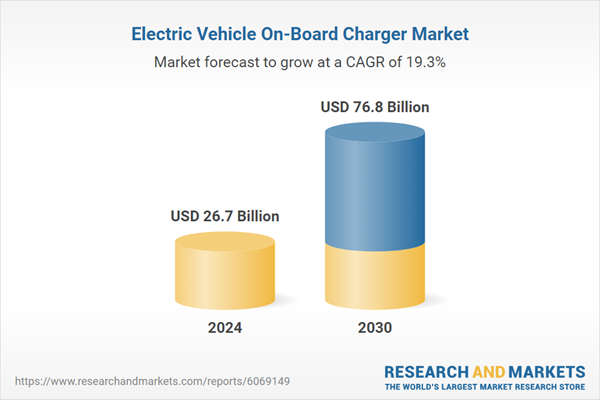
Technological advancements in OBCs have led to faster charging times, improved energy efficiency, and greater compactness, making them an integral part of the growing EV market. In recent years, the shift towards more compact and lightweight OBC designs, which do not compromise on performance, has been a significant trend.
As consumer demand for quicker and more efficient charging grows, the development of high-power OBCs capable of supporting ultra-fast charging is gaining momentum, thereby enhancing the convenience and appeal of electric vehicles. As the industry continues to prioritize seamless user experiences, OBCs will play a pivotal role in ensuring that EVs meet the growing expectations for fast, reliable, and accessible charging solutions.
What Are the Key Drivers Behind the Growth of the Electric Vehicle On-Board Charger Market?
The growth in the electric vehicle on-board charger (OBC) market is driven by several key factors related to technological advancements, market demand, and regulatory pressures. First, the increasing adoption of electric vehicles worldwide is a significant driver. As more consumers and businesses opt for EVs, the demand for faster, more efficient, and more reliable OBCs grows.
Second, advancements in charging technology, including ultra-fast charging capabilities and improvements in battery management systems (BMS), are pushing the need for more advanced OBCs that can handle higher charging rates without compromising battery health. Third, as EV adoption expands across regions with varying infrastructure readiness, the need for standardized and interoperable OBCs is increasing.
Many markets are moving toward universal charging standards, which means that the development of standardized OBCs that can work across different charging networks is crucial. Additionally, the development of public and private charging infrastructure is enhancing access to EV charging, further stimulating the demand for advanced OBCs.
Fourth, regulatory policies targeting the reduction of carbon emissions and the promotion of clean energy are creating favorable conditions for EV adoption, directly impacting the demand for OBCs as part of the broader shift toward electrified transport. Lastly, the growth of electric fleets, including delivery vehicles, buses, and trucks, is contributing to the rise of OBC demand, as fleet operators look for reliable and efficient charging solutions for their vehicles. As these factors continue to align, the OBC market is set for sustained growth, driven by the broader transition to electric mobility and the continuous push for innovation in charging technology.
How Are Technological Innovations Advancing On-Board Chargers for Faster Charging?
The development of on-board chargers (OBCs) is closely linked to innovations in power electronics, thermal management, and battery chemistry, which collectively contribute to faster, safer, and more efficient EV charging. One of the key technological advancements is the integration of silicon carbide (SiC) and gallium nitride (GaN) semiconductors into OBC designs. These wide-bandgap semiconductors enable higher efficiency and faster switching speeds, reducing energy loss and allowing for smaller and lighter charging units.
As a result, EVs equipped with SiC or GaN-based OBCs are able to charge more quickly while also increasing overall system efficiency. Additionally, advances in thermal management techniques are helping to keep OBCs cool during high-speed charging, preventing overheating and ensuring the longevity of both the charger and the vehicle's battery.
New software algorithms that optimize the charging process based on factors like battery health, state of charge, and external temperature are also playing a crucial role in improving charging speeds while protecting the battery from damage. Furthermore, innovations in bidirectional charging technology are enabling OBCs to allow energy to flow in both directions - allowing the vehicle' s battery to discharge power back into the grid or to other devices.
These developments not only enhance the functionality of OBCs but also pave the way for the future of vehicle-to-grid (V2G) capabilities, which will contribute to the grid's efficiency and sustainability.
Key Insights:
- Market Growth: Understand the significant growth trajectory of the Battery Electric Vehicle Propulsion segment, which is expected to reach US$46.0 Billion by 2030 with a CAGR of a 18.1%. The Plug-In Hybrid Electric Vehicle Propulsion segment is also set to grow at 20.9% CAGR over the analysis period.
- Regional Analysis: Gain insights into the U.S. market, valued at $7.0 Billion in 2024, and China, forecasted to grow at an impressive 18.3% CAGR to reach $11.8 Billion by 2030. Discover growth trends in other key regions, including Japan, Canada, Germany, and the Asia-Pacific.
Report Scope
- Segments: Propulsion (Battery Electric Vehicle Propulsion, Plug-In Hybrid Electric Vehicle Propulsion, Other Propulsions); Rating (11 kW Rating, 11 kW - 22 kW Rating, Above 22 kW Rating).
- Geographic Regions/Countries: World; United States; Canada; Japan; China; Europe (France; Germany; Italy; United Kingdom; and Rest of Europe); Asia-Pacific; Rest of World.
Key Attributes:
| Report Attribute | Details |
| No. of Pages | 136 |
| Forecast Period | 2024 - 2030 |
| Estimated Market Value (USD) in 2024 | $26.7 Billion |
| Forecasted Market Value (USD) by 2030 | $76.8 Billion |
| Compound Annual Growth Rate | 19.3% |
| Regions Covered | Global |
Key Topics Covered:
MARKET OVERVIEW
- Trade Shocks, Uncertainty, and the Structural Rewiring of the Global Economy
- How Trump's Tariffs Impact the Market? The Big Question on Everyone's Mind
- Electric Vehicle On-Board Charger - Global Key Competitors Percentage Market Share in 2025 (E)
- Competitive Market Presence - Strong/Active/Niche/Trivial for Players Worldwide in 2025 (E)
MARKET TRENDS & DRIVERS
- Rising EV Sales Globally Throw the Spotlight on Efficient and Compact On-Board Charging Systems
- Growth in Residential and Workplace Charging Infrastructure Spurs Demand for Flexible AC Charging Solutions
- Advancements in Power Electronics and Semiconductor Technologies Strengthen the Business Case for High-Efficiency Chargers
- OEM Focus on Vehicle Lightweighting and Space Optimization Drives Innovation in Integrated Charger Designs
- Expansion of Long-Range and High-Capacity EVs Increases Demand for 11kW to 22kW On-Board Charging Systems
- Government Regulations and Charging Standardization Policies Propel Development of Interoperable Charging Architectures
- Dual and Bi-Directional Charging Capabilities Generate Opportunities in Vehicle-to-Grid (V2G) Integration
- Shift Toward Modular and Scalable Charger Platforms Supports Multi-Model and Platform-Agnostic EV Development
- Silicon Carbide (SiC) and GaN Technologies Enhance Charger Efficiency, Power Density, and Thermal Performance
- Integration of Smart Charging Features and Communication Protocols Drives Adoption in Connected EV Ecosystems
- Rising Demand for Fast and Level 2 Charging at Home and Fleet Depots Expands Market for High-Power On-Board Chargers
- Increased Electrification of Commercial Vehicles and Buses Spurs Demand for Robust and Durable Charger Systems
FOCUS ON SELECT PLAYERS:Some of the 36 companies featured in this Electric Vehicle On-Board Charger market report
- AVID Technology Limited
- Bel Power Solutions & Protection
- BorgWarner Inc.
- Bosch
- BRUSA Elektronik AG
- Current Ways Inc.
- Delphi Technologies
- Eaton Corporation plc
- Hangzhou Aodi Electronic Control Co., Ltd
- Hyundai Mobis
- Infineon Technologies AG
- Innoelectric GmbH
- Lear Corporation
- Stercom Power Solutions GmbH
- STMicroelectronics
- Tesla, Inc.
- Toyota Industries Corporation
- Valeo SA
- Volta Charging
- Xepics Italia SRL
For more information about this report visit https://www.researchandmarkets.com/r/kj1kjz
About ResearchAndMarkets.com
ResearchAndMarkets.com is the world's leading source for international market research reports and market data. We provide you with the latest data on international and regional markets, key industries, the top companies, new products and the latest trends.
Attachment
