Dublin, May 18, 2026 (GLOBE NEWSWIRE) -- The "High Power Electric Vehicle Busbar - Global Strategic Business Report" report has been added to ResearchAndMarkets.com's offering.
The global market for High Power Electric Vehicle Busbar was valued at US$417.5 Million in 2024 and is projected to reach US$1.3 Billion by 2030, growing at a CAGR of 20.4% from 2024 to 2030. This comprehensive report provides an in-depth analysis of market trends, drivers, and forecasts, helping you make informed business decisions.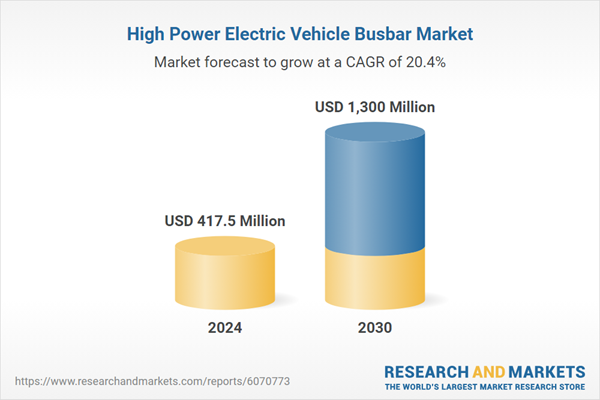
High power electric vehicle (EV) busbars are transforming the way power is transmitted within EVs, replacing traditional wiring harnesses with more efficient, compact, and durable solutions. These advanced conductive components provide superior electrical conductivity, reduced energy losses, and improved thermal management, making them essential in the next generation of EVs. With the increasing demand for high-voltage EVs, including passenger cars, commercial fleets, and electric trucks, the role of high power busbars in ensuring efficient power distribution is becoming more critical.
What Is Driving the Growth of the High Power Electric Vehicle Busbar Market?
The growth in the high power electric vehicle busbar market is driven by several factors, including the accelerating transition to electric mobility, increasing adoption of high-voltage EV architectures, and advancements in power electronics. Government incentives and regulatory mandates promoting EV adoption are compelling automakers to invest in more efficient and high-performance power distribution systems, further fueling demand for busbars.
The rise in fast-charging infrastructure and ultra-rapid charging stations is also contributing to market expansion, as high power busbars play a crucial role in enabling high-speed energy transfer. Additionally, advancements in battery technology and the push for higher energy density and power efficiency in EVs are increasing the need for busbars capable of handling high current loads. The expansion of commercial electric fleets, including buses and trucks, is another major driver, as these vehicles require robust and high-capacity electrical distribution systems.
Furthermore, partnerships between automakers and component manufacturers are accelerating innovation, leading to the development of next-generation busbars with enhanced efficiency, durability, and safety. With these factors in play, the high power electric vehicle busbar market is poised for sustained growth, playing a pivotal role in the evolution of the global electric vehicle industry.
What Are the Key Advancements Driving the High Power Busbar Market?
The rapid evolution of high power electric vehicle busbars is being fueled by advancements in materials, manufacturing techniques, and design optimization.
The adoption of high-conductivity copper and lightweight aluminum alloys is enabling the development of busbars with improved energy efficiency and reduced weight, which is crucial for extending EV range. Additionally, the integration of flexible and modular busbar designs is providing automakers with customizable solutions tailored to specific powertrain requirements.
The implementation of laser welding and automated manufacturing processes is also enhancing production efficiency, ensuring high precision and repeatability in large-scale manufacturing. Another significant development is the incorporation of thermal management solutions within busbars, such as liquid cooling channels and phase change materials, to dissipate heat and maintain optimal performance under high-power loads. As battery technology advances, the need for busbars that can handle higher power densities and fast-charging capabilities is driving continuous research and development in this sector.
Report Features:
- Comprehensive Market Data: Independent analysis of annual sales and market forecasts in US$ Million from 2024 to 2030.
- In-Depth Regional Analysis: Detailed insights into key markets, including the U.S., China, Japan, Canada, Europe, Asia-Pacific, Latin America, Middle East, and Africa.
- Complimentary Updates: Receive free report updates for one year to keep you informed of the latest market developments.
Key Insights:
- Market Growth: Understand the significant growth trajectory of the Copper Material segment, which is expected to reach US$926.3 Million by 2030 with a CAGR of a 22.3%. The Aluminum Material segment is also set to grow at 16.2% CAGR over the analysis period.
- Regional Analysis: Gain insights into the U.S. market, valued at $113.7 Million in 2024, and China, forecasted to grow at an impressive 27.8% CAGR to reach $304.9 Million by 2030. Discover growth trends in other key regions, including Japan, Canada, Germany, and the Asia-Pacific.
Report Scope
- Segments: Material (Copper Material, Aluminum Material).
- Geographic Regions/Countries: World; United States; Canada; Japan; China; Europe (France; Germany; Italy; United Kingdom; Spain; Russia; and Rest of Europe); Asia-Pacific (Australia; India; South Korea; and Rest of Asia-Pacific); Latin America (Argentina; Brazil; Mexico; and Rest of Latin America); Middle East (Iran; Israel; Saudi Arabia; United Arab Emirates; and Rest of Middle East); and Africa.
Key Attributes:
| Report Attribute | Details |
| No. of Pages | 172 |
| Forecast Period | 2024 - 2030 |
| Estimated Market Value (USD) in 2024 | $417.5 Million |
| Forecasted Market Value (USD) by 2030 | $1300 Million |
| Compound Annual Growth Rate | 20.4% |
| Regions Covered | Global |
Key Topics Covered:
MARKET OVERVIEW
- Trade Shocks, Uncertainty, and the Structural Rewiring of the Global Economy
- How Trump's Tariffs Impact the Market? The Big Question on Everyone's Mind
- High Power Electric Vehicle Busbar - Global Key Competitors Percentage Market Share in 2025 (E)
- Competitive Market Presence - Strong/Active/Niche/Trivial for Players Worldwide in 2025 (E)
MARKET TRENDS & DRIVERS
- Growth of Electric Bus Adoption Drives Demand for High Power Electric Vehicle Busbars
- Advancements in Electric Vehicle (EV) Battery Technology Propel the Need for High Power Busbars
- Government Initiatives and Incentives for EVs Expands Addressable Market for High Power Busbars
- The Push Toward Zero-Emission Public Transport Spurs the Adoption of High Power Busbars in Electric Buses
- Increased Investment in EV Charging Infrastructure Accelerates Demand for High Power Busbars
- Rising Fuel Prices and Environmental Concerns Drive Growth in Electric Vehicle Busbar Applications
- Technological Innovations in Lightweight Materials Strengthen the Business Case for High Power Busbars
- Integration of Smart Grid Technologies Enhances Market Opportunity for High Power EV Busbars
- The Surge in Demand for Energy-Efficient Vehicles Drives Adoption of Advanced Busbar Systems
- Regulatory Mandates for Reduced Emissions Propel Growth in Electric Bus Market and High Power Busbar Demand
- Expansion of Electric Vehicle Fleets by Public Transport Providers Creates New Market Demand for Busbars
- The Increasing Focus on Fast-Charging Infrastructure Demands Advanced Busbar Solutions for High Power Charging Stations
- Development of High-Capacity EV Batteries Increases Need for Efficient Power Distribution Solutions like Busbars
- Rising Electrification of Urban Transport Drives Growth of High Power Busbars in Electric Buses
- Advances in Busbar Design for High Current Capability Support the Growing Electric Vehicle Market
- Emergence of New Markets for Electric Buses in Developing Economies Strengthens Demand for High Power Busbars
- Shift Towards Sustainable Public Transport Solutions Spurs Investments in Electric Buses and Busbars
- Integration of Autonomous Driving Technologies in Electric Buses Increases the Need for Advanced Electrical Components like Busbars
- Emerging Trends in Wireless Power Transfer for Electric Vehicles Impact Busbar Innovation and Adoption
- Cost-Effective Manufacturing of High Power Busbars Strengthens Competitive Advantage in the Electric Bus Market
- The Rise of Renewable Energy Adoption for EV Charging Networks Enhances Demand for High Power Busbar Solutions
- Growing Consumer Preference for Eco-Friendly Transportation Options Propels EV Bus Market Growth and Demand for Busbars
- Increase in Global Urbanization Accelerates Demand for Electric Buses and High Power Busbars
- Standardization of Busbar Designs for EVs Increases Operational Efficiency and Drives Market Adoption
- The Focus on Power Density and Thermal Management in Busbar Design Propels Market Growth in Electric Vehicles
FOCUS ON SELECT PLAYERS:Some of the 34 companies featured in this High Power Electric Vehicle Busbar market report
- Aichie Tech Company
- Amphenol Corporation
- Connor Manufacturing Services
- Draxlmaier Group
- Eaton Corporation
- EG Electronics
- Electric Materials Company
- Furukawa Electric Co., Ltd.
- HV Wooding Ltd
- Junkosha Inc.
- Leoni AG
- LS Cable & System
- Mersen
- Nexans
- Raychem RPG
- Rogers Corporation
- RPK Group
- Sumitomo Electric Industries, Ltd.
- TE Connectivity
- Zhuzhou CRRC Times Electric Co., Ltd.
For more information about this report visit https://www.researchandmarkets.com/r/55s4wi
About ResearchAndMarkets.com
ResearchAndMarkets.com is the world's leading source for international market research reports and market data. We provide you with the latest data on international and regional markets, key industries, the top companies, new products and the latest trends.
Attachment
