Dublin, July 20, 2026 (GLOBE NEWSWIRE) -- The "Dental Matrix Systems Market - Global Forecast 2026-2032" report has been added to ResearchAndMarkets.com's offering.
The Dental Matrix Systems Market is projected to reach USD 433.60 Million in 2026. It is expected to continue growing at a CAGR of 5.75%, reaching USD 608.49 Million by 2032. 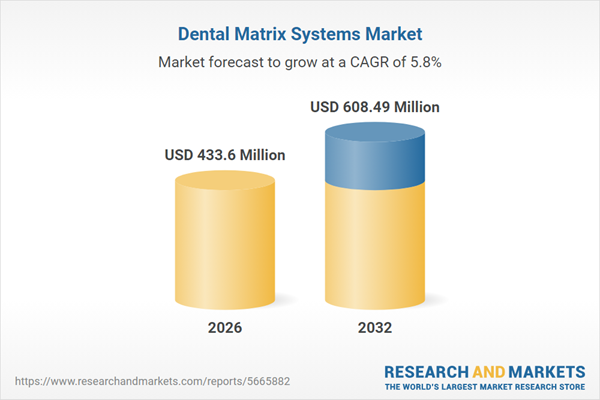
Dental matrix systems are essential restorative dentistry devices used to recreate proximal contours, establish contact points, and support controlled placement of restorative materials during Class II and complex posterior restorations. Demand is being shaped by the global burden of dental caries, the expansion of adhesive dentistry, rising use of composite restorations, and the ongoing shift toward minimally invasive treatment protocols. Verified public health evidence from the World Health Organization identifies oral diseases as among the most common noncommunicable conditions worldwide, while untreated dental caries remains a leading cause of preventable tooth damage. In this environment, sectional matrix systems, circumferential bands, pre-contoured matrices, dental wedges, separator rings, and related accessories are increasingly evaluated on clinical performance, ease of placement, anatomical adaptation, infection control compatibility, and workflow efficiency. SEO-relevant themes driving the dental matrix systems landscape include restorative dentistry, Class II restorations, composite placement, dental bands, sectional matrix systems, posterior tooth restoration, and evidence-based dental practice.
Transformative Shifts Reshaping Dental Matrix Systems
The dental matrix systems landscape is undergoing a meaningful transition from basic mechanical containment toward precision-driven restorative support. Traditional metal bands remain widely used because of their strength and familiarity, but clinicians are increasingly adopting pre-contoured and sectional matrix systems that better support anatomical emergence profiles and tight interproximal contacts. This shift aligns with the broader movement from amalgam-based restorative workflows toward resin composite and adhesive restorations, which require improved isolation, controlled contouring, and predictable adaptation. Material innovation is also changing product expectations, with matrices designed for thinner profiles, improved flexibility, enhanced burnishability, and compatibility with modern curing protocols. At the same time, dental practices are prioritizing single-use and sterilization-compatible components as infection prevention standards remain central to chairside care. Dental education, continuing professional development, and clinical technique standardization are accelerating adoption, particularly where posterior composite restoration outcomes depend on repeatable proximal anatomy, reduced finishing time, and reliable marginal integrity.
Cumulative Impact of Artificial Intelligence on Dental Matrix Workflows
Artificial intelligence is beginning to influence the dental matrix systems ecosystem indirectly through diagnosis, treatment planning, education, inventory management, and digital workflow optimization. AI-enabled dental imaging can support earlier detection of proximal caries and restoration defects, increasing the importance of precise restorative execution after diagnosis. In clinical training, simulation platforms and image-based feedback tools can help practitioners evaluate matrix placement, contact formation, marginal adaptation, and restoration contour quality. For manufacturers and distributors, AI-supported demand planning can improve availability of frequently used bands, rings, wedges, and applicators across dental clinics and academic institutions. AI can also strengthen quality control by supporting defect detection in component manufacturing and packaging inspection. While the matrix itself remains a tactile chairside instrument, the surrounding workflow is becoming more data-driven, linking radiographic assessment, case selection, procedural guidance, documentation, and procurement into a more efficient restorative dentistry value chain.
Key Regional Insights Across Dental Matrix Systems
Asia-Pacific is characterized by a large patient base, rising dental service utilization, and expanding private dental care infrastructure across China, India, Japan, South Korea, Australia, and Southeast Asian economies. Public oral health data indicate that untreated caries and periodontal conditions remain significant concerns in many parts of the region, supporting ongoing need for restorative dentistry tools, including sectional and circumferential matrix systems. North America demonstrates high adoption of advanced restorative materials, strong continuing dental education networks, and mature infection control standards, which encourage the use of anatomically designed matrices, separator rings, and wedge systems for predictable posterior composite restorations. Latin America shows growing access to dental services in urban centers, with Brazil and Mexico playing notable roles in dental education, clinical training, and restorative procedure activity; affordability and product durability remain important purchasing considerations. Europe benefits from well-established dental care systems, strong regulatory oversight, and high emphasis on minimally invasive dentistry, creating demand for precision matrix systems that support conservative tooth preparation and long-term restoration quality. In the Middle East, expanding healthcare investment, medical tourism in selected urban hubs, and rising awareness of aesthetic restorative dentistry support adoption of advanced dental consumables. Africa presents a diverse access landscape, where urban private clinics increasingly use modern restorative systems while many communities continue to face workforce, affordability, and access constraints; durable, easy-to-use, and cost-effective matrix solutions are especially relevant for broader restorative care delivery.
Key Group Insights Influencing Dental Matrix Adoption
ASEAN dental markets are supported by expanding urban dental networks, growing dental education capacity, and rising demand for restorative and aesthetic procedures, making technique-friendly dental matrix systems important for both general dentists and specialist practices. The GCC benefits from healthcare modernization, high private-sector participation, and increased patient expectations for aesthetic restorative outcomes; this supports demand for premium sectional matrix systems, pre-contoured bands, and accessories that reduce chair time and improve contact formation. The European Union places strong emphasis on product safety, clinical evidence, materials compliance, and sustainability considerations, encouraging manufacturers and dental professionals to prioritize quality-controlled matrix systems compatible with regulated dental workflows. BRICS countries reflect substantial heterogeneity, combining large untreated oral disease burdens, expanding middle-class dental consumption, public health challenges, and domestic manufacturing capabilities; this creates a need for both advanced restorative systems and affordable consumable options. G7 countries generally demonstrate advanced dental technology adoption, broader clinician access to continuing education, and high procedural expectations for restorative quality, supporting uptake of precision matrix systems for posterior composite restorations. NATO member countries overlap with many developed dental markets where procurement reliability, regulatory compliance, and clinical standardization are important, particularly in institutional, military, and public-sector dental care settings that require consistent restorative outcomes.
Key Country Insights for Dental Matrix Systems
The United States shows strong utilization of restorative dentistry services, broad adoption of adhesive composite techniques, and robust dental continuing education, supporting sustained use of sectional matrix systems, circumferential bands, wedges, and ring systems in private practices and dental schools. Germany's advanced dental sector and engineering-oriented procurement culture support interest in durable, precise, and ergonomically designed matrix systems, while China's expanding dental infrastructure and rising oral health awareness support broader use of modern restorative systems, especially in urban clinics. The United Kingdom emphasizes evidence-based dentistry and regulated clinical practice, favoring products that support predictable contact points, marginal integrity, and efficient posterior restorations. India's large untreated caries burden, expanding dental workforce, and price-sensitive purchasing environment create demand for scalable and cost-effective matrix solutions. Japan is characterized by an aging population, strong dental technology adoption, and high-quality clinical expectations, supporting precise restorative instrumentation. Canada's dental care landscape is shaped by high clinical standards, preventive care orientation, and expanding public dental coverage initiatives, which may improve restorative treatment access and related consumable use. France, Italy, and Spain demonstrate mature restorative dentistry practices with growing emphasis on aesthetic composite restorations and minimally invasive approaches. South Korea's advanced dental sector, high patient expectations, and strong technology orientation support adoption of modern matrix systems for aesthetic and posterior restorative care. Mexico combines a large domestic patient base with cross-border dental care activity in selected regions, where efficiency, affordability, and reliable restorative outcomes influence matrix system selection. Brazil has one of the world's largest dental professional communities, supporting broad use of restorative consumables and strong demand for training-compatible matrix systems. Russia maintains demand through public and private dental channels, although procurement conditions can vary by region. Australia's preventive and restorative care environment favors clinically efficient systems used across general dental practices.
Actionable Recommendations for Dental Industry Leaders
Industry leaders should prioritize clinically validated product design that supports tight proximal contacts, anatomical contouring, gingival adaptation, and efficient removal after curing. Product portfolios should address both premium and value segments, as purchasing priorities differ across developed, emerging, and access-constrained dental markets. Training is critical: manufacturers, distributors, and dental educators should invest in technique guides, hands-on workshops, digital learning modules, and evidence-based chairside protocols focused on Class II composite restorations. Leaders should also strengthen supply chain resilience for high-turnover consumables such as bands, wedges, rings, and applicators, while ensuring compliance with infection control and medical device regulations in target regions. Sustainability should be addressed through responsible packaging, material efficiency, and clear disposal guidance where feasible. Finally, integration with digital dentistry ecosystems, including AI-supported education, radiographic case review, and inventory analytics, can improve clinician confidence and operational efficiency without compromising the tactile precision required during restorative procedures.
Research Methodology for Evidence-Based Dental Matrix Analysis
This executive summary is built on a structured secondary research approach using verified public health, regulatory, clinical, and industry-relevant sources. The analysis considers global oral disease evidence, restorative dentistry practice patterns, dental materials trends, regulatory expectations for dental devices, infection control norms, and regional healthcare infrastructure indicators. Insights are synthesized from credible sources such as public oral health agencies, dental associations, peer-reviewed literature, regulatory guidance, and health system publications. The methodology emphasizes qualitative interpretation rather than market sizing, market share analysis, or forecasting. Regional, group, and country insights are assessed through the lens of oral disease burden, dental workforce development, access to care, clinical practice maturity, materials adoption, and procurement priorities. The result is an evidence-aligned view of how dental matrix systems are positioned within modern restorative dentistry, without relying on speculative commercial estimates.
Conclusion: Advancing Precision in Dental Matrix Systems
Dental matrix systems remain a foundational component of high-quality restorative dentistry, particularly as clinicians manage posterior composite restorations, proximal caries, and patient expectations for durable, aesthetic outcomes. The category is being reshaped by minimally invasive dentistry, advanced restorative materials, infection control requirements, clinician training needs, and digital workflow support. Regional dynamics vary significantly: mature markets prioritize precision, compliance, and efficiency, while emerging markets require scalable, affordable, and easy-to-use solutions that support broader access to restorative care. Artificial intelligence will not replace the hands-on role of matrix placement, but it can enhance diagnosis, education, quality control, and supply chain decisions around restorative procedures. Industry participants that combine evidence-based design, practical training, regulatory readiness, and adaptable pricing strategies will be better positioned to support dentists in achieving predictable proximal contacts, improved restoration contours, and better patient outcomes.
Key Attributes:
| Report Attribute | Details |
| No. of Pages | 198 |
| Forecast Period | 2026 - 2032 |
| Estimated Market Value (USD) in 2026 | $433.6 Million |
| Forecasted Market Value (USD) by 2032 | $608.49 Million |
| Compound Annual Growth Rate | 5.7% |
| Regions Covered | Global |
Key Topics Covered:
1. Preface
1.1. Objectives of the Study
1.2. Market Definition
1.3. Market Segmentation & Coverage
1.4. Years Considered for the Study
1.5. Currency Considered for the Study
1.6. Language Considered for the Study
1.7. Key Stakeholders
2. Research Methodology
2.1. Introduction
2.2. Research Design
2.2.1. Primary Research
2.2.2. Secondary Research
2.3. Research Framework
2.3.1. Qualitative Analysis
2.3.2. Quantitative Analysis
2.4. Market Size Estimation
2.4.1. Top-Down Approach
2.4.2. Bottom-Up Approach
2.5. Data Triangulation
2.6. Research Outcomes
2.7. Research Assumptions
2.8. Research Limitations
3. Executive Summary
3.1. Introduction
3.2. CXO Perspective
3.3. Market Size & Growth Trends
3.4. New Revenue Opportunities
3.5. Next-Generation Business Models
3.6. Industry Roadmap
4. Market Overview
4.1. Introduction
4.2. Industry Ecosystem & Value Chain Analysis
4.2.1. Supply-Side Analysis
4.2.2. Demand-Side Analysis
4.2.3. Stakeholder Analysis
4.3. Market Dynamics
4.3.1. Key Drivers
4.3.2. Key Restraints
4.3.3. Key Opportunities
4.3.4. Key Challenges
4.4. Porter's Five Forces Analysis
4.5. PESTLE Analysis
4.6. Market Outlook
4.6.1. Near-Term Market Outlook (0-2 Years)
4.6.2. Medium-Term Market Outlook (3-5 Years)
4.6.3. Long-Term Market Outlook (5-10 Years)
4.7. Go-to-Market Strategy
5. Market Insights
5.1. Consumer Insights & End-User Perspective
5.2. Consumer Experience Benchmarking
5.3. Opportunity Mapping
5.4. Distribution Channel Analysis
5.5. Pricing Trend Analysis
5.6. Regulatory Compliance & Standards Framework
5.7. ESG & Sustainability Analysis
5.8. Disruption & Risk Scenarios
5.9. Return on Investment & Cost-Benefit Analysis
6. Cumulative Impact of Artificial Intelligence 2026
7. Dental Matrix Systems Market, by Matrix Type
7.1. Introduction
7.2. Circumferential Matrices
7.2.1. Automatrix Retainer
7.2.2. Tofflemire Retainer
7.3. Retainer Matrices
7.3.1. Ivory Retainer
7.3.2. Universal Retainer
7.4. Sectional Matrices
7.4.1. Ring Systems
7.4.1.1. Automatrix System
7.4.1.2. SuperMat Ring
7.4.2. Strip Systems
7.4.2.1. Metal Strips
7.4.2.2. Plastic Strips
8. Dental Matrix Systems Market, by Component
8.1. Introduction
8.2. Bands and Strips
8.2.1. Coated/PTFE Bands
8.2.2. Polyester/Mylar Strips
8.2.3. Pre-Contoured/Anatomical Bands
8.2.4. Stainless Steel Bands
8.3. Instruments & Accessories
8.3.1. Burnishers/Contact Formers
8.3.2. Ring Placement Forceps
8.3.3. Separators/Spreaders
8.4. Rings & Retainers
8.4.1. Contra-Angle Retainer
8.4.2. Nickel-Titanium Rings
8.4.3. Stainless Steel Rings
8.4.4. Universal Retainer
8.5. Wedges
8.5.1. Elastomeric Wedges
8.5.2. Light-Transmitting Wedges
8.5.3. Plastic Wedges
8.5.4. Wooden Wedges
9. Dental Matrix Systems Market, by Material
9.1. Introduction
9.2. Metals
9.2.1. Nickel-Titanium
9.2.2. Stainless Steel
9.2.3. Titanium
9.3. Natural and Other
9.3.1. Elastomeric Silicone
9.3.2. Transparent Celluloid
9.3.3. Wood
9.4. Polymers
9.4.1. Polycarbonate/Plastic
9.4.2. Polyester/Mylar
9.4.3. PTFE-Coated
10. Dental Matrix Systems Market, by Reusability
10.1. Introduction
10.2. Reusable
10.3. Single-Use
11. Dental Matrix Systems Market, by Price Tier
11.1. Introduction
11.2. Economy
11.3. Mid-Range
11.4. Premium
12. Dental Matrix Systems Market, by Application
12.1. Introduction
12.2. Endodontic Procedures
12.2.1. Endodontic Retreatment
12.2.2. Primary Endodontic Treatment
12.3. Pediatric Dentistry
12.3.1. Pediatric Restorations
12.3.2. Preventive Dentistry
12.4. Restorative Dentistry
12.4.1. Direct Restorations
12.4.2. Indirect Restorations
13. Dental Matrix Systems Market, by Distribution Channel
13.1. Introduction
13.2. Offline
13.2.1. Channel Partners
13.2.2. Direct Sales
13.3. Online
13.3.1. Company Owned Website
13.3.2. Third Party Platforms
14. Dental Matrix Systems Market, by End User
14.1. Introduction
14.2. Academic And Research Institutes
14.2.1. Research Centers
14.2.2. Universities
14.3. Homecare Settings
14.3.1. Individual Consumers
14.3.2. Tele-Dentistry Providers
14.4. Hospitals And Clinics
14.4.1. General Dentistry Clinics
14.4.2. Specialty Dental Clinics
15. Dental Matrix Systems Market, by Region
15.1. Asia-Pacific
15.2. North America
15.3. Latin America
15.4. Europe
15.5. Middle East
15.6. Africa
16. Dental Matrix Systems Market, by Group
16.1. ASEAN
16.2. GCC
16.3. European Union
16.4. BRICS
16.5. G7
16.6. NATO
17. Dental Matrix Systems Market, by Country
17.1. United States
17.2. Germany
17.3. China
17.4. United Kingdom
17.5. India
17.6. Japan
17.7. Canada
17.8. France
17.9. South Korea
17.10. Italy
17.11. Mexico
17.12. Brazil
17.13. Russia
17.14. Spain
17.15. Australia
18. Competitive Landscape
18.1. Market Share Analysis, 2025
18.2. FPNV Positioning Matrix, 2025
18.3. Market Concentration Analysis, 2025
18.3.1. Concentration Ratio (CR)
18.3.2. Herfindahl Hirschman Index (HHI)
18.4. Recent Developments & Impact Analysis, 2025
18.5. Product Portfolio Analysis, 2025
18.6. Benchmarking Analysis, 2025
Companies Featured
- AMD Medicom Inc.
- Bioclear Matrix Systems
- Coltene Holding AG
- Dentsply Sirona Inc.
- FKG Dentaire
- Foshan RIXI Medical Equipment Co.,Ltd.
- Garrison Dental Solutions, LLC
- GC Corporation
- Henan Baistra Industries Corp.
- Henry Schein, Inc.
- Hu-Friedy Mfg. Co., LLC
- Huanghua Promisee Dental Co, Ltd.
- Ivoclar Vivadent AG
- KaVo Dental
- Lifco AB
- Markson Dental Systems
- Osakadent Co., Ltd.
- Pac-Dent Inc.
- Patterson Companies, Inc.
- Premier Dental Co.
- Regenity Biosciences
- Septodont Inc.
- Shanghai S&D International Dental Co., Ltd.
- Shofu Inc.
- Skycare Dental
- SkyDentalSupply
- Solventum
- Straumann Holding AG
- Tianjin Spider Impex Co., Ltd.
- Ultradent Products Inc.
- Water Pik, Inc
- Young Innovations, Inc.
- Zest Anchors
- Zhengzhou Ulike Dental Equipment Co.,Ltd.
- Zyris, Inc.
For more information about this report visit https://www.researchandmarkets.com/r/tmbk1i
About ResearchAndMarkets.com
ResearchAndMarkets.com is the world's leading source for international market research reports and market data. We provide you with the latest data on international and regional markets, key industries, the top companies, new products and the latest trends.
Attachment
