HongKong, July 28, 2026 (GLOBE NEWSWIRE) -- BrowserAct, the AI web scraping and browser automation company, today announced the launch of BrowserAct Agent, a new way to build web scrapers: describe the data you need, and an AI agent goes to the live website and builds the scraper for you — a reusable one you can run again and again, with no code, no selectors, and no scripts for users to write or maintain themselves.
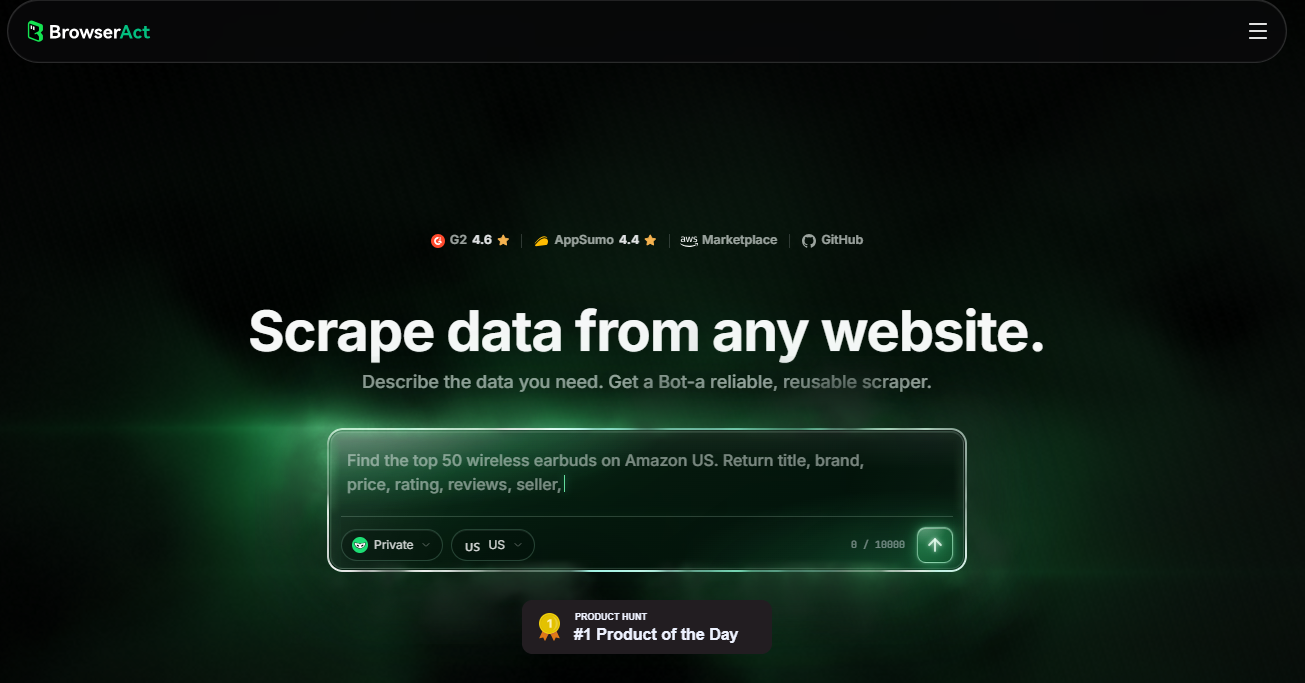
Web data has become a core input for pricing, sourcing, sales, and market research, but collecting it reliably has traditionally required engineering resources: writing custom scrapers, configuring selectors, and revisiting them as websites evolve. Dynamic pages and structural changes often mean ongoing manual upkeep. BrowserAct Agent shifts that work to an AI agent. Users describe the target website, the conditions to apply, and the fields to return; the Agent explores the real site in a real browser, works through filters, pagination, and detail pages, and automatically tests the extraction before handing back a reusable scraper.
"Everyone in this market can generate a scraper. Almost no one verifies it," said a BrowserAct spokesperson. "BrowserAct Agent doesn't just write an extraction and hope it works — it runs the workflow on the live website, checks the output against what the user asked for, and only then delivers the scraper. What you get isn't a script to debug. It's a result you can trust, and a scraper you can run again tomorrow."
Built for the websites that challenge traditional scrapers
Rather than parsing static HTML, BrowserAct Agent drives a real browser through the same steps a person would take. That allows it to extract data from pages where conventional approaches struggle: JavaScript-heavy content, fields hidden behind filters and tabs, infinite scroll, listing-to-detail navigation, and multi-step flows.
Supported CAPTCHA and human-verification scenarios are handled during exploration. Some tasks may still be affected by login requirements, permissions, regional restrictions, website risk controls, or verification types that are not yet supported — and in those cases, the task returns a clear reason rather than a silent failure.
Each completed run returns structured data in a consistent schema — not raw HTML. Where source pages are available, records retain their source page URLs; fields that were not shown or could not be accessed are explicitly flagged instead of silently filled.
Traceability as a first-class feature
A defining design decision in BrowserAct Agent is that results stay inspectable. Extracted records keep their source page URLs when available, missing values are reported openly, and every run is versioned — which version ran, what it returned, why it stopped, and what it cost.
"Structured data is only useful if you can defend it," the spokesperson added. "When a number ends up in a pricing decision or a board deck, someone will ask where it came from. BrowserAct Agent is built so the answer is easy to find."
Built for the people who need the data, not just the people who can code
BrowserAct Agent is aimed squarely at business users who have always needed web data but never had a way to collect it themselves: e-commerce teams gathering product, price, review, and competitor data on a repeatable schedule without building a scraper; marketing teams turning hours of manual competitor research into a repeatable web workflow; sales teams assembling B2B prospect research from public company sites and directories, with parameterized inputs and consistent outputs; and recruiters and talent researchers following job openings and hiring signals across multiple career sites.
BrowserAct Agent is available today through BrowserAct's subscription plans, offered monthly or annually, with usage drawn from a shared credit pool across the platform. Every plan starts with a 7-day free trial that includes trial credits, so new users can build and run their first scraper before committing. Full plan details are available at the BrowserAct pricing page, and new users can get started at www.browseract.com.
About BrowserAct
BrowserAct, is an AI web scraping and browser automation platform. BrowserAct turns plain-English descriptions into tested, reusable scrapers that extract structured data from complex, real-world websites, using a real browser environment with support for stealth browsing, proxy routing, and common verification scenarios. The platform is designed for both business teams and developers who need reliable, traceable web data without building or maintaining scraping infrastructure themselves.
Get started: https://www.browseract.com/?co-from=PRAgent
Media contact: support@browseract.com
