Wilmington, DE, United States, Sept. 09, 2026 (GLOBE NEWSWIRE) -- Industrial Buyers Delaying Long-Term Packaging Agreements to Face Structural Supply Risks
For most of the past decade, bulk packaging was treated as a back-office line item, a cost to be minimized rather than a position to be defended. That assumption is quietly breaking down. As chemical producers redesign supply chains around resilience instead of pure cost, the container itself is becoming a point of competitive leverage, and the firms securing dedicated production capacity now are buying something their rivals cannot easily replicate later.
What looks externally like a stable, slow-moving category is, underneath, a market reorganizing around proximity, traceability, and circular ownership models. The Intermediate Bulk Container Market is being reshaped by buyers who have stopped thinking in purchase orders and started thinking in multi-year supply security. The gap between those two postures is widening, and it is widening faster than quarterly procurement reviews tend to capture.
Request a Free Sample Report: https://marketmindsadvisory.com/request-sample/?report_id=54
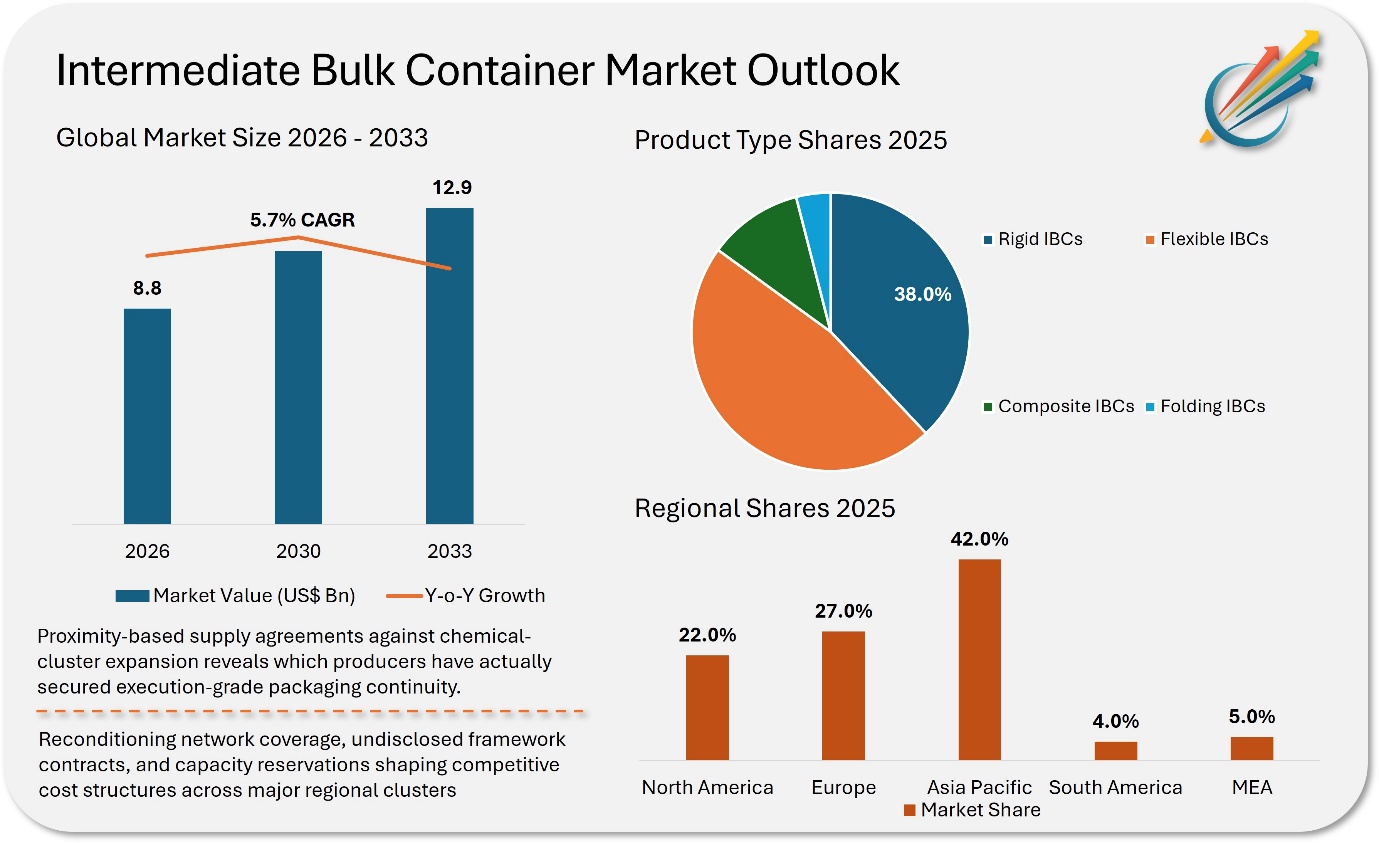
Key Takeaways from Intermediate Bulk Container Market
- The intermediate bulk container market is valued at US$ 8.8 billion in 2026, anchored by sustained chemical and food-grade demand and is estimated to reach US$ 12.9 billion by 2033, expanding at a CAGR of 5.7% over the forecast period.
- Reconditioning and closed-loop reuse are shifting economics from unit price toward total cost of ownership.
- Plastic IBCs hold the dominant material share, though composite formats are gaining in corrosive-service applications.
- On-site and proximity-based production agreements are emerging as a structural supply security strategy in intermediate bulk container market.
- Pharmaceutical and food-grade certification requirements are widening the price gap between commodity and qualified containers.
- Asia-Pacific manufacturing expansion is concentrating new capacity additions outside traditional Western supply bases across intermediate bulk container market.
As per AVP from Market Minds Advisory, "The decisive question has shifted from what an IBC costs to whether a buyer can rely on getting one when a production line needs it. Companies that lock in dedicated capacity and reconditioning relationships over the next four to six quarters will set their packaging economics for the rest of the decade."
Early Movers Locking Dedicated Capacity and Reconditioning Advantage ahead of Competitors
The window for treating containers as interchangeable commodities is closing, and the reasons are structural rather than cyclical.
- Capacity is being reserved, not just purchased: New IBC production lines are increasingly tied to specific anchor customers before they are built. Buyers without forward commitments are competing for residual supply, often at weaker terms.
- Certification is becoming a moat: Food-grade and pharmaceutical-grade qualification involves time, audits, and trust. Once a supplier relationship clears that bar, switching costs rise sharply, and incumbents know it.
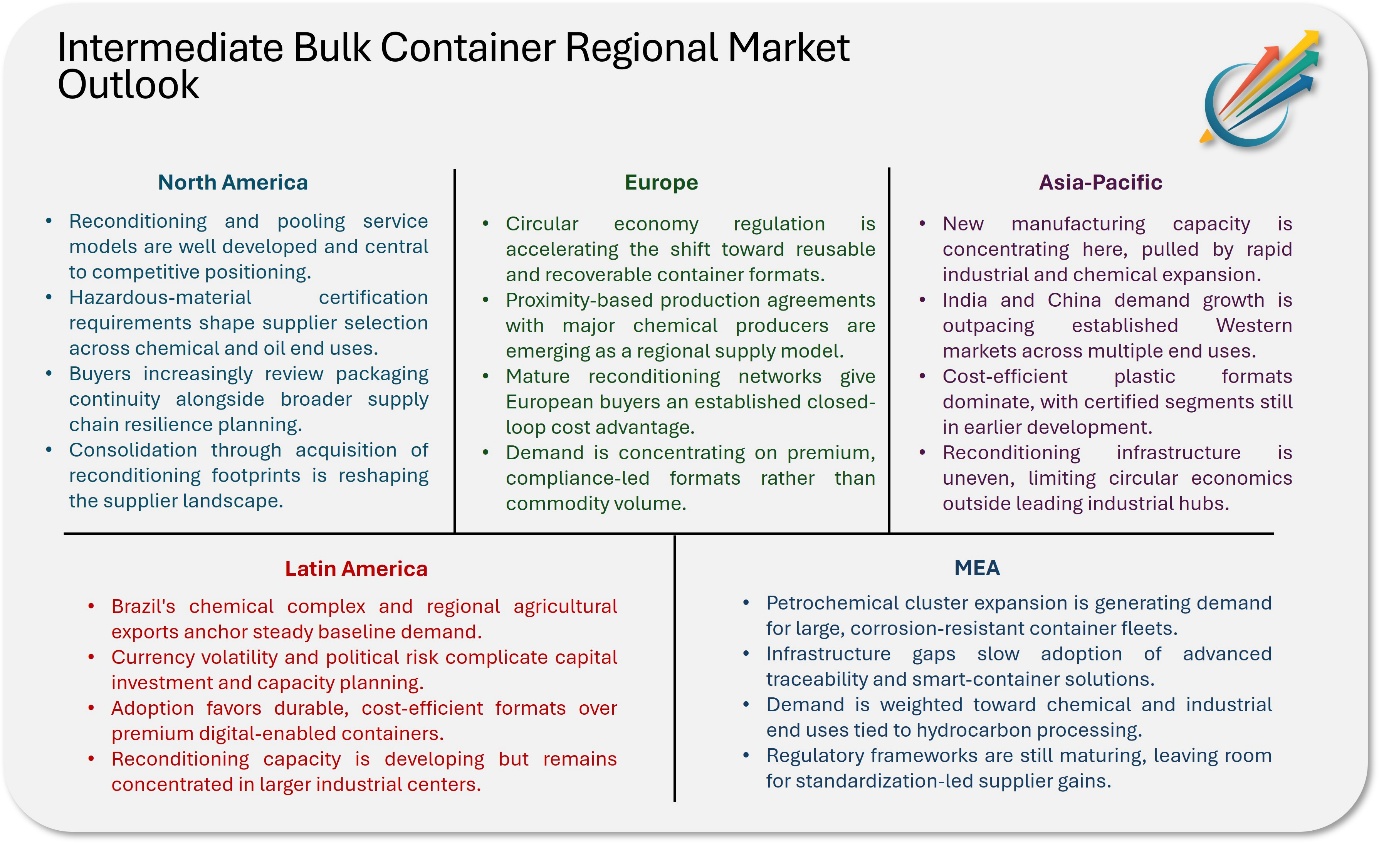
- Reconditioning capacity is geographically uneven: Closed-loop reuse only works where collection and refurbishment networks exist. In regions where they do not, the circular cost advantage simply is not available yet, and that asymmetry is now a sourcing variable across the intermediate bulk container market.
Economics of Bulk Packaging Quietly Moving towards Lifecycle Management and Service Integration
The clearest change in this market is not a new material or a new size. It is a change in what buyers are actually purchasing. Container supply is migrating toward bundled service relationships.
- From transactions to lifecycle agreements: Leading suppliers increasingly sell collection, reconditioning, and replacement as a single managed offering. This reframes the intermediate bulk container market around recurring service revenue rather than one-time unit sales, and it changes how competitive position is built.
- Traceability is becoming an embedded expectation: Digital tracking on containers, once a premium feature, is moving toward standard specification in regulated end uses. Suppliers without a credible data layer face a narrowing addressable market among sophisticated buyers.
- Proximity is being engineered into supply: On-site and adjacent-site production arrangements with major chemical producers point to a model where the container plant is integrated into the customer's logistics. This is difficult for competitors to dislodge once established.
Intermediate Bulk Container Market Evolving Faster than Industrial Sourcing Strategies Anticipated
Commentary that frames this as a low-growth commodity category understates the divergence inside it. Commodity rigid containers and certified, service-wrapped containers are effectively becoming two different markets with two different margin structures, and aggregate growth figures obscure that split.
The widely cited assumption that reconditioning uniformly lowers cost holds only where infrastructure already exists. In several developing regions, reuse economics will lag for years. Buyers who assume a universal circular advantage will misprice their sourcing strategy.
Consolidation will not be driven mainly by scale-seeking acquisitions of capacity. The more consequential moves will be acquisitions of reconditioning networks and regional service footprints, because those assets, not raw production volume, are the harder constraint to build organically.
Supply Chain Resilience, Reconditioning Networks, and Certification Standards Reshaping Competitive Dynamics
Supply chain resilience as a procurement priority
Chemical and pharmaceutical manufacturers have absorbed several years of disruption, and the lesson has stuck. Packaging continuity is now reviewed alongside feedstock security rather than after it. This elevates suppliers who can guarantee availability through dedicated capacity, regional redundancy, or proximity arrangements, and it penalizes those competing purely on spot price. The container has moved up the risk register, and procurement mandates increasingly reflect that repositioning across major buying organizations.
Regulatory tightening around reuse and material recovery
Environmental regulation in developed markets is steadily favoring reusable and recoverable packaging formats over single-use alternatives. Compliance is shifting from a voluntary sustainability narrative toward a binding operational requirement. Suppliers with established reconditioning systems and recycled-content credentials are structurally advantaged as these rules harden, while those reliant on single-cycle sales face a slowly contracting compliant market and rising pressure on their commercial positioning.
The rise of certified, application-specific containers
Generic containers are losing ground to formats engineered for defined service conditions, whether pharmaceutical sterility, food contact, or aggressive chemical exposure. Qualification for these uses is demanding and slow, which means the certified segment behaves differently from the commodity base. Pricing power, customer retention, and switching friction are all higher here, and this is where suppliers are concentrating differentiation rather than competing on undifferentiated volume.
Geographic redistribution of manufacturing capacity
New production investment is not landing evenly. Asia-Pacific industrial expansion is pulling fresh capacity toward regional demand centers, while developed markets prioritize premium, compliance-led formats over volume. The result is a gradual redrawing of where the intermediate bulk container market is actually made, and buyers with single-region exposure are reassessing that concentration as both a cost and a continuity risk worth actively managing.
Ignoring Structural Risks could Delay Competitive Readiness across Industrial Supply Chains
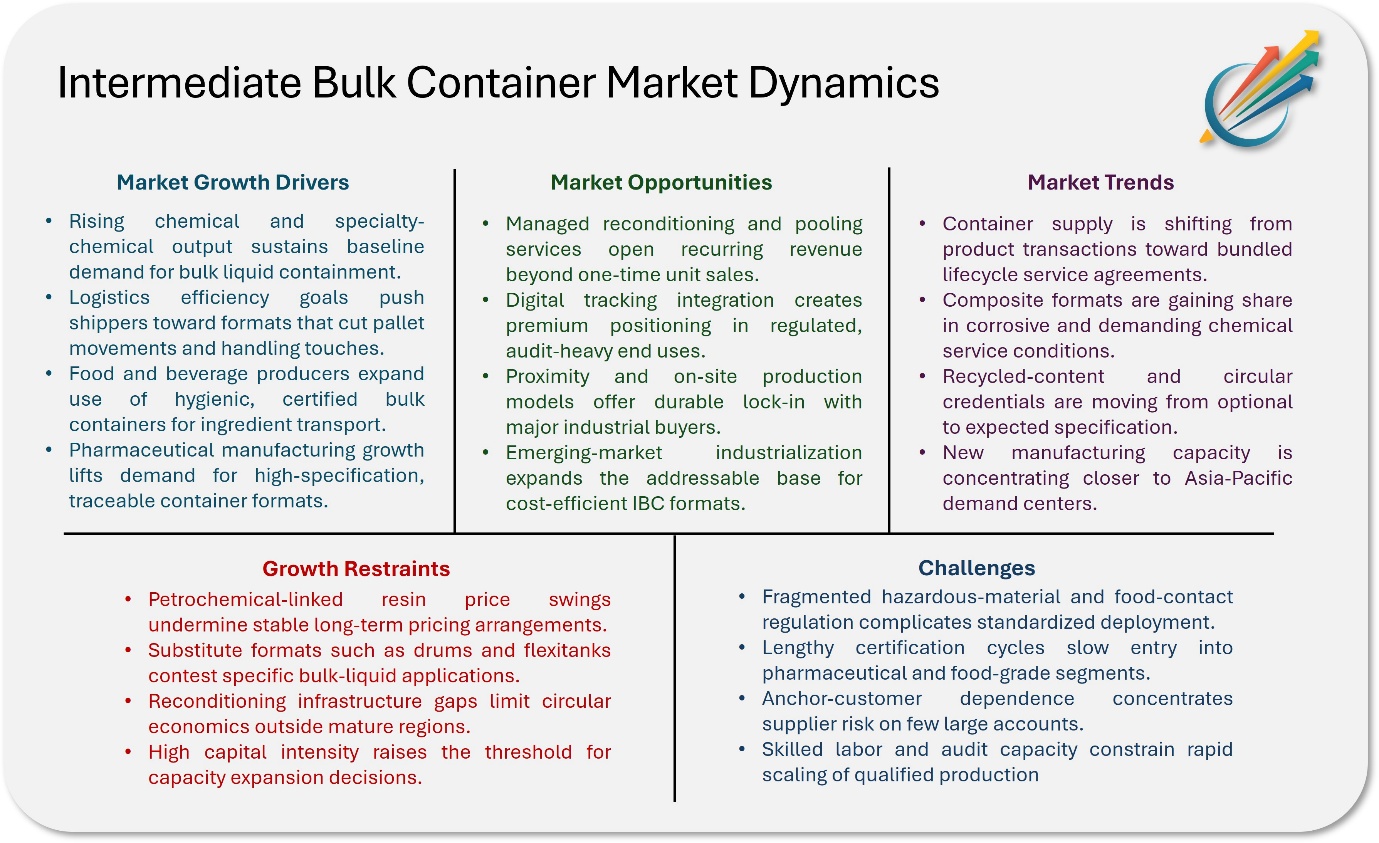
- Resin price volatility: Polyethylene and polypropylene input costs remain exposed to petrochemical cycles, compressing margins and complicating long-term pricing commitments for suppliers and buyers alike.
- Uneven reconditioning infrastructure: Closed-loop economics depend on collection density that does not yet exist in many regions, limiting the circular cost advantage outside mature markets.
- Regulatory fragmentation: Diverging hazardous-material and food-contact standards across jurisdictions raise compliance complexity and can slow cross-border deployment of standardized formats.
- Substitution pressure: Drums, flexitanks, and flexible bulk formats continue to compete for specific bulk-liquid lanes, capping IBC penetration in contested applications.
- Capital intensity of new capacity: High fixed-cost manufacturing investment raises the barrier for expansion and exposes suppliers to demand-timing risk if industrial output softens.
- Customer concentration: Proximity and anchor-customer models, while defensive, also tie supplier economics tightly to a small number of large accounts all over intermediate bulk container market.
None of these risks reverses the directional conclusion. They shape the pace and the geography of growth rather than the trajectory itself, and buyers who plan around them will be better positioned than those who treat the outlook as frictionless.
Market Dynamics Shaping the Intermediate Bulk Container Market
Intermediate Bulk Container Market Segmentation
By Product Type
- Rigid IBCs
- Flexible IBCs
- Type A
- Type B
- Type C
- Type D
- Composite IBCs
- Folding IBCs
Rigid and composite formats anchor the bulk of demand, particularly where chemical compatibility and structural durability are decisive in the intermediate bulk container market. Flexible IBCs serve dry powder and granule handling where collapsibility and lower return-freight cost matter. Folding designs address a narrower need around storage footprint and reverse logistics. The strategic divide within product type is less about format and more about whether a container is sold as a standalone good or embedded in a reuse program.
By Material Type
- Plastic IBC
- High Density Polyethylene
- Polypropylene
- Metal IBC
- Carbon Steel
- Stainless Steel
- Composite Materials
- Fabric Materials
Plastic holds the dominant material position, supported by chemical resistance, weight advantage, and a mature reconditioning base all over intermediate bulk container market. Metal IBCs, especially stainless steel, retain a defensible niche in high-purity and high-pressure service. Composite formats are gaining where corrosion exposure is severe. Material choice increasingly tracks regulatory and lifecycle considerations rather than sticker price, and that reframing favors suppliers with credible recovery systems.
By Capacity
- Up to 500 liters
- 500 to 1,000 liters
- 1,000 to 1,500 liters
- 1,500 to 2,000 liters
- Above 2,000 liters
The 1,000 to 1,500 liter band represents the practical workhorse range across chemical and food applications, balancing pallet compatibility with payload efficiency. Smaller capacities serve specialty and pharmaceutical batch handling. Larger formats address industrial fluid handling where fewer, bigger units reduce handling cost. Capacity selection is becoming a logistics optimization decision rather than a simple volume choice, with handling economics driving specification across intermediate bulk container market.
By Grade
- Food grade IBC
- Pharmaceutical grade IBC
- Chemical grade IBC
- Industrial grade IBC
- Hazardous material certified IBC
Grade is where margin structure diverges most sharply. Industrial and chemical grades behave like a competitive commodity base, while pharmaceutical and food grades command pricing power through certification difficulty and switching friction. Hazardous-material certified formats carry compliance value that buyers will pay to secure. In the intermediate bulk container market, grade increasingly predicts profitability better than volume does.
By Application
- Liquid transport
- Powder and granule storage
- Hazardous material handling
- Bulk ingredient storage
- Industrial fluid handling
Liquid transport remains the largest application anchor, reinforced by chemical and lubricant flows in the intermediate bulk container market. Powder and granule storage sustains flexible-format demand. Hazardous material handling is the most regulation-sensitive application and the one where traceability and certification deliver the clearest premium. Bulk ingredient storage ties demand to food and beverage growth, giving the segment a steadier, less cyclical profile than industrial uses.
By End Use
- Chemical industry
- Food and beverage
- Pharmaceutical
- Agriculture industry
- Oil and lubricants
- Construction
The chemical industry is the demand backbone and the primary driver of proximity-based supply models across intermediate bulk container market. Food and beverage and pharmaceutical end uses, though smaller, grow faster and reward suppliers who can meet hygiene and audit standards. Agriculture and oil and lubricants provide volume with pronounced cyclicality. Construction is a smaller, project-linked contributor. End-use mix increasingly determines which suppliers are structurally advantaged.
Shape this report around your priorities: https://marketmindsadvisory.com/request-customization/?report_id=54
Regional Market Outlook
Investment Focus where the Lucrative Opportunity is Anticipated in Intermediate Bulk Container Market
Managed reconditioning and pooling services
The strongest recurring-revenue position lies in owning the reuse cycle rather than the unit sale. Reconditioning networks are slow and capital-intensive to build, which makes them genuinely defensible. Suppliers that control collection density and refurbishment capacity capture margin that pure manufacturers cannot reach, and they raise switching costs for the customers they serve.
Certified pharmaceutical and food-grade formats
Qualification difficulty is the moat here. Containers cleared for pharmaceutical and food contact carry pricing power that commodity formats lack, and the audit-heavy approval process discourages buyers from switching. As regulated end uses grow faster than the industrial base, this is where disproportionate value will accumulate for suppliers willing to invest in certification.
Traceability and digital container intelligence
Embedded tracking is shifting from premium feature to expected specification in regulated applications. Suppliers building a credible data layer convert commodity steel and plastic into service-differentiated assets. The opportunity is not the sensor itself but the lifecycle visibility, compliance support, and loss reduction it enables, which together deepen customer lock-in.
Proximity and on-site production arrangements
Integrating container production into a major customer's site or adjacent footprint creates a position competitors struggle to dislodge. These arrangements convert a procurement relationship into shared infrastructure. For suppliers, the strategic logic is durability of revenue; for buyers, it is the supply security that intermediate bulk container market disruption has made a board-level concern.
What This Means for Decision-Makers
Chemical Manufacturers - Treat packaging continuity as a supply chain risk rather than a procurement detail. Securing dedicated capacity or proximity-based arrangements now protects production uptime that spot purchasing cannot reliably guarantee through the next demand cycle.
Packaging Suppliers - The defensible growth is in reconditioning networks, certification, and service bundling, not raw volume. Competing on unit price alone cedes the higher-margin segments of the intermediate bulk container market to better-positioned rivals.
Investors - The category is not a uniform low-growth commodity. The split between commodity and certified, service-wrapped containers creates clearer risk-return positions, and reconditioning footprints are scarce assets worth pricing accordingly.
Industrial Buyers in Food, Pharma, and Agriculture - Begin certification-aligned supplier qualification early, since approval cycles are long. Single-region sourcing exposure deserves active review as manufacturing capacity continues redistributing toward Asia-Pacific demand centers.
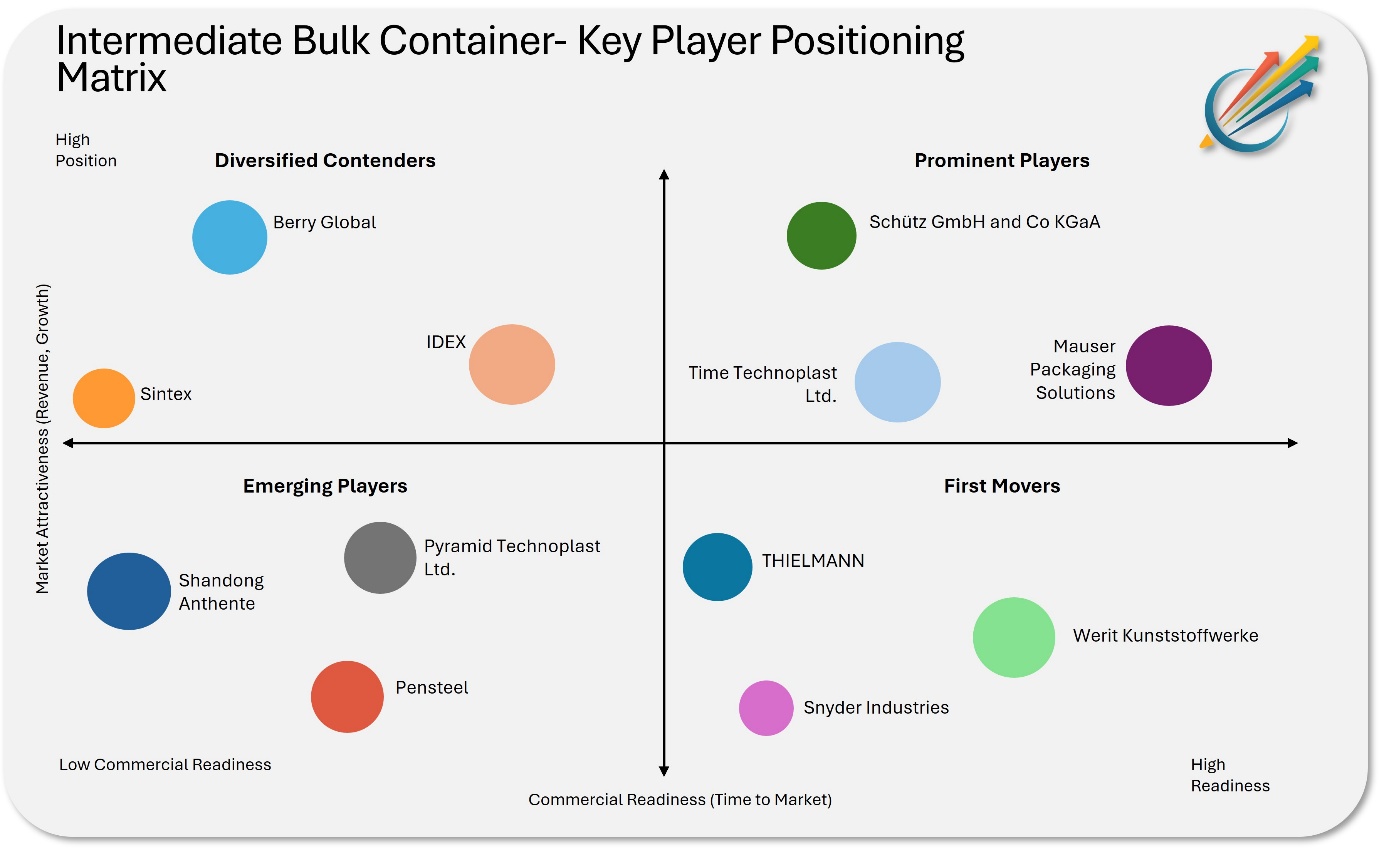
Competitive Landscape: Intermediate Bulk Container Market
Recent Market Developments
- In March 2026, Schütz GmbH and Co KGaA signed an agreement with BASF to build a highly automated IBC production and storage facility directly adjacent to BASF's main complex in Ludwigshafen.
- In October 2025, Greif Inc completed the acquisition of a European IBC manufacturer, adding substantial annual production capacity to its portfolio.
- In September 2025, Mauser Packaging Solutions introduced an RFID-enabled industrial container line, with initial deployment among major chemical producers.
- In January 2026, Time Technoplast Ltd. continued expanding its industrial packaging capacity to serve growing chemical and pharmaceutical demand across South Asian markets.
Market is segmented by product type (rigid, flexible, composite, folding IBCs), material type (plastic, metal, composite, fabric), capacity (up to 500 liters through above 2,000 liters), and end use (chemical, food and beverage, pharmaceutical, etc)
Get Access to complete Analysis, Buy Now: https://marketmindsadvisory.com/buy-now/?report_id=54
Trending Reports
- Hermetic Jars Market
- Hemp Paper Bag Market
- Heel Tampography Printing Machine Market
- Heavy Duty Paper Tags Market
- Heavy Duty Vacuum Bottle Market
- Heat Shrink Packaging Market
- Hazardous Disposal Bag Market
- HDPE Crate Market
- Handheld Tagging Gun Market
- Metal Bulk Containers Market
Why choose Market Minds Advisory
Market Minds Advisory delivers decision-grade intelligence to executives across machinery, packaging, chemicals, automotive, ICT, food and beverage, consumer goods, and healthcare. We help organizations sharpen market expansion strategies, accelerate share gains, refine brand positioning, and enable account-level growth. Our forecasting integrates primary interviews, proprietary demand models, and continuous market validation, producing the kind of clarity volatile and emerging industries require. Backed by over a decade of sector expertise, our research surfaces white space, opportunity gaps, and competitive blind spots, accounting for recent developments and geopolitical risk. We help businesses see the future of their markets.
Contact Us
Market Minds Advisory
1521 Concord Pike, Suite 301
Wilmington, DE 19803
United States
Email: sales@marketmindsadvisory.com
Website: https://marketmindsadvisory.com/
