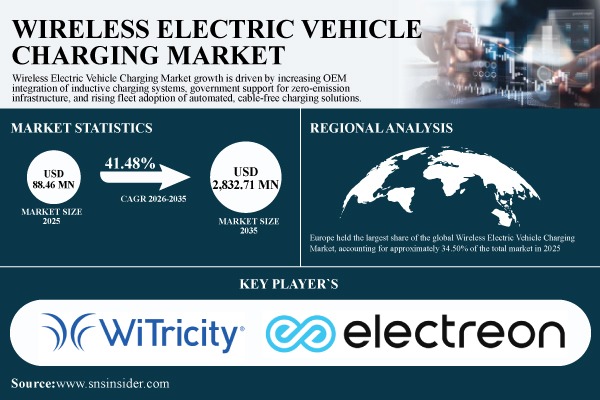
Austin, Sept. 18, 2026 (GLOBE NEWSWIRE) -- As per the SNS Insider, the Wireless Electric Vehicle Charging Market was valued at USD 88.46 Million in 2025 and is expected to reach USD 2,832.71 Million by 2035, growing at a CAGR of 41.48% from 2026 to 2035.
Market expansion is fueled by rapid adoption of inductive charging technology within battery electric vehicles by OEMs, more government support for zero emission transport infrastructure, and growing fleets' interest in cable-free charging systems. Further development in magnetic resonance, efficient inductive power transmission, dynamic road charging technology, and compatibility standards, such as SAE J2954 and ISO/IEC 61980 will contribute to further adoption of this technology.
Download the Wireless Electric Vehicle Charging Market Sample Report: https://www.snsinsider.com/sample-request/11110
Wireless Electric Vehicle Charging Market Key Highlights
- Market size, 2025: USD 88.46 Million
- Market forecast, 2035: USD 2,832.71 Million
- CAGR: 41.48% from 2026 to 2035
- Largest region: Europe, with approximately 34.50% share in 2025
- Fastest-growing region: Asia Pacific, at approximately 48.65% CAGR from 2026 to 2035
- Largest charging type: Static Wireless Charging, with 71.85% share in 2025
- Fastest-growing charging type: Dynamic Wireless Charging, at approximately 52.40% CAGR
- Largest technology: Inductive Power Transfer, with 68.75% share in 2025
- Fastest-growing technology: Magnetic Resonance Coupling, at approximately 47.90% CAGR
- Largest component: Base Charging Pad, with 46.30% share in 2025
- Fastest-growing component: Power Control Unit, at approximately 44.65% CAGR
- Largest power output: 11–50 kW, with 52.15% share in 2025
- Fastest-growing power output: Above 50 kW, at approximately 49.80% CAGR
- Largest vehicle type: Battery Electric Vehicle, with 76.40% share in 2025
- Fastest-growing vehicle type: Battery Electric Vehicle, at approximately 43.25% CAGR
- Largest application: Passenger Vehicles, with 63.20% share in 2025
- Fastest-growing application: Commercial Vehicles, at approximately 46.55% CAGR
- Largest distribution channel: OEM, with 58.90% share in 2025
- Fastest-growing distribution channel: Aftermarket, at approximately 45.10% CAGR
- Largest end use: Commercial & Public Infrastructure, with 41.75% share in 2025
- Fastest-growing end use: Fleet & Depot Charging, at approximately 50.20% CAGR
Market Relevance
The relevance of wireless charging for EVs is growing as electric transportation evolves towards more automation and convenience. This technology allows less manual intervention in plugging the charging cable in, and enables the charging of autonomous vehicles, fleets, luxury vehicles, public transport, and electrified roads. The static technology offers easy charging at home, office, and fleets, while the dynamic one could potentially lower battery capacity due to charging on the go.
Wireless Electric Vehicle Charging Market Overview
Market for Wireless Electric Vehicle Charging covers static and dynamic charging technologies using inductive power transfer, magnetic resonance coupling, charging pads, power control unit, receiving systems, and software. Static charging system is the leader since it can be installed at existing garages, car parks, bus depots, and other places with low infrastructural challenges.
Strategic Market Outlook
Dynamic vehicle electrification holds great promise, especially with regard to the heavy trucking and public transport segments. Dynamic charging of vehicles traveling along certain sections of road corridors can potentially help decrease onboard batteries, vehicle weight, and time spent on charging. There have been recent successful attempts at providing power to Class 8 trucks traveling at highway speed.
Wireless Electric Vehicle Charging Market Regional Analysis
Europe accounted for the highest market share with approximately 34.50% in the year 2025 due to the high adoption rate among premium automobile companies, investments in research regarding electrified transport, and a favorable automotive supplier base. In Europe, the German region held approximately 24.60% of the revenue in 2025 due to vehicle manufacturing companies moving towards commercialization from the prototyping stage for wireless charging technology.
The North American region was responsible for 28.40% share of the global market in 2025 due to research initiatives from universities for electrified highways, programs implemented by state transportation departments, and increased interest among commercial fleets in depot charging solutions. The value of the U.S. Wireless Electric Vehicle Charging Market stood at USD 20.68 Million in 2025 and is estimated to be worth USD 459.23 Million by 2035, growing at a CAGR of 35.79% during the period 2026 to 2035.
Asia Pacific accounted for approximately 26.75% of the global market in 2025 and is projected to be the fastest-growing region, registering a CAGR of approximately 48.65% from 2026 to 2035. Growth is supported by China’s large EV manufacturing base, wireless charging standardization, urbanization, and development of domestic charging component supply chains.
Buy the Wireless Electric Vehicle Charging Market Report with Competitive Analysis and 2035 Forecast: https://www.snsinsider.com/checkout/11110
Wireless Electric Vehicle Charging Market Segment Analysis
By Charging Type: Static Wireless Charging held the largest market share of about 71.85% in 2025, owing to simple installation in garages, parking lots, workplaces, and fleet yards. The Dynamic Wireless Charging segment grew at the highest CAGR of about 52.40%, due to the development of in-road technology that can charge electric vehicles while on the move.
By Technology: Inductive Power Transfer held the lion’s share of around 68.75%, owing to standardized coils, robust supplier networks, and conformance with SAE J2954 and ISO/IEC standards. Magnetic Resonance Coupling is the most promising technology, holding the highest CAGR of around 47.90% as this technology has high potential to provide flexibility in position and varying ground clearance heights.
By Component: Base Charging Pads dominated with approximately 46.30% share in 2025, reflecting their role as the main power-transfer interface incorporating coils, cooling systems, and foreign-object detection. Power Control Units are the fastest-growing component, at approximately 44.65% CAGR, as higher-power systems increasingly require advanced electronics, software control, diagnostics, and fleet-management integration.
By Power Output: The 11-50 kW segment was dominant, representing about 52.15% of the market share in 2025, driven by the need for passenger and light commercial vehicle charging needs. The above 50 kW range was the fastest growing segment, accounting for about 49.80% CAGR, owing to buses, delivery, and heavy-duty trucks
By Vehicle Type: Battery Electric Vehicles led the way in the market by taking up about 76.40% market share in 2025, and Battery Electric Vehicles were the fastest growing vehicles having registered approximately 43.25% CAGR. The wireless charging method has clear benefits in the BEVs since the method can do away with any kind of cable charging altogether.
By Application: Passenger Vehicles have a major share of around 63.20%, driven by the early commercialization of premium and luxury EVs. Commercial Vehicles have the highest growth rate of approximately 46.55% CAGR as there is a need to automate the charging of transit buses, delivery vans, autonomous vehicles, and heavy-duty freight vehicles.
By Distribution Channel: In 2025, OEM installations were leading with around 58.90% market share because factory installations offer improved vehicle integration and better software integration and warranty support. The aftermarket was the fastest growing channel, with an around 45.10% CAGR, owing to retrofitted systems enabling wireless charging to existing EVs.
By End Use: Commercial & Public Infrastructure Segment captured maximum market share at around 41.75% in 2025 due to its deployment across controlled parking, transit, and public demonstration sites. The end-use segment experiencing maximum growth in the coming years is expected to be Fleet & Depot Charging, with a CAGR of around 50.20%.
Wireless Electric Vehicle Charging Market Key Trends
- Rising OEM integration of factory-installed inductive charging continues expanding commercial availability.
- Growing deployment of dynamic wireless power transfer on public highway corridors supports freight electrification.
- Increasing convergence between wireless charging and autonomous fleet operations continues strengthening hands-free charging demand.
- Expansion of ultra-fast static wireless charging continues supporting heavy-duty transit and freight depots.
- Industry consolidation through M&A continues combining dynamic and stationary charging technologies.
- Global standardization through SAE J2954 and ISO/IEC 61980 continues improving interoperability.
Competitive Landscape
The Wireless Electric Vehicle Charging Market includes specialized wireless charging developers, automotive OEMs, power electronics companies, infrastructure technology providers, and autonomous mobility companies competing across passenger, commercial, transit, freight, and public charging applications.
In May 2026, HEVO Inc. disclosed early-stage manufacturability discussions with Foxconn Interconnect Technology aimed at scaling production of its Rezonant wireless charging hardware. In February 2026, Beam Global and HEVO Inc. launched a market-ready autonomous charging platform combining off-grid solar-plus-storage infrastructure with wireless charging hardware.
Major key players include
WiTricity Corporation, Electreon Wireless Ltd., InductEV Inc., HEVO Inc., Wiferion GmbH, IPT Technology GmbH, Continental AG, Mahle GmbH, Siemens AG, Delta Electronics Inc., Hyundai Mobis Co., Ltd., Porsche AG, Volkswagen AG, ABT e-Line GmbH, STEER Tech, Beam Global, Foxconn Interconnect Technology, Plugless Power Inc., ZTE Corporation, Toyota Motor Corporation
Explore the Complete Wireless Electric Vehicle Charging Market Report: https://www.snsinsider.com/reports/wireless-electric-vehicle-charging-market-11110
About Us:
SNS Insider is one of the leading market research and consulting agencies that dominates the market research industry globally. Our company's aim is to give clients the knowledge they require in order to function in changing circumstances. In order to give you current, accurate market data, consumer insights, and opinions so that you can make decisions with confidence, we employ a variety of techniques, including surveys, video talks, and focus groups around the world.
