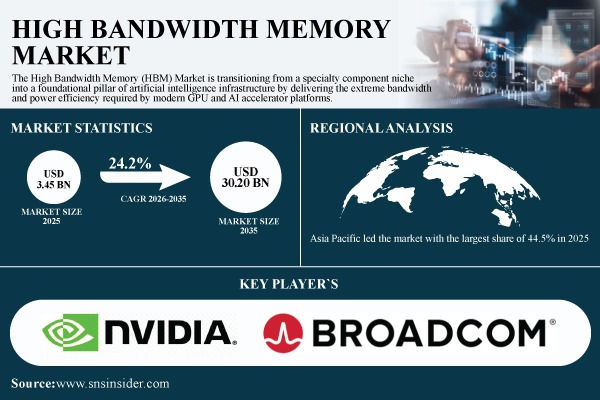
Austin, Sept. 21, 2026 (GLOBE NEWSWIRE) -- The global High Bandwidth Memory Market was valued at USD 3.45 billion in 2025 and is projected to reach USD 30.20 billion by 2035, expanding at a CAGR of 24.2% during 2026–2035. The demand has been bolstered by generative AI training clusters, GPU and AI accelerator usage, high performance computing (HPC), advanced packaging in 2.5D and 3D, as well as growing multi-stack HBM implementations.
The U.S. High Bandwidth Memory Market was valued at approximately USD 1.01 billion in 2025 and is projected to reach approximately USD 8.00 billion by 2035, growing at a CAGR of approximately 23.0% during 2026–2035. Growth will be enabled through hyperscaler buying, domestic GPU and customized AI accelerator production, AI training and inference infrastructure and HPC with the focus shifting to resilient memory supply chains.
Download the High Bandwidth Memory Market Sample Report: https://www.snsinsider.com/sample-request/10832
Why this Market is Gaining Attention in 2026
Generative AI is Raising Memory Bandwidth Requirements
The High Bandwidth Memory market is becoming more associated with the computational intensity of the AI algorithms rather than just the volume of the semiconductor. The training of generative AI, large language models, and advanced inference tasks need GPUs and AI accelerators that can handle large amounts of data with very high memory bandwidth.
The increase in deployment of four-to-eight-stack HBM setups per AI accelerators means that the content of the memory becomes a factor in the deployment of AI servers. This shows that HBM becomes relevant not only for performance but also for power efficiency.
HBM3E and HBM4 are Creating a Parallel Opportunity for Memory Suppliers
Shifts in HBM3 technology to HBM3E and even next-generation HBM4 technology have generated a need for more bandwidth, more density in terms of memory, and more energy efficiency. The new generation of GPU and AI accelerators will need memory stacks that will enable them to support increased computational loads.
This creates opportunities for companies specializing in advanced stacking, through-silicon-via integration, high yield manufacturing, and working closely with GPU and specialized AI silicon manufacturers. HBM technology qualification and manufacturing capacity have become key competitive differentiators for securing future AI infrastructure.
Advanced Packaging and Custom AI Silicon Expand the HBM Opportunity
There are opportunities going beyond traditional GPU architectures as well. With advanced 2.5D and 3D packaging, specially designed AI accelerators, and central automotive computing systems, more demand for high bandwidth memory comes to the table. This helps widen the value chain for HBM in terms of GPUs, AI accelerators, ASICs, high performance computing, autonomous driving, and next generation data centers.
Buy the High Bandwidth Memory Market Report (20% Discount) with Competitive Analysis and 2035 Forecast: https://www.snsinsider.com/checkout/10832
Commercial Findings from the High Bandwidth Memory Market
HBM3 Dominated and HBM3E is the Fastest Growing Technology: In 2025, HBM3 accounted for 49.00% of the market share, backed by the well-proven integration capability of HBM3 within deployed GPU and AI accelerator solutions. HBM3E is the fastest growing segment and is expected to grow at a CAGR of 27.10% through 2026, fueled by high bandwidth requirement and efficient power consumption of the next-generation AI platforms.
Servers Dominated and Automotive & Transportation is the Fastest Growing Application: Server occupied 65.00% of the market share in 2025 owing to constant demand for GPUs in order to provide support for the generative AI model training and inference process. The application with the highest growth rate is automotive & transportation with a projected CAGR of 29.30% due to the presence of central computing, sensor fusion, and autonomous drive.
Regional Semiconductor Manufacturing is Reshaping HBM Demand: In 2025, the share held by Asia Pacific region in terms of the Global High Bandwidth Memory Market was around 44.5%. It is also anticipated that Asia Pacific will continue to be the most rapidly growing regional market at a CAGR of 24.9% from 2026 through 2035, supported by concentrated memory fabrication capacity, advanced semiconductor manufacturing expertise and continued investment across South Korea, Taiwan, China and Japan.
Who Should be Watching the High Bandwidth Memory Market?
The market is increasingly relevant across the broader AI and semiconductor ecosystem, including:
Memory manufacturers → GPU developers → AI accelerator companies → hyperscale cloud providers → semiconductor foundries → advanced packaging companies → data center operators → custom silicon developers → automotive compute suppliers
For memory manufacturers, the opportunity extends beyond supplying higher-capacity DRAM. Competitive positioning increasingly depends on bandwidth performance, power efficiency, stack density, production yield, advanced packaging compatibility, manufacturing capacity and qualification with leading accelerator platforms. For AI infrastructure developers, meanwhile, memory bandwidth and supply availability can directly influence accelerator performance, model scalability and system deployment timelines.
HBM4 Commercialization and AI Memory Innovation Shape the 2026 Market
As AI accelerators become more powerful and memory intensive, HBM suppliers are being pushed toward higher bandwidth, greater stack density, advanced thermal management and increased manufacturing capacity.
- In 2026, SK hynix unveiled iHBM, an integrated thermal-management solution embedding cooling elements within HBM packages and reducing thermal resistance by approximately 30%.
- In 2026, SK hynix began mass shipments of HBM4 in Q2, with plans to increase production during the second half of the year as AI memory demand continued to accelerate.
Market Challenge: Expanding HBM Supply Without Increasing Packaging Bottlenecks and Capital Intensity
High Bandwidth Memory manufacture is restricted by the capabilities of 2.5D package technology, interposers and through silicon, which have not scaled as fast as the memory needs created through AI applications. Such constraints can affect the overall market throughput despite the growth in purchase orders from hyperscalers.
Additionally, the high amount of capital needed to manufacture and package advanced HBM also poses a major barrier to entry into the market. This has made HBM manufacturers compete not just on the basis of their memory density, but also on their manufacture yields, advanced package capability, performance, and scalability alongside AI infrastructure.
Explore the Complete High Bandwidth Memory Market Report: https://www.snsinsider.com/reports/high-bandwidth-memory-market-10832
Key Competitors in the Market
Companies covered in the High Bandwidth Memory Market research include SK Hynix Inc., Samsung Electronics Co., Ltd., Micron Technology, Inc., NVIDIA Corporation, Advanced Micro Devices, Inc. (AMD), Intel Corporation, Broadcom Inc., Taiwan Semiconductor Manufacturing Company Limited (TSMC), Amkor Technology, Inc., ASE Technology Holding Co., Ltd., JCET Group Co., Ltd., Synopsys, Inc., Cadence Design Systems, Inc., Rambus Inc., Marvell Technology, Inc., Alphabet Inc. (Google LLC), Amazon.com, Inc., Microsoft Corporation, Meta Platforms, Inc., and Cerebras Systems Inc.
About Us:
SNS Insider is one of the leading market research and consulting agencies that dominates the market research industry globally. Our company's aim is to give clients the knowledge they require in order to function in changing circumstances. In order to give you current, accurate market data, consumer insights, and opinions so that you can make decisions with confidence, we employ a variety of techniques, including surveys, video talks, and focus groups around the world.
