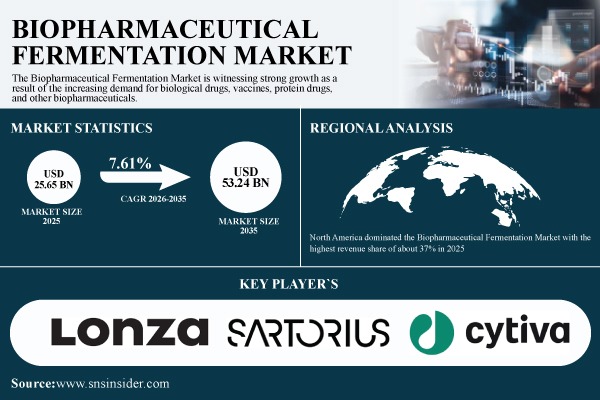
Austin, Texas, Sept. 21, 2026 (GLOBE NEWSWIRE) -- The global Biopharmaceutical Fermentation Market was valued at USD 25.65 billion in 2025 and is projected to reach USD 53.24 billion by 2035, expanding at a CAGR of 7.61% during 2026–2035. Demand is rising due to increased production of biologics, vaccines, recombinant proteins, and personalized medicines, along with the adoption of single-use bioreactors, continuous fermentation, and process automation.
The U.S. Biopharmaceutical Fermentation Market was valued at approximately USD 8.24 billion in 2025 and is projected to reach approximately USD 16.71 billion by 2035, growing at a CAGR of 7.36% during 2026–2035. Industry growth is driven by increased biologic production, rising demand for vaccines and therapeutic proteins, single-use technologies, continuous fermentation, automation, and investments in biotechnology and personalized medicines.
Download the Biopharmaceutical Fermentation Market Sample Report: https://www.snsinsider.com/sample-request/11113
The Europe Biopharmaceutical Fermentation Market was valued at approximately USD 7.18 billion in 2025 and is projected to reach approximately USD 14.53 billion by 2035, growing at a CAGR of 7.30% during 2026–2035. Growth is supported by advancements in scalable bioreactor systems, microbial fermentation technologies, single-use upstream platforms, high-yield strain engineering, and automated process control.
Why this Market is Gaining Attention in 2026
Biologics and Recombinant Products Are Increasing Fermentation Capacity Requirements
The biopharmaceutical fermentation process is becoming increasingly associated with biologics rather than traditional pharmaceutical manufacturing. The production of recombinant proteins, monoclonal antibodies, vaccines, enzymes, and other advanced therapies depends on biological fermentation technology that supports the synthesis of complex molecules.
The increase in the number of drug pipelines and the increasing demand for biologic therapy have resulted in an increased need for fermentation technology. Consequently, advanced fermentation technology is required not only to support large-scale production but also to improve yield and quality.
Single-Use Bioreactors Are Creating a Parallel Opportunity for Bioprocessing Suppliers
The process of fermentation concerning the development of biopharmaceuticals has been associated increasingly with biologics rather than the production of pharmaceuticals. Recombinant proteins, monoclonal antibodies, vaccines, enzymes, and other complex therapies cannot be produced without biological fermentation technology.
The rising number of drug pipelines and increasing demand for biologic therapies have driven the need for fermentation technology. Therefore, advanced fermentation technology is now needed not only to support large-scale production but also to improve yield and quality.
Automation and Continuous Fermentation Expand the Biomanufacturing Opportunity
Not only is this possible through the conventional technique of batch fermentation. Automatic monitoring methods, artificial intelligence, and continuous fermentation and process control technologies make greater visibility and production consistency possible.
Real-time monitoring of pH, dissolved oxygen, temperature, and nutrient levels allows deviations to be identified and controlled. This expands the potential applications of fermentation technologies beyond their current scope.
Commercial Findings from the Biopharmaceutical Fermentation Market
Upstream Products Dominated and Downstream Products are the Fastest Growing Product Type: The Upstream Products accounted for 57% of the market share in 2025 owing to their importance in cell growth, nutrient management, process control, and fermentation. Downstream Products is the fastest-growing product segment and is expected to grow at a CAGR of 7.98% over the forecast period due to rising demand for product recovery and purification.
Recombinant Proteins Dominated and Remain the Fastest Growing Application: The Recombinant Proteins segment held around 42% of the market share in 2025 and is projected to experience the highest CAGR of 8.50% from 2026 to 2035. The growth will be driven by the rising need for therapeutic proteins, hormones, enzymes, antibodies, and replacement proteins.
Regional Biomanufacturing Investment is Reshaping Fermentation Demand: In North America, the Biopharmaceutical Fermentation Market comprised about 37% share in 2025 due to the well-developed pharmaceutical industry, highly developed biomanufacturing infrastructure, and investments in biologics. The Asia Pacific region is expected to become the fastest-growing regional market, with a CAGR of about 8.72% from 2026 to 2035, driven by pharmaceutical manufacturing, biotechnology investments, and increased biologics production in China and India.
Do you have any specific queries or need any customized research on Biopharmaceutical Fermentation Market? Schedule a Call with Our Analyst Team: https://www.snsinsider.com/enquiry/11113
Who Should be Watching the Biopharmaceutical Fermentation Market?
The market is increasingly relevant across the broader biopharmaceutical manufacturing ecosystem, including:
Biopharmaceutical companies → vaccine manufacturers → recombinant protein producers → contract research organizations → contract manufacturers → bioreactor suppliers → process automation providers → filtration and purification companies → biotechnology companies
For biopharmaceutical manufacturers, the opportunity extends beyond increasing fermentation volume. Competitive positioning is increasingly defined by process scalability, contamination control, automation, monitoring, purification efficiency, manufacturing flexibility, and consistent product quality. For technology suppliers, meanwhile, increasing biologics production creates demand for advanced upstream and downstream processing solutions.
Biomanufacturing Expansion and Process Innovation Shape the 2026 Market
As biologics production increases and manufacturing becomes more flexible, companies are expanding bioprocessing capacity and adopting advanced single-use technologies.
- In 2026, Lonza Group expanded its biopharmaceutical manufacturing capabilities and maintained strong growth in its contract manufacturing business, supported by increasing demand for biologics production capacity.
- In 2026, Sartorius expanded its bioprocessing portfolio with new single-use bioreactor technologies and increased manufacturing capacity for scalable fermentation and biologics production.
Market Challenge: Maintaining Fermentation Consistency Without Increasing Contamination and Process Risk
Biopharmaceutical fermentation depends heavily on environmental operating conditions; consequently, contamination and variability remain significant challenges for manufacturers. Variables such as raw material characteristics, nutrient composition, temperature, oxygen availability, and agitation may affect the efficiency, yield, and consistency of the final product.
Effective fermentation therefore requires complex monitoring systems, process controls, quality management, and qualified staff. As a result, biopharmaceutical manufacturers increasingly compete on process consistency, contamination control, automation, and manufacturing reliability.
Key Competitors in the Market
Companies covered in the Biopharmaceutical Fermentation Market research include Lonza Group, Samsung Biologics, WuXi Biologics, Thermo Fisher Scientific, Sartorius, Merck KGaA, Danaher, Cytiva, FUJIFILM Diosynth Biotechnologies, Boehringer Ingelheim, Catalent, AGC Biologics, Eppendorf, Repligen, Getinge, ABEC, Bioengineering, INFORS HT, PBS Biotech, and Solaris Biotech.
Buy the Biopharmaceutical Fermentation Market Report with Competitive Analysis at a 20% Discount: https://www.snsinsider.com/checkout/11113
