Syndicated Articles: turn important stories into earned media coverage at scale
Syndicated Articles transform press releases, thought leadership and owned content into reader-first editorial stories distributed across trusted publisher sites.
Expand your reach, strengthen your digital footprint and measure the impact in Newswire Analytics.

Your story deserves to travel further
Most brands already have stories worth telling. Some start as press releases. Others start as research, thought leadership, newsroom content, or a strong point of view. The challenge is getting those stories in front of more people, in places they already trust. Syndicated Articles turn useful brand stories into third-party editorial coverage that extends visibility beyond your owned channels.
3,000+
News publications in the network
75+
Guaranteed placements per article
40+
Average publisher Domain Authority
Up to 5
Do-follow backlinks per article
1 year+
Live on publisher pages
Why brands use article syndication
Distributed at scale
Reach publishers across a news syndication network of 3,000+ news publications.
Reader-first editorial
Turn company news or thought leadership into useful, non-promotional stories designed for discovery.
Control + credibility
Shape the story you want to tell while editorial standards keep the content objective and useful to publisher audiences.
Measurable results
Track placements, reach, publisher signals and other performance metrics through Newswire Analytics.
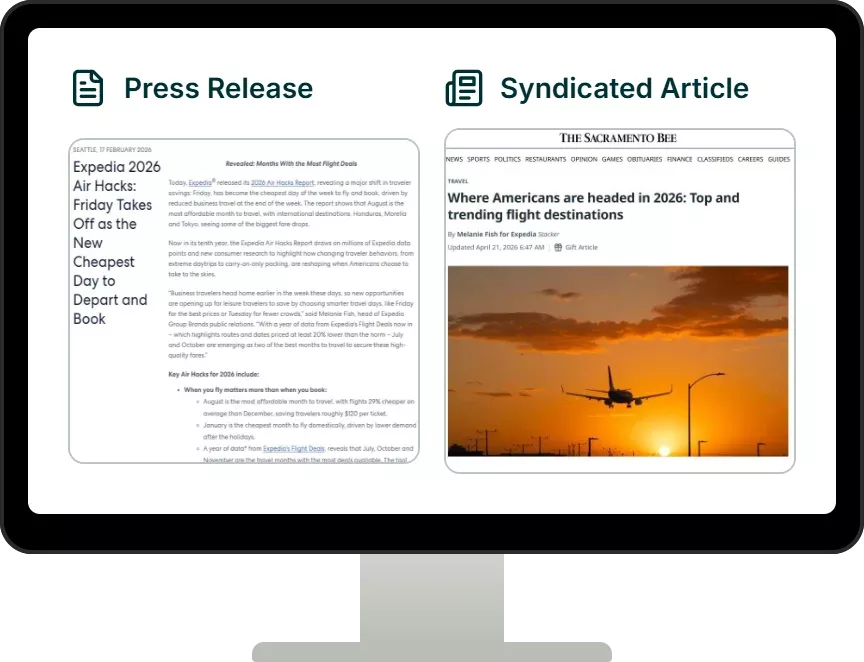
Press releases establish the story. Syndicated Articles expand it.
A press release answers: What happened?
It creates an authoritative record of verified company news and supports announcement-driven communications and brand-intent discovery.
A Syndicated Article answers: Why does it matter?
It connects your story to a broader problem, trend, use case or audience need, giving people more ways to discover it even when they are not searching for your company by name.
And you do not always have to start with a press release. Existing thought leadership, research, blog posts and newsroom content can also provide the basis for a Syndicated Article.
Earn attention without giving up your story
Traditional earned media gives you credibility.
But you do not control the angle, timing, or depth of the story.
Owned content gives you control.
But its reach and influence are concentrated on channels you already own.
Syndicated Articles bring control and credibility together.
You shape the story in your own words while editorial standards keep it useful, engaging and objective enough to earn publisher interest.

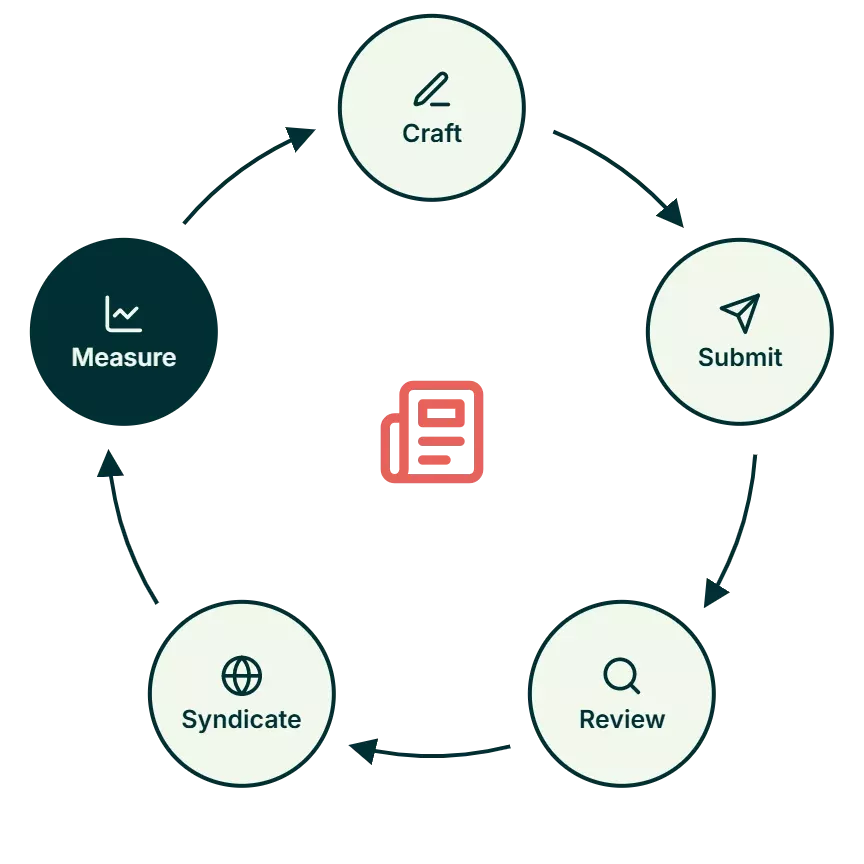
How article syndication works
- Craft. Turn a press release, blog, research report, newsroom post or thought-leadership asset into an educational, non-promotional article.
- Submit. Submit the article as part of your Syndicated Article campaign.
- Review. Notified reviews the article against editorial standards.
- Syndicate. Once approved, the article is distributed to a network of 3,000+ newsrooms.
- Measure. See placements and performance metrics in Newswire Analytics.
Give your best stories more places to be discovered
Turn the content you have already invested in into reader-first editorial coverage at scale.
What makes a strong Syndicated Article?
The best articles give the reader something useful, whether or not they already know your brand. Talk to Our Team
Strong fits
- Trends and market shifts
- Original data and research
- Explainers and how-to content
- Human-impact stories
- Real use cases
- Expert insights
Usually a weaker fit
- Routine company announcements
- Internal news
- Highly promotional product copy
Know where your story goes
Newswire Analytics helps you understand how your Syndicated Article performed after publication, including publisher pickups, placements, reach and domain information.
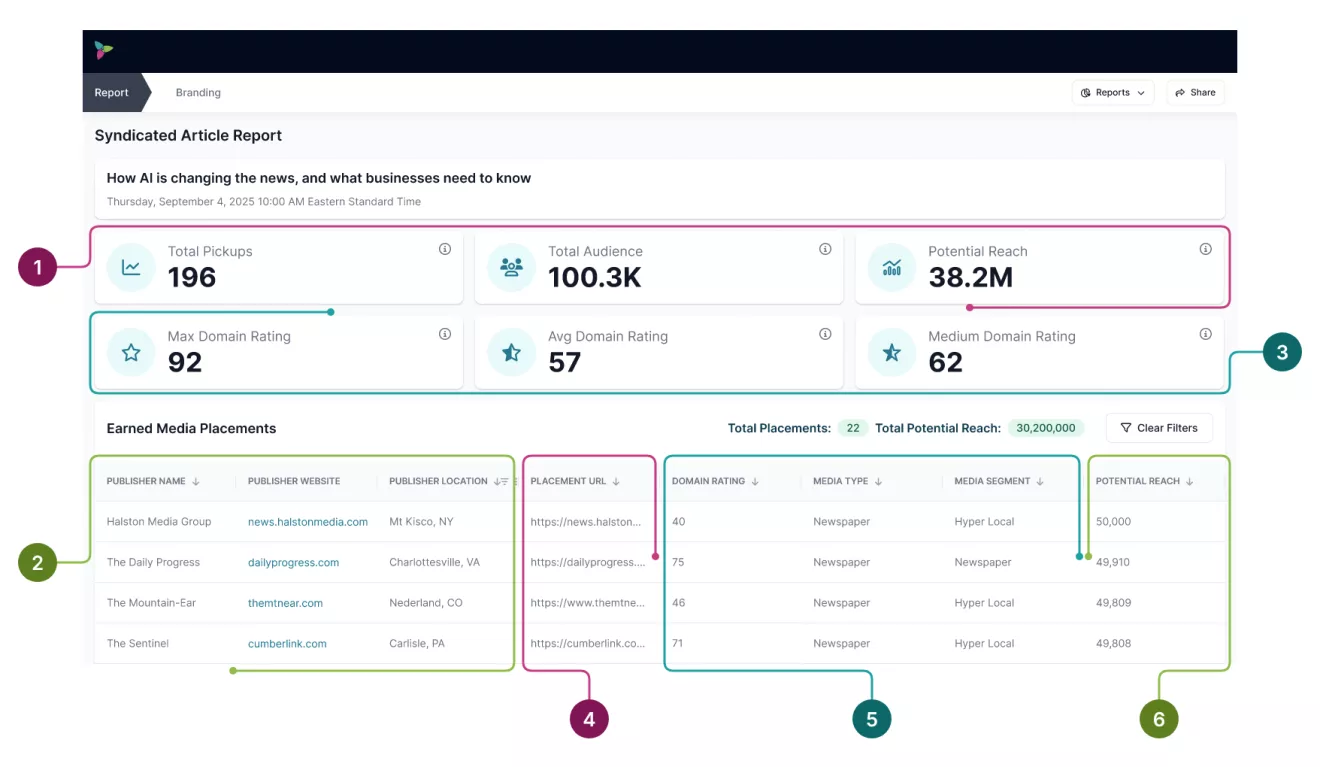
1. Total Pickups, Audience & Research
Shows rolled-up metrics of the article's online visibility.
2. Publication Details
Name, website, and location are included for each publication
3. Domain Details
Highlights the reach and influence of domains where the article appears.
4. Clickable Links to View Placements
Opens article placements in a new window for viewing
5. Sortable Columns
Allows easy organization of article placements across multiple categories
6. Potential Reach
Figures highlight the monthly traffic of domains where the article appears
Article syndication for AI search visibility
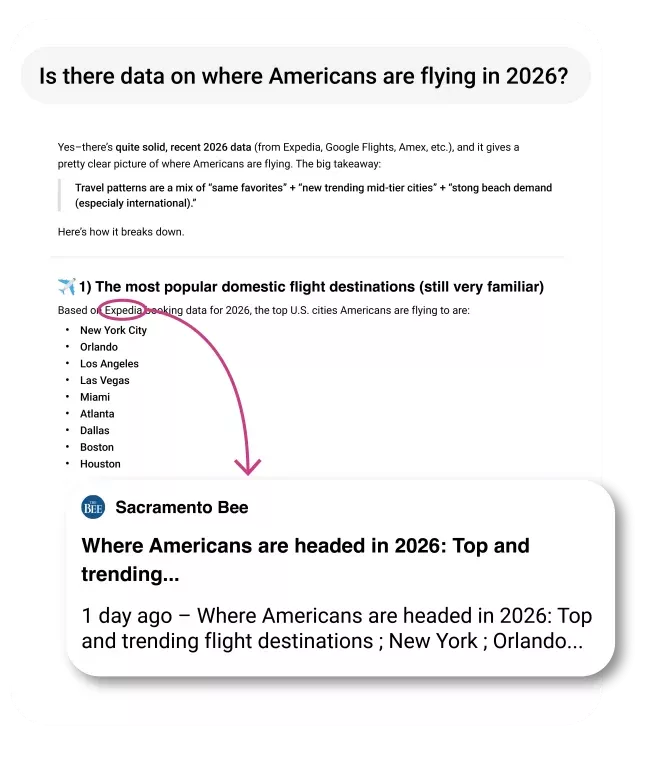
AI answer engines draw on credible, third-party sources when they summarize a topic. Syndicated Articles place your story on trusted publisher sites, giving AI more independent, editorial context to discover, understand and cite.
- More third-party sources
Each publisher pickup creates another independent placement of your story across our news syndication network. - Context, not just announcements
Reader-first articles explain why your news matters, the kind of useful material AI answers are built from. - Stronger source material from the start
Pair Syndicated Articles with AI Press Release Optimizer to strengthen your article for clarity, authority and citation potential before it goes live.
Frequently asked questions
What is a Syndicated Article?
A syndicated article is a news-style story about your topic, written in your words, that our network of 3,000+ U.S. news outlets can choose to run. It’s written to be useful to a publisher’s readers, not to sell, so it reaches people beyond your own channels.
What is article syndication?
Article syndication is the distribution of an editorial article to multiple publisher sites, so it can reach new audiences beyond the original source. With Syndicated Articles, our editors review your article against editorial standards and send it to 3,000+ news outlets, where publishers can choose to publish it.
Is article syndication the same as news syndication?
They’re close. News syndication usually means spreading news items, like press releases, across media outlets. Article syndication is about stories that explain why the news matters. Syndicated Articles are the second kind.
How is a Syndicated Article different from a press release?
A press release announces what happened. A Syndicated Article explains why it matters, by tying your news to a trend, problem or customer needs. They work together, and neither replace the other. The release is your official record. The article gives people more ways to find the story, including readers who have never searched for your company name.
Do I need a press release to create a Syndicated Article?
No. You can start from research, blog posts, thought leadership or newsroom content.
Can a Syndicated Article be tied to an existing press release?
Yes. If you’ve sent a release through GlobeNewswire’s press release distribution services, you can link your article to it and see both in Newswire Analytics together
What makes a Good Syndicated Article?
One that helps a reader who has never heard of you: trends and market shifts, original data and research, explainers and how-to articles, human-impact stories, real use cases and expert insights.
What is the benefit of using a press release and Syndicated Article together?
A press release establishes the news, while a Syndicated Article provides additional context and a broader editorial angle that gives audiences more ways to discover and understand the story.
What types of content are not a good fit?
Routine company announcements, internal news, and highly promotional product copy are weaker fits. The dedicated FAQ also excludes product launches, earnings announcements and blatant branded calls to action.
Can I use AI to write my Syndicated Article?
No. It needs to be written by a person and hold up to editorial review. If you’d like help, our editors can write or revise it with you for $290 an hour.
How do I submit one, and what happens next?
Syndicated Articles are submitted through a General Request rather than through the standard press-release Distribute workflow. Our editors review it against our editorial standards. Once approved, it goes to the network, and the outlets that choose to run it publish it.
How long does it take, and can I choose the publishing date?
Editorial reviews usually take about seven days. After that, most pickups come in the first 7 to 14 days and more can trickle in over the following months. Because each outlet decides on its own, you can’t set an exact publish time like you can with a press release.
Will all my placements appear at the same time?
Not necessarily. Pickups can occur over time rather than simultaneously, extending the period during which the story can be discovered.
How quickly will I see results?
Editorial review typically takes about seven days. The FAQ says most pickups occur during the first 7–14 days, with additional placements potentially appearing over the following months.
How do I measure results?
Newswire Analytics shows which outlets ran your article, where they are, how many people they reach, and domain information, all in one report.
Is article syndication paid media or advertising?
No. You aren’t buying ad space on a set list of sites. Outlets choose whether to run each article.
Does a Syndicated Article replace a press release?
No. They serve different purposes. A press release announces company news, while a Syndicated Article tells a broader story in an editorial narrative format.
Can article syndication help my brand show up in AI search?
It can help. When trusted publishers run your story, AI tools have more independent sources to find and cite. No one controls whether they do, so we can’t promise citations. To strengthen the source material, pair Syndicated Articles with AI Press Release Optimizer.
Do Syndicated Articles include do-follow backlinks?
Yes. Published articles carry do-follow links back to your site, up to 5 per article.
Can I publish the article on my own website too?
Yes, and we suggest publishing it on your site first, then syndicating it.
Where does the company's name appear?
In the author box and near the top of the article, so readers know where it came from.
Can Syndicated Articles include images?
Yes, depending on the image. Charts, infographics, and other visuals that help tell the story are encouraged, while heavily branded imagery such as corporate logos is considered inappropriate.
Can I use stock images?
Only if you can provide ownership, authorization, or proof of usage rights.
Does Notified guarantee better SEO rankings or more AI citations?
No. Results controlled by third parties cannot be guaranteed.