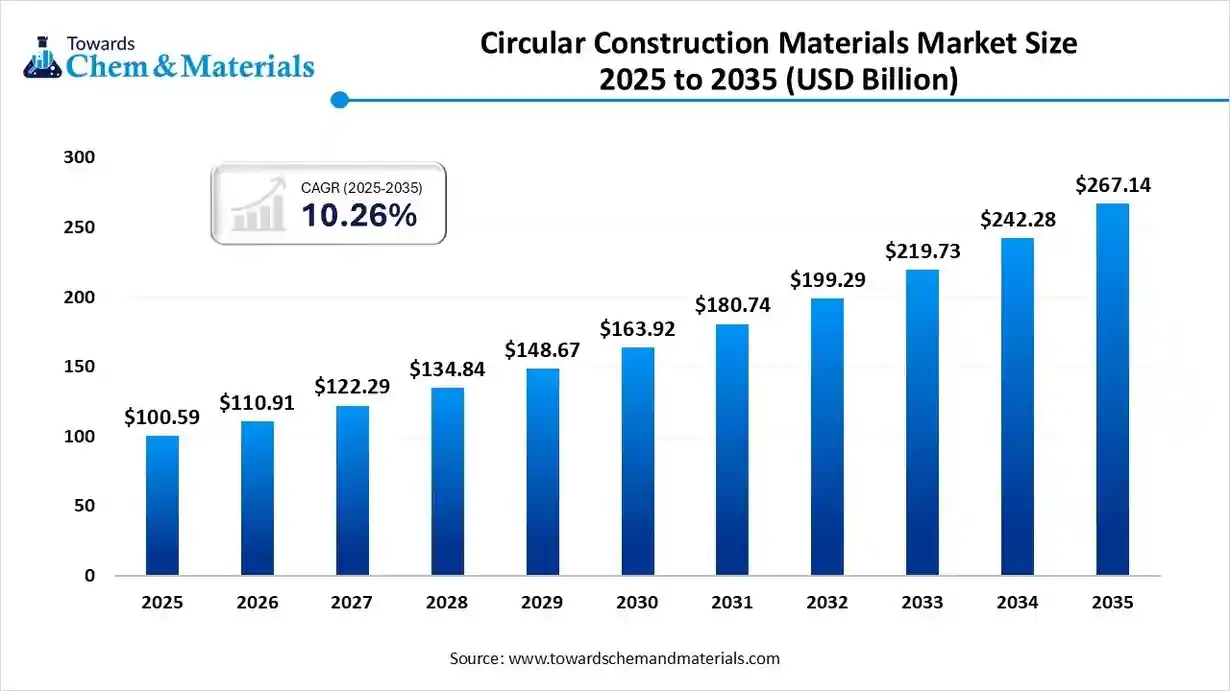
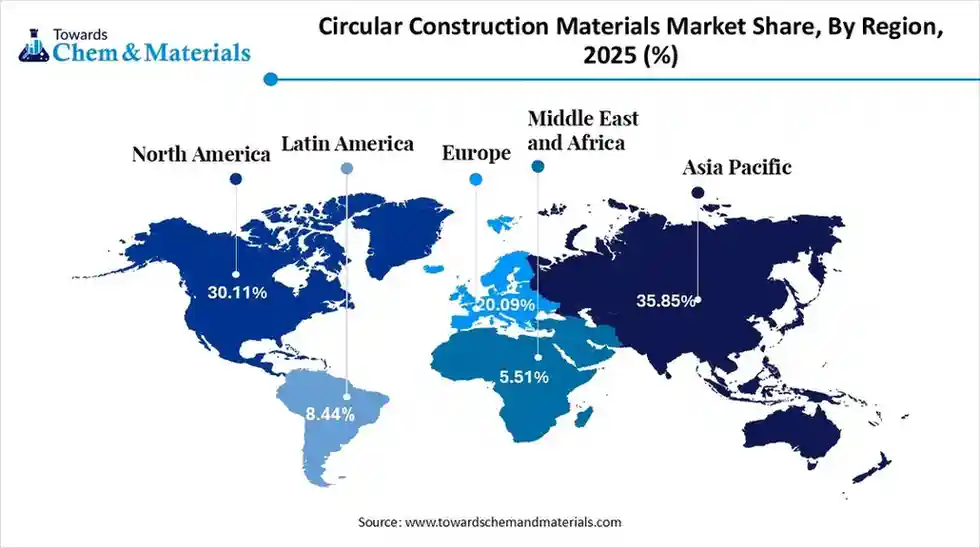
Ottawa, Dec. 18, 2025 (GLOBE NEWSWIRE) -- The global circular construction materials market size is calculated at USD 100.59 billion in 2025 and is predicted to increase from USD 110.91 billion in 2026 and is projected to reach around USD 267.14 billion by 2035, The market is expanding at a CAGR of 10.26% between 2026 and 2035. Asia Pacific dominated the circular construction materials market with a market share of 35.85% the global market in 2025. The rising demand for sustainable building solutions is driving the increased adoption of recycled and reusable materials in circular construction. A study published by Towards Chemical and Materials a sister firm of Precedence Research.
Download a Sample Report Here@ https://www.towardschemandmaterials.com/download-sample/6057
What are Circular Construction Materials?
The circular construction materials market is expanding as the industry shifts toward sustainable, closed-loop practices driven by rising environmental awareness, stricter waste regulations, and growing demand for recycled and bio-based materials. Increasing adoption of green building policies and preference for resource-efficient construction further support the use of recycled aggregates, reclaimed wood, metals, and plastics, positioning circular materials as a key element in reducing waste and dependence on virgin resources.
Request Research Report Built Around Your Goals: sales@towardschemandmaterials.com
Circular Construction Materials Market Report Highlights
- The Asia Pacific dominated the circular construction materials market, accounting for the largest revenue share of 35.85% in 2025.
- By material, the recycled aggregates segment held the largest revenue market share of 38.60% in 2025
- By material, the recycled plastics segment is expected to grow at the fastest CAGR of 11.06% over the forecast period.
- By end use, the residential segment held the largest revenue market share of 56.11% in 2025
- By end use, the non-residential segment is expected to grow at the fastest CAGR of 10.55% over the forecast period.
What is the Circular Economy?
The circular economy is a systemic approach to economic development designed to benefit businesses, society, and the environment. In contrast to more traditional economic practices, a circular economy is regenerative by design and aims to reduce our dependence on finite resources gradually. It’s an innovative model that ensures sustainability at the core of economic activities.
The Pros and Cons of Using Circular Building Materials
In our journey towards more sustainable construction practices, understanding the advantages and challenges of circular building materials is crucial. That’s why this section delves into the pros and cons of various circular materials, including recycled, up-cycled, biodegradable, and locally-sourced options.
1. Recycled Materials
Utilising recycled materials like steel and concrete from demolition waste reduces the reliance on new raw materials, conserves energy, and reduces carbon emissions. It’s a practical approach to resource conservation. On the other hand, recycling processes can still be energy and water-intensive, which can potentially offset some of the benefits.
2. Up-Cycled Materials
Up-cycling adds value to otherwise discarded materials by turning waste into higher-quality products. This innovative process encourages creativity and reduces waste, which allows you to get more involved in how you’re embracing the circular economy mindset.
On the other hand, the challenge lies in finding efficient and scalable processes for up-cycling that are resource-efficient and economically viable. There are options available, but they aren’t always easy to find.
3. Biodegradable Materials
Biodegradable materials are renewable and have a lower embodied carbon footprint. Plus, they offer excellent insulation properties and, when kept pure, can be safely returned to the biosphere, making them one of the best circular building materials. On the other hand, ensuring the purity of these materials and avoiding chemical treatments to maintain their biodegradability can be challenging.
4. Locally-Sourced Materials
Using locally-sourced materials cuts down on transportation emissions, supports local economies, and often results in fresher, more authentic designs. It can also help you create networking opportunities with local establishments.
On the other hand, the availability and variety of locally-sourced materials can be limited, which can potentially affect design choices and project timelines.
The Economic and Environmental Benefits
Using circular building materials provides substantial economic and environmental benefits. Economically, it can lead to cost savings in the long term through reduced material purchases and waste disposal costs.
Environmentally, using circular materials minimises the depletion of natural resources and reduces greenhouse gas emissions. That’s why these materials are key to sustainable construction in an era where global demand for building materials is skyrocketing.
Immediate Delivery Available | Buy This Premium Research Report@ https://www.towardschemandmaterials.com/checkout/6057
Circular Construction Materials Market Report Scope
| Report Attribute | Details |
| Market size value in 2026 | USD 110.91 Billion |
| Revenue forecast in 2035 | USD 267.14 Billion |
| Growth rate | CAGR of 10.26% from 2025 to 2035 |
| Base year for estimation | 2025 |
| Actual estimates/Historical data | 2021 - 2025 |
| Forecast period | 2025 - 2035 |
| Segments covered | Material, end use, region |
| Regional scope | North America; Europe; Asia Pacific; Central & South America; Middle East & Africa |
| Country scope | U.S.; Canada; Mexico; Germany; UK; France; Spain; China; Japan; India; South Korea; Saudi Arabia; UAE; Egypt; Kuwait; Qatar |
| Key companies profiled | LafargeHolcim; CRH plc; Heidelberg Materials; CEMEX; Boral Limited; Vulcan Materials Company; Commercial Metals Company; Putman Groep; Miniwiz; FRONT |
For more information, visit the Towards Chemical and Materials website or email the team at sales@towardschemandmaterials.com| +1 804 441 9344
EU-funded projects related to circular principles in construction
Horizon Europe programme
- EASI ZERo aims to use bio-sourced and recycled materials to enhance the thermal performance of new and existing buildings’ envelopes by 20%. The diverse materials include grown mycelium, wood fibres, low carbon foam, recycled raw material. The project thus addresses the growing need to cut the environmental impact of EU buildings.
- GreeNest aims for a transformative approach to sustainable and low-carbon building practices which integrate CO2-neutral building materials, such as reused, recycled and locally sourced biogenic elements with renewable energy sources. This ecosystem requires fewer materials and adopts energy efficient circular practices.
- RECONSTRUCT aims to replace carbon-intensive materials with a blend of construction and demolition waste, avoiding traditional Portland cement. It also aims to create modular elements for easy disassembly, encouraging reuse and recycling.
- DRASTIC aims to implement whole-life cycle GHG emission reduction in new construction and retrofit by demonstrating affordable and innovative circular solutions in five geographical areas, covering different building layers, raw materials, building typologies, circular strategies, and local drivers.
- INBUILT aims to advance sustainable building practices and reduce the carbon footprint of buildings through their entire life cycle in Europe. To achieve so, it involves the development and demonstration of ten innovative products and systems, such as recycled concrete and recycled concrete blocks, bio-based prefabricated curtain walls, bio-based recycled insulation sheet panels/infill and second life photovoltaic panels, etc.
- circEUlar aims to develop circular pathways for the EU low-carbon transition. It will develop new modelling approaches for analysing circularity and understand the transformation of society towards a net-zero emission circular economy. It will contribute to the objectives of the EU by assessing the feasibility and new technologies, processes and products combining them to the new business models for more sustainable and circular buildings.
- BusGoCircular aimed to address and overcome the challenges of demand for green energy skilled workforce by developing and implementing a circular construction skills qualification framework with a focus on multifunctional green roofs, facades, and interior elements.
- CIRCuIT supported the creation of regenerative cities by implementing sustainable and circular construction practices. Through a variety of means, it showcased how circular construction approaches could be scaled and replicated across Europe.
- HOUSEFUL introduced solutions to become more resource efficient throughout the lifecycle of the building, taking into account an integrated circular approach. The concept has been demonstrated in four demo-sites adapting the approach to different scenarios, including social housing buildings.
What Are the Major Trends in The Circular Construction Materials Market?
- Growing emphasis on green building certifications and sustained construction practices is boosting demand for circular construction materials.
- Governments worldwide are implementing policies and incentives to encourage reuse, recycling, and the use of circular materials in construction.
- Advances in recycling and material processing technologies, such as recycled aggregates, recycled plastics, bio-based composites, and reclaimed materials are improving are improving performance and making circular materials more reliable.
- A shift toward prefabricated and modular construction methods is supporting circular construction by enabling easier reuse, disassembly, and material recovery.
How Does AI Influence the Growth of the Circular Construction Materials Industry in 2025?
AI is accelerating the shift toward circular construction by enabling smarter material selection, waste reduction, and resource-efficient processes throughout the building lifecycle. Machine learning and computer vision systems help automate the sorting of demolition waste, accurately identifying and separating materials like concrete, metal, wood, or plastics for reuse rather than landfill disposal.
AI driven predictive maintenance and lifecycle analysis tools allow construction projects to optimize how materials are used and maintained, extending their lifespan and reducing the need for fresh raw materials are used and maintained, extending their lifespan and reducing the need for fresh raw materials.
Market Opportunity
What If AI Makes Circular Contraction Smarter?
AI-driven waste sorting and material identification systems can automatically sort demolition and construction waste into reusable categories, wood, improving recovery efficiency and enabling more recycled materials to flow back into new builds.
Could Recycled Plastics Become the Next Construction Staple?
New research is showing recycled plastics being transformed into structural components using computational design and novel fabrication techniques, offering lighter, more adaptable, and easier-to-reuse materials that could reshape sustainable construction approaches.
Immediate Delivery Available | Buy This Premium Research Report@ https://www.towardschemandmaterials.com/checkout/6057
Circular Construction Materials Market Segmentation Insights
Material Insights:
Why the Recycled Aggregates Segment Dominated the Circular Construction Materials Market?
The recycled aggregates segment dominated the market in 2025. Its dominance reflects widespread use in structural concrete, foundations, and road construction because recycled aggregates deliver mechanical strength and compatibility with existing cement-based construction methods, making them a reliable replacement for virgin aggregates across diverse projects.
The recycled plastics segment is expected to grow fastest over the forecast period because it benefits from a large, consistent waste-plastic feedstock that supports scalable production. Its cost-effectiveness compared to many virgin materials makes it attractive for builders seeking lower project and life-cycle costs. Recycled plastics also deliver strong durability, moisture resistance, and weatherability, making them suitable for cladding, decking, pipes, panels, and other non-structural components.
End Use Insights:
Which End-Use Segment Held the Dominating Share of the Circular Construction Materials Market in 2024?
The residential segment held the dominant position in the market in 2025. The dominance of this segment stems from growing demand for affordable and sustainable housing, increased retrofitting/ renovation activity, and supportive government policies and incentives promoting eco-friendly housing solutions that make circular materials an attractive choice for residential developers.
The non-residential segment is expected to experience the highest growth rate in the market during the forecast period. Rising interest in green commercial building, public infrastructure, and industrial facilities, combined with increasing emphasis on sustainability standards in such projects, is driving the rapid adoption of recycled and circular materials in non-residential construction.
➤ Contact Us: sales@towardschemandmaterials.com | ☎ +1 804 441 9344
Regional Insights
What Makes Asia Pacific the Hotbed for Circular Construction Materials?
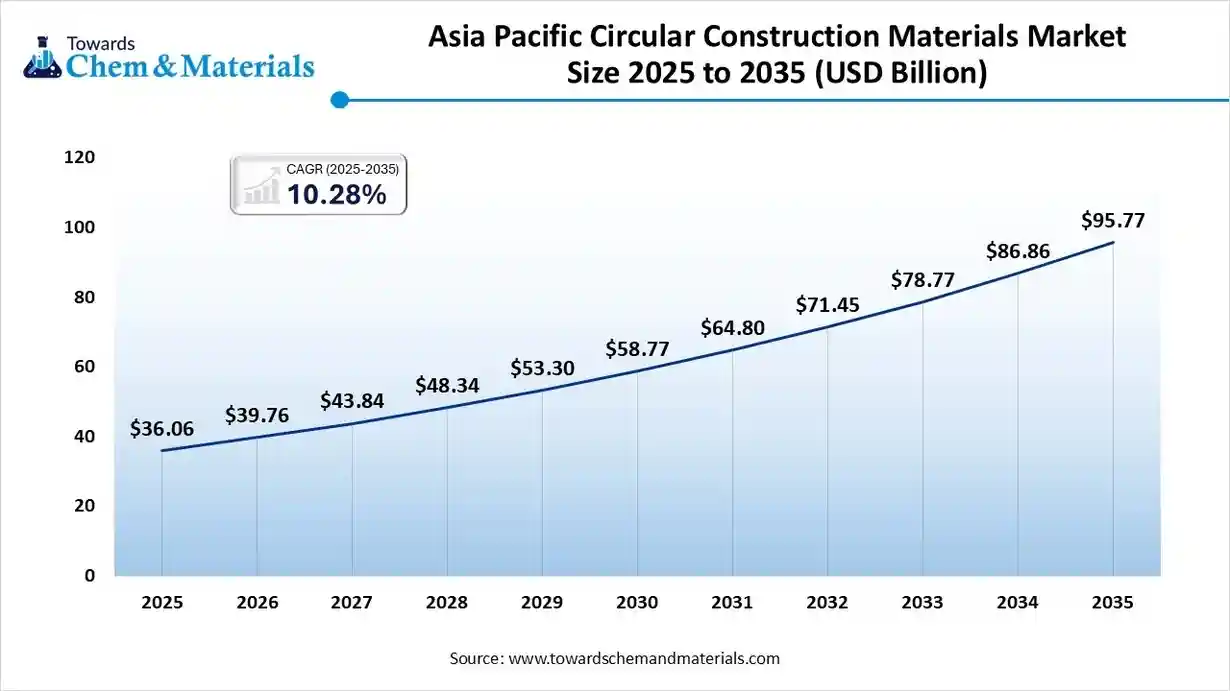
The Asia Pacific circular construction materials market size was valued at USD 36.06 billion in 2025 and is expected to reach USD 95.77 billion by 2035, growing at a CAGR of 10.28% from 2026 to 2035. Asia Pacific dominated the market with the largest share 35.85% in 2025.
The Asia Pacific region stands out globally in circular construction materials because of its rapid urbanisation, extensive infrastructure investments, and strong push by governments toward sustainable building practices. In many countries in the region, policies and incentives promote the use of recycled and bio-based materials in construction projects, while large-scale demand for housing and commercial space drives the adoption of circular materials over virgin resources.
China Circular Construction Materials Market Trends
China within the Asia Pacific is gaining prominence because of its focus on low-carbon development, recycling of demolition and industrial waste, and integration of advanced construction technologies such as smart buildings and prefabrication. These factors help accelerate the uptake of recycled aggregates, reclaimed wood, plastics, and other recycled materials in both public and private construction projects, setting a pattern that is likely to influence broader regional adoption.
What Makes North America the Fastest-Growing Region for Circular Construction Materials?
North America is set to grow at the fastest CAGR among regions in the market, driven by strong regulatory frameworks, growing corporate sustainability commitments, and rising government funding for green infrastructure. The region’s well-established waste management and recycling infrastructure also supports efficient reuse of construction and demolition materials, which encourages widespread adoption of circular construction practices.
U.S. Circular Construction Materials Market Trends
Within North America, the U.S. plays a central role thanks to growing demand for sustainable building practices, advanced materials and digital technologies, and rising scrutiny of supply chain environmental impact. The U.S. government’s green building initiatives and corporate sustainability policies are pushing developers to choose recycled, reclaimed, and low-carbon materials, reinforcing the country’s leadership in circular construction adoption.
Top Companies in the Circular Construction Market & Their Offerings:
- CEMEX: Collects, manages, recycles, and co-processes waste as alternative raw materials and fuels in its cement and concrete production through its Regenera business.
- Boral Limited: Reprocesses construction and demolition waste into high-quality recycled products like roadbase and asphalt, and uses industrial byproducts in low-carbon concrete mixes.
- Vulcan Materials Company: Incorporates recycled concrete and asphalt into its products, using processed demolition waste as aggregates for new construction.
- Commercial Metals Company: Recycles post-consumer scrap metal into new steel products, such as rebar and merchant bar, via its energy-efficient electric arc furnaces.
- Putman Groep: Focuses on processing construction and demolition waste materials into secondary raw materials, reducing reliance on virgin materials and landfill.
- Miniwiz: Specializes in upcycling industrial and consumer waste into high-performance sustainable building materials and architectural solutions.
- FRONT: A design and consulting firm that develops and implements circular material strategies and business models for the built environment sector.
More Insights in Towards Chemical and Materials:
- What is the Material Informatics Market Size?
- Building Materials Market Size to Reach USD 2.17 Trillion by 2034
- 3D Printing Materials Market Size to Reach USD 31.23 Bn by 2035
- Aerospace Materials Market Size to Reach USD 112.78 Bn by 2035
- Circular Construction Materials Market Size to Reach USD 267.14 Bn by 2035
- Smart Building Materials Market Size to Hit USD 115.85 Bn by 2035
- Building & Construction Materials Market Size to Reach USD 3.90 Trillion by 2034
- Sustainable Materials Market Size to Hit USD 1078.35 Bn by 2034
- Advanced Composite Materials Market Size to Surpass USD 102.15 Bn by 2035
- Aerospace and Defense Materials Market Size to Surpass USD 49.07 Bn by 2035
- Cork Building Materials Market Size to Hit USD 20.82 Bn by 2035
- Mycelium-Based Building Materials Market Size to Hit USD 3.81 Bn by 2035
- Advanced Carbon Materials Market Size to Hit USD 86.27 Bn by 2035
- Green Building Materials Market Volume to Reach 1,271.6 Million Tons by 2034
- Biomaterials Market Size to Surge USD 526.63 Billion by 2034
- Europe Green Building Materials Market Volume to Reach 406.7 Million Tons by 2034
- High-Temperature Insulation Materials Market size to Reach USD 16.09 Bn by 2034
- Recycled Plastics In Green Building Materials Market Size to Reach USD 12.24 Bn by 2034
- Aluminum Composite Materials Market Size to Reach USD 8.18 Billion by 2034
- Energy Dense Materials Market Size to Reach USD 211.44 Bn by 2034
- Electronic Materials And Chemicals Market Size to Surge USD 136.03 Bn by 2034
- Thermal Interface Materials Market Size Hits USD 12.67 Bn By 2034
- Semiconductor Fabrication Materials Market Size to Expand $ 113.37 Bn by 2034
- Magnetic Materials Market Size to Reach $ 58.05 Billion by 2034
- Compound Semiconductor Materials Market Size to Expand $ 91.61 Bn by 2034
- Advanced Materials Market Size to Reach USD 128.06 Bn by 2034
- Next-Gen Fireproof Materials Market Size, Industry Report, 2034
Circular Construction Materials Market Top Key Companies:
- LafargeHolcim
- CRH plc
- Heidelberg Materials
- CEMEX
- Boral Limited
- Vulcan Materials Company
- Commercial Metals Company
- Putman Groep
- Miniwiz
- FRONT
What is Going on Around the Global Circular Construction Materials Industry?
- In December 2025, Holcim acquired its recycling firms in the UK, Germany, and France to strengthen its circular construction business. The move expands Holcim’s capacity to recycle construction and demolition waste, reinforcing the supply of recycled construction materials for future building projects.
- In June 2025, Zero Waste Scotland is launching a “Circular construction hub” pilot to facilitate the reuse of building materials across projects, aiming to divert demolition waste from landfills and extend the life of construction materials by making them easily available for reuse.
- In February 2024, CRH introduced “ReConn”, a new line of low-carbon, recycled aggregate-based materials in Europe. The launch aligns with CRH’s goal to reduce construction waste and achieve circular material sourcing across its infrastructure projects by 2035.
- In March 2025, Heidelberg Materials North America announced that it acquired certain assets of Concrete Crushers Inc. (CCI), the largest concrete recycler in Calgary, Alberta.
Circular Construction Materials Market Report Segmentation
This report forecasts revenue growth at global, regional, and country levels and provides an analysis of the latest industry trends in each of the sub-segments from 2019 to 2035. For this study, Towards Chemical and Materials has segmented the global Circular Construction Materials Market
By Material
- Recycled Aggregates
- Recycled Metals
- Reclaimed Wood
- Recycled Plastics
- Others
By End Use
- Residential
- Non-residential
By Regional
- North America
- Europe
- Asia Pacific
- Latin America
- Middle East & Africa
Immediate Delivery Available | Buy This Premium Research Report@ https://www.towardschemandmaterials.com/checkout/6057
About Us
Towards Chemical and Materials is a leading global consulting firm specializing in providing comprehensive and strategic research solutions across the chemical and materials industries. With a highly skilled and experienced consultant team, we offer a wide range of services designed to empower businesses with valuable insights and actionable recommendations.
Our Trusted Data Partners
Towards chem and Material | Precedence Research | Statifacts | Towards Packaging | Towards Healthcare | Towards Food and Beverages | Towards Automotive | Towards Consumer Goods | Nova One Advisor | Nutraceuticals Func Foods | Onco Quant | Sustainability Quant | Specialty Chemicals Analytics | TCM Blog
For Latest Update Follow Us: https://www.linkedin.com/company/towards-chem-and-materials/
USA: +1 804 441 9344
APAC: +61 485 981 310 or +91 87933 22019
Europe: +44 7383 092 044
Email: sales@towardschemandmaterials.com
Web: https://www.towardschemandmaterials.com/
