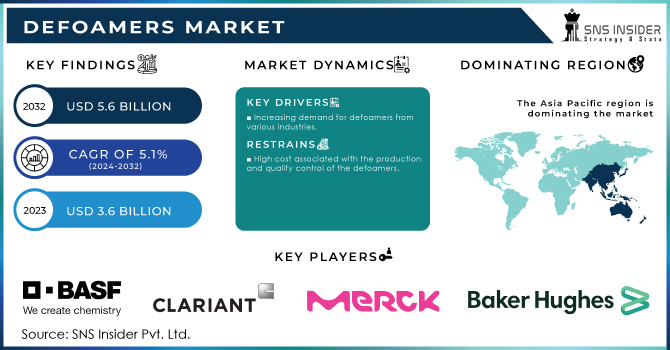
Austin, Aug. 13, 2024 (GLOBE NEWSWIRE) -- The Defoamers Market Share was valued at USD 3.6 billion in 2023 and is expected to reach USD 5.6 billion by 2032 and grow at a CAGR of 5.1% over the forecast period 2024-2032.
Get a Sample Report of Defoamers Market @ https://www.snsinsider.com/sample-request/3911
Key Players
- BASF SE
- Clariant AG
- Merck KGaA
- Ashland Inc.
- Dow Corning Corporation
- Evonik Industries AG
- Shin-Etsu Chemical Co. Ltd.
- Kemira Oyj
- Baker Hughes
- Eastman Chemical Company
- Air Products and Chemicals
The defoamers market has been positively evolving and growing strong with industrial applications and technology. In March 2024, BASF announced its new range of environmentally friendly defoamers targeting better performance with reduced ecological impact. This move emphasizes a fundamental shift in the industry—to sustainable yet high-performance solutions. Similarly, in January 2024, Dow Chemical Company introduced a new advanced defoamer formulation to improve food and beverage industry-related processes, thus capturing tremendous demand for specialized defoaming solutions. In December 2023, Clariant AG continued to strengthen its defoamer portfolio by acquiring a leading Asian defoamer manufacturer. This corresponds to the strategic priorities of geographical growth and market penetration. The foregoing developments clearly describe the progress and competitive dynamics taking place in the defoamers market.
Growth in the defoamers market has been high in many industries, such as pharmaceuticals, water treatment, and paints and coatings. This has been driven by enhanced demand from the pharmaceutical industry, with a 30% market share being enjoyed by the segment due to increasing demand for high-purity defoamers to be used in the formulation of drugs. For instance, the design of new defoaming agents with improved efficiency and safety profiles is essential in trying to meet strict requirements for industries manufacturing pharmaceuticals. For example, in water treatment, the demand for effective defoamers to minimize foam formation occurring at wastewater treatment plants is leading market growth through innovation. Another key contributor is the paints and coatings industry itself, as defoamers become of major importance in delivering the right product consistency and quality. Examples, such as the adoption of advanced defoaming technologies by principal paint manufacturers, further instill dynamism into this market.
Defoamers Market Report Scope & Overview:
| Report Attributes | Details |
| Market Size in 2023 | USD 3.6 billion |
| Market Size in 2032 | USD 5.6 billion |
| CAGR (2024-2032) | 5.1% |
| Report Scope & Coverage | Market Size, Segments Analysis, Competitive Landscape, Regional Analysis, DROC & SWOT Analysis, Forecast Outlook |
| Market Driver |
|
Do you need any customization research on Defoamers Market, Speak to Our Analyst @ https://www.snsinsider.com/enquiry/3911
Segment Analysis
The Oil-based defoamer segment dominated and contributed to the largest share of about 40% in 2023. This dominance is upheld by their extended application in the industrial sector, where the effectiveness of oil-based defoamers against high-temperature and high-viscosity situations supersedes. For example, oil-based defoamers find wide application in the manufacturing process of paints and coatings, whereby they prevent foam formation during mixing and application to provide a smooth, even finish. In addition, having wide compatibility with solvents, coupled with good performance under harsh conditions, they have wide applicability in industries such as adhesives and detergents. It has further consolidated the dominant position of this segment in the market, as it now can help address specific operational challenges and improve product quality.
Defoamers for The Food Industry
Defoamers are essential in the food sector as they help maintain high quality and efficiency in food processing by stopping foam formation. These specially designed antifoaming agents are meant for use in food applications, meeting stringent regulations and safety standards. They are utilized at different points in food processing, such as brewing, dairy manufacturing, and vegetable oil extraction, to prevent foam from affecting processing efficiency and product uniformity. One example is brewing, where defoamers control foam to prevent overflow and contamination, ensuring a stable fermentation process. These defoamers are designed to work well in small amounts, reducing their influence on the end product while improving both processing efficiency and product quality.
Regional Analysis
The Asia-Pacific region dominated and held the largest share in the defoamers market with an estimated market share of around 45% in 2023. This has mainly been driven by the rapid industrialization and extensive manufacturing base in the region. This heavy use of defoamers to optimize production processes and improve product quality in sectors including textiles, water treatment, paints & coatings since expansion represents critical channels pushing the development of global defoaming masterbatches over this duration. An example is the textile sector in China, which has increased rapidly and is a market primarily utilized as an antifoaming agent during dyeing or finishing processes to prevent production inefficiencies affecting product quality uniformity. Furthermore, the expansion of infrastructure and strong industrial activities in the region is escalating demand for defoamers, consolidating its frontrunner position market-wise.
SNS View: Defoamers Market
The Defoamers Market is set to grow further due to technological advancements and expanded industrial use. Advancements in defoaming methods, like creating eco-friendly and effective defoamers, are expected to influence the market's direction. The continued emphasis on sustainability and following regulations is causing manufacturers to put money into more environmentally friendly options, leading to an expected increase in the market. Moreover, the increasing need for defoamers in developing countries, along with improvements in industrial procedures, offers substantial chances for market participants. As industries change and adjust to shifting market conditions, defoamers will continue to be essential in guaranteeing effective and top-notch production in different sectors.
Buy an Enterprise User PDF of Defoamers Market Outlook Report 2024-2032 @ https://www.snsinsider.com/checkout/3911
Key Takeaways:
- Significant growth in the Defoamers Market is fueled by innovations and regional expansions.
- The industrial sector holds the biggest market share, underscoring its crucial role across different manufacturing operations.
- Rapid industrialization and increasing infrastructure investments support the market leadership of the Asia-Pacific region.
- Movements towards environmentally friendly and personalized defoaming options are influencing the market, demonstrating a move towards sustainability and specific uses.
Table of Contents – Major Key Points
1. Introduction
2. Industry Flowchart
3. Research Methodology
4. Market Dynamics
4.1 Drivers
4.2 Restraints
4.3 Opportunities
4.4 Challenges
5. Porter’s 5 Forces Model
6. Pest Analysis
7. Defoamers Market Segmentation, By Product
- Oil-based
- Water-based
- Silicone-based
- Others
8. Defoamers Market Segmentation, By Application
- Pulp & Paper
- Water Treatment
- Oil & gas
- Paints & Coatings
- Agrochemical
- Pharmaceuticals
- Detergents
- Food & Beverages
- Others
9. Regional Analysis
10. Company Profiles
11. Competitive Landscape
12. Use Case and Best Practices
13. Conclusion
Access Complete Report Details @ https://www.snsinsider.com/checkout/3911
About SNS Insider
At SNS Insider, we believe that businesses should have access to the best market intelligence and insights, regardless of their size or industry. That's why we offer a range of solutions tailored to meet the unique needs of each client, from startups to big corporations. With a passion for our work and an unwavering commitment to delivering value, we are dedicated to helping our clients achieve their full potential.
