Las Vegas, NV, May 04, 2026 (GLOBE NEWSWIRE) -- Las Vegas, NV - May 04, 2026 - -
Dr. Andrea Adams-Miller of The RED Carpet Connection, LLC, is drawing attention to a critical factor shaping tornado recovery outcomes across the United States, explaining that post-tornado results depend less on visible damage and more on how decisions are made in the first critical days following impact.
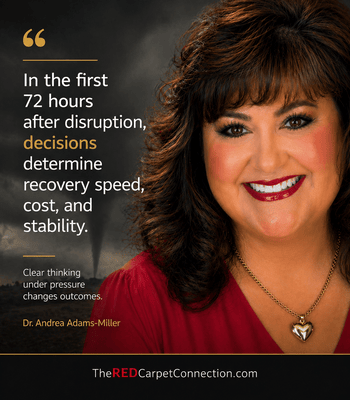
A series of recent tornado outbreaks across multiple regions in the United States has placed communities into rapid-response recovery mode, where timelines, financial outcomes, and long-term stability are determined within days. While structural damage is the most visible consequence, disaster response data shows that early-stage decisions made under pressure often determine how quickly and effectively communities and businesses recover.
According to the National Oceanic and Atmospheric Administration, the number of billion-dollar weather and climate disasters has increased significantly in recent years, with tornado outbreaks contributing to widespread disruption across the Midwest and Southern regions. Post-event analyses from the Federal Emergency Management Agency show that breakdowns in coordination, delays in communication, and misaligned resource allocation commonly occur within the first 72 hours of response, directly impacting recovery timelines.
Behavioral research further explains why these breakdowns occur. Under high stress, the brain reduces processing efficiency, narrows attention, and relies on familiar patterns instead of deliberate analysis, which can lead to delayed decisions, missed priorities, and inconsistent communication (American Psychological Association, 2023). These effects influence critical actions such as filing insurance claims, coordinating teams, securing temporary operations, and managing financial exposure.
Dr. Andrea Adams-Miller, a neuroscience-driven executive advisor and founder of The RED Carpet Connection, works with leaders, business owners, and individuals following high-impact events such as tornadoes to stabilize cognitive processing, reduce emotional interference, and restore structured decision-making during recovery.
"In the aftermath of a tornado, people focus on what was lost physically," said Adams-Miller. "What determines recovery is how decisions are made when everything feels urgent and uncertain."
After a disaster, people are told to stay strong, yet strength alone does not guide decisions. In those first critical days, every choice carries weight, from where to direct resources to how to communicate next steps. When stress takes over, people default to a reactive response rather than a strategic one. When they learn how to slow that process down and think with clarity, recovery shifts from chaotic and delayed to structured and decisive.
Historical disaster recovery patterns reinforce this distinction. Following major events such as the 2011 Joplin tornado and the 2021 Western Kentucky tornado outbreak, reports showed that communities with clearer communication structures, faster decision alignment, and defined leadership roles moved through recovery phases more efficiently than those with fragmented early responses.
This pattern extends beyond municipal response. Business owners navigating insurance claims, operational shutdowns, staffing instability, and supply chain disruption often face compounded losses when early decisions are delayed or inconsistent. Individuals managing personal loss encounter similar challenges, where emotional overwhelm can interfere with immediate actions such as securing housing, accessing aid, and coordinating support.
"Most people are making high-stakes decisions while their nervous system is still in shock," Adams-Miller said. "When that goes unrecognized, it leads to hesitation, second-guessing, or reactive choices that slow recovery. When people understand what is happening internally, they can make cleaner decisions that protect time, money, and energy."
As severe weather events continue to impact communities nationwide, disaster response experts are placing increased emphasis on human behavior, cognitive resilience, and decision-making structure as measurable factors influencing recovery speed and long-term outcomes.
Dr. Andrea Adams-Miller is currently advising leaders, business owners, and organizations impacted by severe weather events and is available for media interviews, expert analysis, and strategic guidance related to disaster recovery and decision-making under pressure. AndreaAdamsMiller@TheREDCarpetConnection.com, +1-419-722-6931
About Dr. Andrea Adams-Miller
Dr. Andrea Adams-Miller is a neuroscience-driven executive advisor and business strategist who works with high-level leaders, entrepreneurs, athletes, and organizations to improve decision-making, communication, and performance under pressure. With advanced training in neuroscience, neurofeedback, biofeedback, hypnotherapy, and Neuro-Linguistic Programming, she integrates behavioral science with real-world strategy to help clients navigate complex, high-stakes environments. She is the founder of The RED Carpet Connection, LLC, and is known for her work in visibility, influence, and rapid recalibration of decision-making for leaders operating at the highest levels.
About The RED Carpet Connection, LLC
The RED Carpet Connection, LLC is an Ohio-based advisory firm working locally, nationally, and internationally, specializing in decision-making, behavioral strategy, and visibility for leaders, entrepreneurs, and organizations operating in high-pressure environments.
###
For more information about TheREDCarpetConnection.com, LLC, contact the company here:
The RED Carpet Connection, LLC
Dr. Andrea Adams-Miller, Ph.D.
+1-419-722-6931
AndreaAdamsMiller@TheREDCarpetConnection.com
8155 Township Road 89, Findlay, OH 45840
